What Is Offside in Hockey? Rules Explained
What is offside in hockey? A plain-English guide to the blue-line rule: why offside is judged by the skates and not the stick, the 2020-21 vertical-plane change that lets a skate in the air stay onside, delayed offside, the tag-up reset, and the coach's challenge.
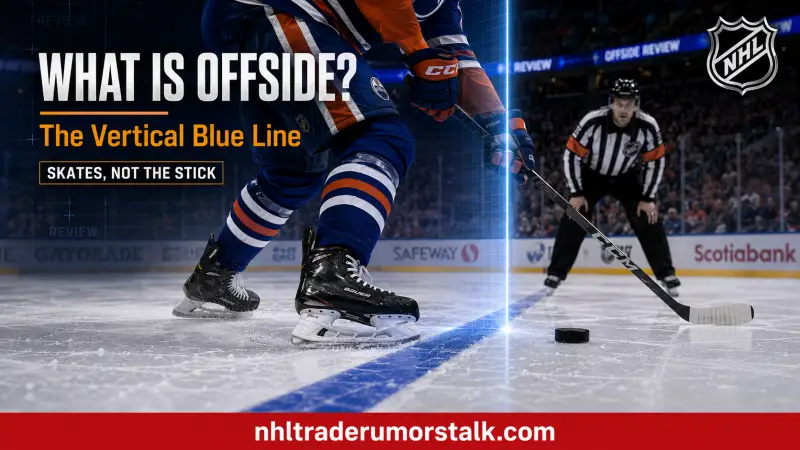
In a typical NHL season, around 14 goals used to be wiped off the board for a reason almost invisible to the naked eye: an attacking player's skate hovering a fraction of an inch above the blue line. Then, in 2020, the league rewrote the rule and let those goals count. So what is offside in hockey, why does a skate in mid-air now keep a player onside, and how do delayed offside and the coach's challenge fit in? Here is the whole rule, modernized, through one idea: The Vertical Blue Line.
Offside is the rule that stops hockey from turning into a game of cherry-picking, where one attacker just camps next to the other team's net waiting for a long pass. The principle is simple: the puck has to enter the attacking zone before the players do. Get it backwards, and the linesman blows the whistle. Where it gets interesting is exactly how the league measures that, because the answer changed in a way that rewards offense.
| Figure | What it represents |
|---|---|
| 14 | Goals from a single prior season that would have counted under the new plane rule, per NHL Hockey Operations |
| 2 skates | The number that must fully cross the blue line ahead of the puck for a player to be ruled offside |
One number shows how much the rule loosened in 2020, and the other is the bedrock test that has not changed: it is about the feet, not the stick.
Key Takeaways
- What it is: Offside is called when an attacking player's skates fully cross the defending team's blue line before the puck does.
- Skates, not the stick: the puck and a player's stick can be in the zone; offside is judged purely by the position of the skates.
- The Vertical Blue Line: since 2020-21, a skate breaking the line's upward plane in the air still counts as onside, so players no longer have to drag a foot.
- Delayed offside: the linesman raises an arm, and the attacking team can clear the zone to "tag up" and reset the play instead of stopping it.
- Coach's challenge: a goal can be challenged for a missed offside, but since 2017-18 a failed challenge costs a minor penalty.
What Offside in Hockey Actually Means
The rink has two blue lines, one for each team's attacking zone, and offside lives at those lines. A player on the attacking team is offside if both of his skates completely cross the blue line into the offensive zone before the puck does. The single most common misunderstanding: it has nothing to do with the stick. A player can reach his stick and the puck deep into the zone, but as long as a skate is still on or behind the line, he stays onside. The linesman watches the feet, not the stick.
Why does the rule exist? Without it, an attacker could simply station himself by the far net and wait for a teammate to fling the puck up the ice, turning hockey into a long-bomb track meet. Offside forces teams to carry or pass the puck into the zone as a unit, which is why clean zone entries are a real skill coaches obsess over. The rule dates back to the late 1920s, and the core test has stayed remarkably stable since.
The Vertical Blue Line: the 2020 Change
Here is the part even longtime fans get wrong. For decades, a player had to keep a skate physically touching the ice on or behind the blue line to stay onside, which led to the strange sight of attackers dragging a back foot as they entered the zone. Replay review made it worse, with goals overturned because a skate was a hair off the ice at the blue line. So for the 2020-21 season, the NHL and NHLPA changed Rule 83.
The new language treats the blue line as a vertical plane that rises straight up off the painted stripe. A player is now onside as long as a skate has not broken that plane before the puck crosses, even if the skate is up in the air and touching nothing. NHL Hockey Operations estimated the change would have allowed 14 disallowed goals from a prior season to stand. The tweak made the rule friendlier to offense, but the people who run the game knew judging a skate in mid-air on replay would be its own headache.
It's almost worse because it's so minute, it's almost like a hair, is [the skate] up or is it not up?
— Colin Campbell, NHL senior executive vice president of hockey operations, NHL.com
Delayed Offside and the Tag-Up Reset
Not every offside stops play immediately. If an attacking player drifts over the blue line ahead of the puck but his team does not actually control it, the linesman raises an arm to signal a delayed offside rather than blowing the whistle. The attacking team then gets a chance to fix it: if every attacker skates back out and clears the zone, the delayed call washes out and play continues. That escape hatch is called tagging up, and it was reinstated for the 2005-06 season.
That same post-lockout offseason brought the other big change to how zone entries work, the removal of the two-line pass rule. Until 2005, a pass could not travel across both the defending blue line and the center red line, which choked off long stretch passes. Scrapping it let teams fire the puck up to a streaking forward and opened the game considerably. If you want to see how that sped-up game is scored and ranked, our standings explainer walks through the points system, and the icing rule is offside's mirror image at the other end of the ice.
The Coach's Challenge
Because a single missed offside can lead directly to a goal, the NHL gave coaches a way to contest it. Introduced for the 2015-16 season, the coach's challenge lets a team ask officials to review a goal for a missed offside earlier in the same rush. If replay shows the zone entry was offside, the goal comes off the board. The system was popular enough that teams began challenging marginal plays constantly, slowing games to a crawl, so the league added a deterrent.
Since the 2017-18 season, a failed offside challenge has cost the challenging team a two-minute minor for delay of game, rather than just a lost timeout. The league tightened the system further in 2019-20, extending that penalty to every type of challenge and adding a double-minor for repeat challenges. Those changes cut down on fishing-expedition reviews almost overnight, and the commissioner framed the philosophy bluntly.
The theory there is we don't want lots and lots of challenges. We don't want to disrupt the flow of the game. We only want challenges where it's crystal clear that an egregious mistake has been made.
— Gary Bettman, NHL Commissioner, via Scouting The Refs
Offside is one thread in the web of rules that shapes a game. The same logic runs through how overtime is decided, what the plus/minus stat rewards, how penalty minutes are counted, and even how teams draft the players who master it. Add up the stoppages and you also see how long a hockey game really takes.
Written by Mike Johnson, NHL Senior Editor, with 15 years covering the league. The offside mechanics, the 2020-21 plane change to Rule 83, the tag-up and two-line-pass history, and the coach's-challenge penalty were checked against NHL.com, ESPN and Wikipedia's offside entry. Both quotes were traced verbatim to their sources with inline links. The Vertical Blue Line is my framework for the modern, plane-based offside test, introduced in this piece. Published June 23, 2026. Editorial review and fact-check: Sarah Chen, Hockey Operations Editor. Corrections: editorial@nhltraderumorstalk.com.
Sources and Reporting
- Offside (ice hockey): rule definition, skates test, history
- NHL.com: the plane rule, Colin Campbell quote
- ESPN: 2020-21 Rule 83 wording
- Scouting The Refs: the vertical-plane change and the 14-goal Hockey Operations estimate
- Scouting The Refs: 2019-20 failed-challenge penalty, Gary Bettman quote
The Verdict: The Vertical Blue Line
So the next time a goal gets reviewed for a skate at the blue line, you will know exactly what the officials are hunting for. Both feet have to beat the puck into the zone for offside, the stick never mattered, and since 2020 the league judges it all against a vertical plane rising off the ice rather than the paint itself. The Vertical Blue Line is the small, modern fix that quietly handed a handful of goals back to the attackers every season.
Frequently Asked Questions
What is offside in hockey?
Offside is called when an attacking player crosses the defending team's blue line into the offensive zone before the puck does. The puck must enter the zone first. When it does not, the linesman blows the whistle and play restarts with a faceoff in the neutral zone, just outside the blue line.
Is offside determined by the skates or the stick?
By the skates. A player is offside only if both of his skates completely cross the blue line ahead of the puck. The stick does not matter, so a player can reach his stick and even the puck deep into the zone and still be onside, as long as a skate remains on or behind the line.
What changed about the NHL offside rule in 2020-21?
For the 2020-21 season the NHL amended Rule 83 to treat the blue line as a vertical plane rising off the painted stripe. A player is now onside as long as a skate has not broken that plane before the puck crosses, even if the skate is in the air touching nothing. Players no longer have to drag a foot on the ice, and NHL Hockey Operations estimated the change would have let 14 previously disallowed goals stand.
What is delayed offside and the tag-up rule?
If an attacker crosses the blue line ahead of the puck but his team does not control it, the linesman signals a delayed offside by raising an arm instead of stopping play. The attacking team can erase the call by having all of its players clear the offensive zone, which is known as tagging up. The tag-up rule was reinstated for the 2005-06 season.
What happens if a coach's offside challenge fails?
A team can challenge a goal for a missed offside in the lead-up play, a system introduced in 2015-16. Since the 2017-18 season, an unsuccessful offside challenge has cost the challenging team a two-minute minor penalty for delay of game, instead of the lost timeout it carried before. In 2019-20 the penalty was extended to all challenge types, with a double-minor for repeat challenges, which sharply reduced marginal challenges.
Related Stories

What Is the Crease in Hockey? Explained
What is the crease in hockey? A plain-English guide to the goalie's blue paint: the 6-foot protected zone, the strict skate-in-the-crease ru...
By Mike Johnson · 7 min read
Why Is Fighting Allowed in Hockey? Explained
Why is fighting allowed in hockey? An educational guide to Rule 46: how it penalizes fighting with a five-minute major instead of an ejectio...
By Mike Johnson · 7 min read

What Is a Power Play in Hockey? Explained
What is a power play in hockey? A plain-English guide to the man advantage: five-on-four and five-on-three, why a minor penalty ends on a go...
By Mike Johnson · 7 min read

What Is Icing in Hockey? Rules Explained
What is icing in hockey? A plain-English guide to the rule: the red line and goal line, the three icing systems (touch, no-touch and hybrid)...
By Mike Johnson · 8 min read
Comments
Be the first to share your take.
Get NHL trade rumors in your inbox
One email per week, zero spam, verified rumors only.