What Is Icing in Hockey? Rules Explained
What is icing in hockey? A plain-English guide to the rule: the red line and goal line, the three icing systems (touch, no-touch and hybrid), why the NHL moved the race to the faceoff dots for safety, when icing gets waved off, and the no-line-change penalty.
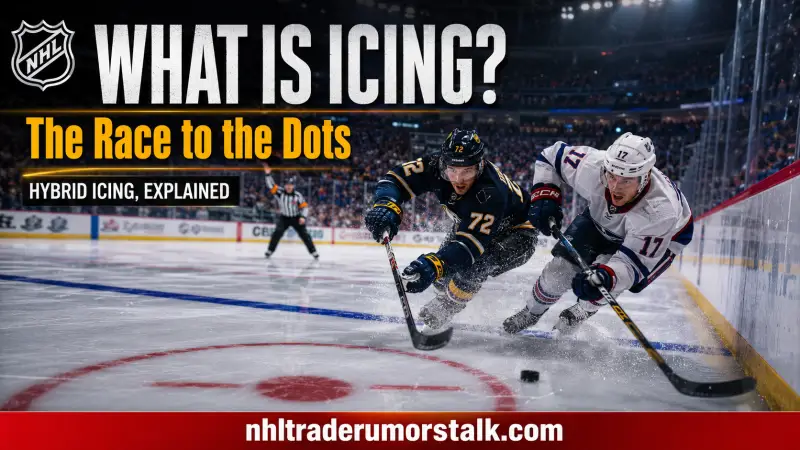
In 2008, Minnesota defenseman Kurtis Foster broke his left femur racing an opponent to a loose puck near the end boards. The play was an icing call, and that dangerous sprint to touch the puck first is exactly why the NHL eventually rewrote the rule. So what is icing in hockey, and why does the modern NHL version send players racing to the faceoff dots instead of all the way to the goal line? Here is the whole rule, the three versions of it, and the safety change at its heart: The Race to the Dots.
Icing is one of the first rules a new fan trips over, because the whistle blows and the play just stops for no obvious reason. The short version: a team cannot fire the puck the length of the ice to relieve pressure without a consequence. Do it, and the puck comes all the way back for a faceoff in your own end, and you are not allowed to change tired players. That is icing, and it shapes how every NHL game is played.
| Figure | What it represents |
|---|---|
| 2013-14 | The season the NHL adopted hybrid icing, moving the race from the goal line to the faceoff dots for player safety |
| 0 | Line changes the offending team may make before the icing faceoff, the tactical penalty that makes icing hurt |
One number is about safety, the other about strategy, and together they explain why coaches drill players never to ice the puck carelessly.
Key Takeaways
- What it is: Icing is called when a team shoots the puck from behind the center red line and it crosses the opponent's goal line untouched.
- The Race to the Dots: The NHL uses hybrid icing, where a linesman judges the race to the faceoff dots, not the goal line, to prevent dangerous end-board collisions.
- Three versions exist: traditional touch icing, no-touch (automatic) icing, and the NHL's hybrid icing.
- It can be waved off: a shorthanded team may ice freely, and the call dies if the goalie plays it or the defense could have.
- The penalty: a faceoff in the offending team's zone with no line change allowed, leaving tired players stuck on the ice.
What Icing in Hockey Actually Means
The rule hangs on two lines. If a player shoots or deflects the puck from his own side of the center red line and it travels all the way across the opponent's goal line without being touched, the linesman signals icing and play stops. The key word is untouched: the puck has to cross the goal line clean. If it hits the post and stays out, there is no icing, because the puck never crossed the line. If an opponent could have played it but let it go, the call can die too.
Why does the rule exist at all? Before 1937, teams with a lead would simply blast the puck down the ice over and over to kill time and avoid pressure, and games turned into a chore to watch. Icing was introduced to stop that stalling, forcing teams to actually carry or pass the puck out of trouble. Nearly a century later, that is still its job: it keeps the game honest and flowing instead of letting a defense dump-and-survive its way through a period.
The Race to the Dots: Touch, No-Touch and Hybrid
Here is where most explanations stop short, because there is not one icing rule, there are three. Traditional touch icing required a defending player to actually skate down and touch the puck for the call to count, which created a flat-out race to the end boards. No-touch (automatic) icing, used by USA Hockey and most amateur bodies, blows the whistle the instant the puck crosses the goal line, with no race at all. The NHL settled on a middle path.
Hybrid icing, adopted to open the 2013-14 season, is the compromise. The linesman watches the race only to the faceoff dots in the defending zone, not the goal line. If the defender would clearly reach the dots first, the whistle goes immediately and nobody has to crash the boards. If the attacker has a real shot at the puck, the race continues. The NHL made the switch for one blunt reason, after years of broken legs and concussions on those goal-line collisions.
Ultimately the managers believe it's a safety issue. It makes the game safer for the players and we think it's important.
— Bill Daly, NHL Deputy Commissioner, NHL.com (archived)
That safety case won the day after plays like the Kurtis Foster injury, but writing the rule was harder than approving it. Officials needed clear guidance on a judgment call made at full speed.
It's easy to have these ideas and try to push them forward, but when it comes time to actually write up the rules and think of all the situations and all the scenarios that could happen on the ice, there is a lot of work to do.
— Pierre Gauthier, then Montreal Canadiens GM, NHL.com (archived)
When Icing Gets Waved Off
Icing is not automatic, and knowing the exceptions is what separates a casual viewer from someone who actually reads the game. The biggest one: a team killing a penalty is allowed to ice the puck freely, because it would be unfair to trap a shorthanded team in its own end with no relief. So during a penalty kill, you will see defenders flip the puck down the ice with no whistle.
The other wave-offs come down to whether the puck could have been played. If the goaltender leaves the crease and moves toward the puck, the linesman waves it off, on the theory the goalie chose to play it. If the linesman judges a defender could have stopped the puck but let it go, no icing. And the puck cannot be iced directly off a faceoff. Each exception traces back to the same logic: icing punishes a team for giving up on the puck, not for a smart defensive play.
Why Icing Costs You the Game
The real bite of icing is not the whistle, it is what follows. The faceoff goes all the way back into the offending team's defensive zone, deep in their own end. Worse, since a 2005 rule change, the team that iced the puck cannot make a line change before that faceoff. Tired players who just dumped the puck to survive are now stuck on the ice, defending a faceoff next to their own net, with the other team free to send out fresh legs.
That is why a careless icing late in a shift can flip a game. A gassed defense pinned in its own zone against a rested top line is how goals get scored, and how the same rule that keeps the game flowing also doubles as a punishment. The math is simple, and it is the whole reason coaches treat icing as a near-cardinal sin. Icing also eats clock, which matters more than you would think once you see how long a hockey game actually runs with the stoppages added up.
Icing sits inside a whole cluster of rules that decide games. If you are learning the sport from scratch, the same logic threads through how NHL standings work, how overtime is decided, what the plus/minus stat actually rewards, and even how teams build rosters through the draft. Master the small rules like icing and the bigger picture, right down to which franchises have won the most Stanley Cups, starts to click.
Written by Mike Johnson, NHL Senior Editor, with 15 years covering the league. The icing mechanics, hybrid-icing history and wave-off exceptions were checked against the NHL rulebook, NHL.com reporting and Wikipedia's icing entry; the Kurtis Foster injury and the 2013-14 hybrid adoption are documented via NHL.com. Both quotes were traced verbatim to their original NHL.com articles, linked here via the Internet Archive because NHL.com retired the original URLs. The Race to the Dots is my framework for the safety logic behind hybrid icing, introduced in this piece. Published June 23, 2026. Editorial review and fact-check: Sarah Chen, Hockey Operations Editor. Corrections: editorial@nhltraderumorstalk.com.
Sources and Reporting
- Icing (ice hockey): rule definition, touch/no-touch/hybrid systems, history
- NHL.com (archived): hybrid icing GM recommendation and the Pierre Gauthier quote
- NHL.com (archived): 2013-14 hybrid icing rule change and the Bill Daly quote
- HockeyMonkey: icing mechanics and wave-off exceptions
The Verdict: The Race to the Dots
So the next time the whistle blows and the puck sails back the length of the ice, you will know exactly what happened. A team gave up on the puck, fired it past the goal line untouched, and now pays for it with a defensive-zone faceoff and no fresh legs. The modern NHL just decided that race should end at the faceoff dots instead of the end boards, because a broken femur is too high a price for a dump-and-chase. The Race to the Dots is the rare rule change that made the game both safer and smarter at once.
Frequently Asked Questions
What is icing in hockey?
Icing is called when a player shoots or deflects the puck from his own side of the center red line and it crosses the opponent's goal line untouched. Play stops, and the puck comes all the way back for a faceoff in the offending team's defensive zone. The rule stops teams from simply firing the puck the length of the ice to relieve pressure.
What is hybrid icing in the NHL?
Hybrid icing, adopted by the NHL for the 2013-14 season, has the linesman judge the race to the faceoff dots rather than the goal line. If a defending player would clearly reach the dots first, the whistle blows immediately so nobody has to crash the end boards. It was a player-safety change made after dangerous goal-line collisions, including the 2008 leg-break suffered by Kurtis Foster.
When is icing waved off or not called?
Icing is waved off in several cases: a shorthanded team killing a penalty may ice the puck freely; the call dies if the goaltender leaves the crease to play the puck, or if the linesman judges a defender could have played it but chose not to. The puck also cannot be iced directly off a faceoff, and there is no icing if the puck does not fully cross the goal line.
What happens after an icing call?
The faceoff goes back into the offending team's defensive zone, deep in their own end. Crucially, since a 2005 rule change the team that iced the puck is not allowed to change lines before that faceoff, so tired players are stuck on the ice against fresh opponents. That no-line-change penalty is what makes icing genuinely costly.
What is the difference between touch and no-touch icing?
Traditional touch icing requires a defending player to actually skate down and touch the puck for the call to count, which creates a race to the end boards. No-touch (automatic) icing, used by USA Hockey and most amateur leagues, blows the whistle the instant the puck crosses the goal line with no race at all. The NHL uses hybrid icing, a compromise that judges the race only to the faceoff dots.
Related Stories

What Is the Crease in Hockey? Explained
What is the crease in hockey? A plain-English guide to the goalie's blue paint: the 6-foot protected zone, the strict skate-in-the-crease ru...
By Mike Johnson · 7 min read
Why Is Fighting Allowed in Hockey? Explained
Why is fighting allowed in hockey? An educational guide to Rule 46: how it penalizes fighting with a five-minute major instead of an ejectio...
By Mike Johnson · 7 min read

What Is a Power Play in Hockey? Explained
What is a power play in hockey? A plain-English guide to the man advantage: five-on-four and five-on-three, why a minor penalty ends on a go...
By Mike Johnson · 7 min read
What Is Offside in Hockey? Rules Explained
What is offside in hockey? A plain-English guide to the blue-line rule: why offside is judged by the skates and not the stick, the 2020-21 v...
By Mike Johnson · 8 min read
Comments
Be the first to share your take.
Get NHL trade rumors in your inbox
One email per week, zero spam, verified rumors only.