What Does PIM Mean in Hockey?
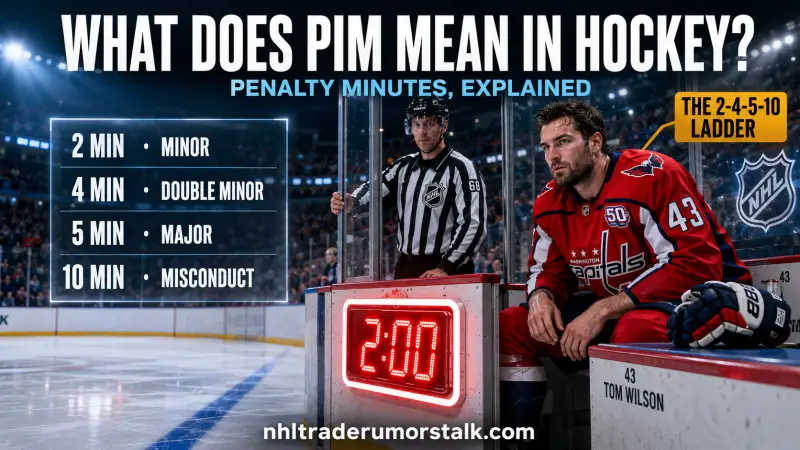
PIM means penalty minutes — the running total of penalty time a player has been assessed, built from 2-minute minors, 4 doubles, 5 majors, and 10 misconducts. Inside the 2-4-5-10 Ladder, the all-time records, and why high PIM means less than it used to.
Tiger Williams spent 3,971 minutes in the penalty box across 14 NHL seasons, more than any player ever has. That is more than 66 hours of sitting alone behind glass while the game went on without him. PIM is what the box score calls penalty minutes, the running total of penalty time a player has been assessed, and the four numbers that build it run 2, 4, 5, and 10. I call that simple structure The 2-4-5-10 Ladder.
PIM stands for penalty minutes, the total time a player has been assessed in penalties over a season or career. The four standard penalty lengths are 2 minutes for a minor, 4 for a double minor, 5 for a major, and 10 for a misconduct, with a match penalty recorded as 15 PIM since 2022. A game misconduct counts as 10 PIM for the stat sheet, even though the player is also ejected for the night.
| Figure | What it represents |
|---|---|
| 3,971 | Career penalty minutes for Tiger Williams, the most in NHL history, posted across 962 regular-season games and 14 seasons from 1974-75 to 1987-88 |
| 472 | Dave Schultz's 1974-75 single-season PIM with the Philadelphia Flyers, a record that has stood for more than 50 years |
Both records belong to enforcers from the same rough era of the league, and that is a clue to how PIM works as a stat. The number measures penalty time, not penalty count, so two players with the same number of trips to the box can carry very different PIM totals depending on what kind of penalties they took.
Key Takeaways
- PIM means penalty minutes: the total penalty time a player has been assessed during a season or career, measured in minutes rather than penalty count.
- The 2-4-5-10 Ladder: almost every PIM total is built from minors (2), double minors (4), majors (5), and misconducts (10).
- Game misconducts still count: a player ejected for the night is charged 10 PIM on the stat sheet, even though a teammate serves any other time.
- The record book is enforcer-era: Tiger Williams sits at 3,971 career, Dave Schultz at 472 in a single season, neither in real danger of falling.
- It is a fading measuring stick: as fighting has dropped, PIM tells you less about toughness than it used to and more about pure discipline.
What PIM means in hockey
PIM stands for penalty minutes. The number you see in a box score is the running total of minutes a player has been assessed in penalties so far this season or career, broken down later in this guide by what kind of penalty was called. Every infraction in the NHL rulebook carries a fixed length, and PIM is just the sum of those lengths added up over time. A player with 30 PIM after 40 games is not in trouble; a player with 30 PIM after 4 games probably is.
Two confusions worth heading off. PIM tracks penalty time only, so it does not count fights and does not count goals allowed. It lives in the same box-score family as goals, assists, and plus/minus, but it measures something completely different from any of them. It also sits apart from the rules behind how the standings work and how NHL overtime works, even though every penalty obviously affects the score around it.
The 2-4-5-10 Ladder of penalty lengths
Four numbers do almost all the work. Every PIM total in a normal NHL season comes from some mix of 2-minute minors, 4-minute double minors, 5-minute majors, and 10-minute misconducts, with a small bump from game misconducts and the rare match penalty. Here is the full ladder, top to bottom, with the kinds of infractions that earn each rung.
| Penalty | PIM | Common examples |
|---|---|---|
| Minor | 2 | Tripping, hooking, holding, interference, slashing, roughing |
| Double minor | 4 | High-sticking that draws blood, two minors called together |
| Major | 5 | Fighting, boarding causing injury, charging, spearing |
| Misconduct | 10 | Abuse of officials, dissent, persistent unsportsmanlike conduct |
| Game misconduct | 10 | Ejection for the night; teammate serves any other time owed |
| Match penalty | 15 | Deliberate attempt to injure; mandatory NHL on-ice video review (recorded as 5+10 since 2022) |
The catch on the bottom three rungs is that they look identical on the stat line (all 10 PIM) but mean very different things on the ice. A misconduct keeps the player off the bench for ten minutes but does not give the other team a power play, since a teammate sits in the box for the actual minor that usually goes with it. A game misconduct ejects the player for the night and triggers a possible suspension review. A match penalty, the most severe call a referee can make, requires on-ice video review by the league for every instance and almost always leads to a hearing with the Department of Player Safety. Statistically, the NHL began recording a match penalty as 15 PIM in the 2022-23 season (a 5-minute major served by a teammate plus a 10-minute game misconduct), up from the older 10-minute figure.
How PIM gets counted on the stat sheet
The rule runs mechanically: whatever penalty time is assessed against a player gets added to that player's PIM column at the final horn. A minor adds 2, a double minor adds 4, and so on, with the misconduct family all adding 10. Two penalties on the same shift simply stack: a minor plus a 10-minute misconduct on one play lands as 12 PIM on the stat sheet, even though the team only kills off the 2-minute power play.
That stacking is where casual fans get confused. A player can be charged 17 PIM in a single trip to the box (a 5-minute major for fighting plus a 10-minute misconduct plus another 2-minute minor he picked up at the scrum) without anyone scoring against his team at all. The PIM column does not care about the goals; it cares about the minutes. For a comparison, our plus/minus guide walks through the goal-differential stat that lives one column over, and the two columns can move in completely different directions on the same night.
The penalty kings and their records
The all-time leaders in PIM are a who's-who of the 1970s and 1980s enforcer era, when fighting was a nightly part of the job. The career list is led by Dave "Tiger" Williams, whose 3,971 minutes are recognized by Guinness World Records as the NHL career mark, and the single-season list is led by Dave "The Hammer" Schultz, whose 472 minutes in 1974-75 powered the Philadelphia Flyers to their second straight Stanley Cup.
| Record | Holder | Total |
|---|---|---|
| Most career PIM | Dave "Tiger" Williams | 3,971 |
| Most single-season PIM | Dave "The Hammer" Schultz (1974-75) | 472 |
| Second career | Dale Hunter | 3,565 |
| Third career | Tie Domi | 3,515 |
| Williams's games played | 14 seasons, 5 teams | 962 games |
Schultz looked back on his Flyers years and the fights that came with them in a 2023 conversation with NHL.com, and the part of his story that lands hardest is how the old rivalries softened only with distance.
"Terry O'Reilly and I fought nine times, and for the first 10 years or so after we retired, we weren't too friendly." — Dave Schultz, via NHL.com
Williams, whose 3,971 career PIM were recognized by Guinness World Records in 2025, has stayed close to the game in retirement, popping up at alumni events and team functions across the league.
"It's a game that keeps you young, that keeps the kid in you. Everybody should play the game as long as they can." — Tiger Williams, via Guinness World Records
Neither record sits in serious danger, because even today's most penalized regulars rarely clear 100 PIM in a season, never mind 400-plus, and the average length of an enforcer's career has shrunk in step with the disappearance of the role. The drop in fighting alone has cut yearly PIM totals across the league nearly in half since Schultz's peak.
Is PIM still a useful stat today?
PIM still tells you something, but it tells you less than it used to. As the NHL has gotten faster and skill has crowded out the old enforcer role, a high PIM total now usually reflects undisciplined play rather than nightly toughness. A defenseman with 70 PIM in a season is probably taking too many sticks-on-hands minors in the offensive zone, not winning seven heavyweight bouts. The number that used to define a player's identity is now a flag for coaches to look at.
Modern team-building treats penalties as a tax to be managed, not a brand. A cap-strapped contender like the one our salary-cap explainer describes cannot afford a 90-PIM player whose third-period parade to the box hands the other side a power play and a possible win. That same math runs through the playoffs, where one bad cross-check can decide a game in our 16-win playoff map, and where droughts can stretch as long as Buffalo's 14-year exile. Even the Presidents' Trophy regular-season king-makers in our 82-game mirage breakdown rarely lead the league in PIM, because the teams chasing banners in the post-3-on-3 era of how long a hockey game lasts live and die on the power play.
The PIM column is also a reminder of an older NHL, the one that lived in our all-time Cups history when Schultz and Williams ran the league. Read it that way and the stat still has plenty of life. Just do not confuse it with toughness anymore.
This explainer was written by Mike Johnson, NHL Senior Editor, who has covered the league for 15-plus years. The penalty definitions and PIM-counting rules were checked against the official NHL rulebook; every career and single-season record was cross-checked against Hockey-Reference, NHL.com, and Guinness World Records. The "2-4-5-10 Ladder" is our own framing for the four penalty lengths, introduced in this piece. Published June 2026; last verified against live sources in June 2026. Editorial review: Sarah Chen, Hockey Operations Editor. Corrections: editorial@nhltraderumorstalk.com.
Sources and Reporting
- NHL.com: official 2024-25 rulebook with penalty definitions
- NHL.com: Dave Schultz Q&A on the Broad Street Bullies
- Guinness World Records: Tiger Williams career PIM record
- Hockey-Reference: NHL/WHA career PIM leaders
- Penalty (ice hockey): penalty types and durations
The Verdict: The 2-4-5-10 Ladder
So what does PIM mean in hockey? It is the running total of penalty minutes a player has been assessed, built from minors at 2, double minors at 4, majors at 5, and the misconduct family at 10. Read it as a quick gauge of who is in the box too often, and the 2-4-5-10 Ladder gives you everything you need. Read it as the measure of how tough a player is, and you are reading a stat from a league that does not exist anymore. The next time you see a 70-PIM regular on a contender, do not picture an enforcer. Picture a stick foul his coach wishes he could take back.
Frequently Asked Questions
What does PIM mean in hockey?
PIM stands for penalty minutes, the total amount of penalty time a player has been assessed during a season or career. It is the running sum of every minor, double minor, major, and misconduct penalty a player has taken, measured in minutes rather than penalty count.
How is PIM calculated?
PIM is the sum of every penalty length assessed to a player. A minor adds 2 minutes, a double minor adds 4, a major adds 5, and any misconduct, game misconduct, or match penalty adds 10. Two penalties on one shift simply stack together on the stat sheet.
What is a minor penalty in the NHL?
A minor penalty is the most common NHL infraction and carries a 2-minute box time. Common minors include tripping, hooking, holding, interference, slashing, and roughing. If the opposing team scores during a minor power play, the penalized player is released early.
What is the difference between a misconduct and a game misconduct?
A misconduct keeps a player in the box for 10 minutes but does not give the other team a power play, since a teammate serves any minor that goes with it. A game misconduct ejects the player from the rest of the night and also adds 10 PIM, plus a possible league suspension review.
Who has the most career penalty minutes in NHL history?
Dave "Tiger" Williams holds the NHL career penalty-minutes record at 3,971, posted across 962 regular-season games over 14 seasons from 1974-75 to 1987-88. Guinness World Records recognized the mark in September 2025.
What is the single-season PIM record?
Dave "The Hammer" Schultz set the NHL single-season record with 472 penalty minutes in 1974-75 for the Philadelphia Flyers, in 76 games. The record has stood for more than 50 years and is generally considered unbreakable in the modern, lower-fighting NHL.
Do shorthanded goals or power-play goals affect PIM?
No. PIM only tracks penalty time assessed to a player, regardless of what happens during that time. A goal scored on the power play ends a minor early on the ice but does not change the 2 PIM that already went on the stat sheet.
Is a high PIM a good or bad stat?
It depends on the era and the role. In the 1970s and 1980s a high PIM total signaled an enforcer doing his job; in the modern NHL it usually flags an undisciplined player whose stick fouls hand the opposing team easy power plays. A defenseman over 70 PIM today is almost always a problem, not an asset.
Related Stories

What Does Plus/Minus Mean in Hockey? +/- Explained
What does plus/minus mean in hockey? It is goal differential on the ice: +1 when your team scores at even strength, -1 when it allows one. H...
By Mike Johnson · 10 min read

How Long Is a Hockey Game? Periods, Times and Overtime
How long is a hockey game? An NHL game is only 60 minutes of play, three 20-minute periods, but it takes about two and a half hours of real...
By Mike Johnson · 9 min read

How NHL Standings Work: Points, ROW and Tiebreakers
How do NHL standings work? A win is worth two points, ties break on regulation wins then ROW, and point percentage can flip the order when a...
By Mike Johnson · 8 min read

How NHL Overtime Works
How does NHL overtime work? The regular season is a 5-minute 3-on-3 then a shootout; the playoffs are full 5-on-5 sudden death until someone...
By Mike Johnson · 9 min read
Comments
Be the first to share your take.
Get NHL trade rumors in your inbox
One email per week, zero spam, verified rumors only.