Why Is Fighting Allowed in Hockey? Explained
Why is fighting allowed in hockey? An educational guide to Rule 46: how it penalizes fighting with a five-minute major instead of an ejection, the 1992 instigator penalty, why fights have fallen over 70 percent, and why college and Olympic hockey eject for it.
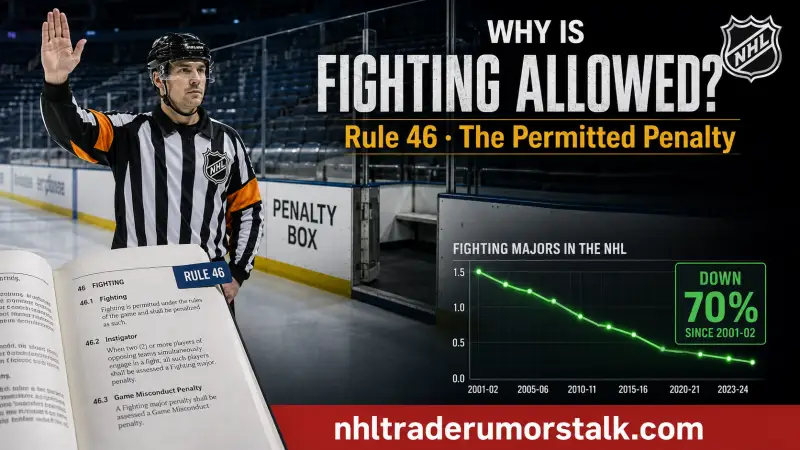
Fighting in the NHL fell from a peak of 0.64 fights per game in the 2001-02 season to a low near 0.18 by the end of the 2010s, a decline of more than 70 percent, before leveling off in recent seasons. That long drop is the most important fact about the subject, and it reframes the usual question. People ask why fighting is allowed in hockey, but the rules never simply allowed it, and the sport pulled sharply away from it over two decades. Here is what the rulebook actually says, why a penalized act survived this long, and where it stands, through one idea: The Permitted Penalty.
This is an explainer about the rules and the trend, not a highlight reel. Fighting in hockey is best understood as a regulated infraction the league has spent decades discouraging, and the conversation around it today is driven by player health and concussion research more than tradition. With that framing set, the mechanics are straightforward.
| Figure | What it represents |
|---|---|
| 0.64 → 0.18 | Fights per game from the 2001-02 peak to the 2018-19 low, a decline of roughly 70 percent (it has since leveled off near 0.25) |
| 17 minutes | The total penalty for instigating a fight: a 2-minute minor, a 5-minute major and a 10-minute misconduct |
One number shows how far fighting fell from the sport over two decades, and the other shows how heavily the rulebook punishes the player who starts one.
Key Takeaways
- Not banned, but penalized: under Rule 46, fighting draws a five-minute major for each player rather than an automatic ejection.
- The Permitted Penalty: the majors usually offset, so neither team gets a power play, which is why the act persisted despite being against the rules.
- The instigator rule: introduced in 1992 and revised in 1996, it adds penalties for the player who starts a fight, totaling 17 minutes today.
- A two-decade decline: fights per game fell more than 70 percent from the 2001-02 peak to a 2018-19 low, driven by a faster game and concussion research, before leveling off.
- Banned elsewhere: college, Olympic and international hockey eject players for fighting, so it is largely an NHL and pro-league phenomenon.
How the Rulebook Treats Fighting in Hockey
Fighting in the NHL is governed by Rule 46, which defines it and sets the punishment rather than banning it outright. When two players fight, each is typically assessed a five-minute major penalty, the origin of the phrase "five for fighting." Because both players sit for the same amount of time, the majors usually offset and the teams play on at full strength, so unlike most penalties a fight does not hand the other side a power play. Officials can add minors, misconducts or game misconducts depending on what happened.
That structure is the crux of the whole topic. Most rule-breaking in hockey costs your team a man for two minutes, as our guide to penalty minutes lays out. Fighting was carved out as a special case: serious enough for a five-minute major, but not an automatic ejection the way a dangerous hit to the head would be. The league chose to manage fighting rather than erase it, and that choice is exactly what made it a fixture for so long.
The Permitted Penalty: a Penalized Act That Survived
So why did a rule-breaking act stick around for a century? The honest answer is history and self-policing. For generations, players and coaches argued that the threat of a fight deterred dangerous stickwork and cheap shots, letting teams "police" the ice themselves. Because the majors offset and carried no immediate scoreboard cost, there was little structural pressure to stamp it out. That is the paradox captured by the Permitted Penalty: an infraction the rules punished but the culture protected.
It is worth being clear that this rationale is heavily contested. Critics, including many former players, argue the self-policing case was always overstated and that the real costs, in injuries and long-term brain health, were ignored for decades. The modern league has clearly sided with the skeptics, tightening supplementary discipline for dangerous plays so that retaliation through fighting is no longer the only deterrent available.
The Instigator Rule
The single biggest rule change came in 1992, when the NHL introduced the instigator penalty. A player judged to have started a fight, the instigator, is penalized more heavily than a willing participant. The 1992 version carried a game misconduct; a 1996 revision set today's structure, a two-minute minor for instigating, the five-minute major for fighting and a ten-minute misconduct, seventeen minutes in all. The goal was to discourage one-sided aggression and to remove the "serial fighter" whose only role was to drop the gloves.
The penalties climb higher at the end of a game. A player who instigates a fight in the final five minutes of regulation, or in overtime, receives a game misconduct and an automatic one-game suspension, and his coach can be fined. Those escalating consequences are a long way from a sport that simply waved fighting through, and they are part of why the numbers have collapsed.
Why Fighting Declined
The numbers tell the story. Fights per game fell from that 0.64 peak in 2001-02 to a low of about 0.18 in 2018-19, the first time the rate dropped below 0.20. Fights once broke out in more than 40 percent of games, a share that has roughly halved. The rate has since ticked back up and settled near 0.25 over the past several seasons, an unexpected reversal, yet it remains far below the 2000s, and the 2020s are still on track to be the first decade on record to average below 0.25. Several forces pushed it down at once: the game got faster and more skill-driven after the 2005 rule changes, roster spots grew too valuable to spend on a one-dimensional fighter, and the league cracked down on staged bouts.
The largest force, though, is health. The recognition that repeated blows to the head carry serious long-term risk has reshaped how the sport views fighting.
As the hockey community continues to appreciate that head impacts can have significant long-term consequences, I would expect the number of fights to continue to decline.
— Chris Nowinski, Concussion Legacy Foundation, via ESPN
Many who played the game share that view, including former players who once filled the role themselves and now advocate for change.
I believe this is the new normal, and I think the game is better off without fighting, no doubt.
— Daniel Carcillo, former NHL player and player-health advocate, via ESPN
Fighting is one corner of a rulebook worth understanding in full. The same league shapes how icing works, how offside is judged, how overtime is decided, how standings and tiebreakers stack up, and even how long a game really runs.
Written by Mike Johnson, NHL Senior Editor, with 15 years covering the league. This is an educational explainer focused on the rules and the documented decline of fighting, not an endorsement of it. The Rule 46 mechanics, the 1992 instigator penalty and the last-five-minutes rule were checked against the NHL rulebook, ESPN, Britannica and Wikipedia; the fights-per-game figures come from peer-reviewed data and ESPN reporting. Both quotes were traced verbatim to ESPN with inline links. The Permitted Penalty is my framework for fighting as a punished-but-tolerated act, introduced in this piece. Published June 23, 2026. Editorial review and fact-check: Sarah Chen, Hockey Operations Editor. Corrections: editorial@nhltraderumorstalk.com.
Sources and Reporting
- Fighting in ice hockey: Rule 46, the instigator rule, history
- ESPN: the historic decline, Nowinski and Carcillo quotes
- Britannica ProCon: the fighting debate, arguments for and against
- Frontiers in Sports and Active Living: fights-per-game data, 2000-2020
The Verdict: The Permitted Penalty
So the honest answer to "why is fighting allowed in hockey" is that it never really was, not cleanly. The rulebook treats it as a five-minute major, piles seventeen minutes of penalties on whoever starts it, and ejects players for it everywhere outside the pro ranks. The Permitted Penalty was always a compromise between a sport's history and its rules, and with concussion science now driving the conversation, the long-term decline in the numbers, even with a recent uptick, suggests which way the sport is leaning.
Frequently Asked Questions
Why is fighting allowed in hockey?
Fighting is not truly allowed; it is penalized. Under NHL Rule 46, fighting draws a five-minute major penalty rather than an automatic ejection. Because the majors usually offset and carry no immediate scoreboard cost, the act survived for generations as a form of self-policing, but the modern league has steadily discouraged it through tougher discipline and the instigator rule.
What penalty do you get for fighting in the NHL?
Each player in a fight is typically assessed a five-minute major penalty, the source of the phrase "five for fighting." Since both players sit for the same time, the majors usually offset and neither team gets a power play. Officials can add minors, misconducts or game misconducts depending on the severity and circumstances.
What is the instigator rule in hockey?
Introduced in 1992 (then a game misconduct) and revised in 1996, the instigator rule punishes the player judged to have started a fight more heavily than a willing participant. Today an instigator receives a two-minute minor for instigating, the five-minute major for fighting and a ten-minute misconduct, seventeen minutes in total. Instigating a fight in the final five minutes of a game brings a game misconduct and an automatic suspension.
Is fighting in hockey going away?
Fighting fell sharply over two decades. Fights per game dropped from a peak of about 0.64 in the 2001-02 season to a low near 0.18 in 2018-19, a drop of more than 70 percent. The rate has since ticked back up and leveled off near 0.25 over the past several seasons, an unexpected reversal, though the 2020s are still on track to be the first decade on record averaging below 0.25. A faster, more skill-driven game, more valuable roster spots and growing concern over concussions and long-term brain health all drove the long decline.
Is fighting allowed in college or Olympic hockey?
No. College (NCAA), Olympic and international (IIHF) hockey eject players for fighting, usually with a game misconduct and possible suspension. Fighting is largely confined to the NHL and a handful of professional and major-junior leagues, which is why it is treated very differently depending on where the game is played.
Related Stories

What Is the Crease in Hockey? Explained
What is the crease in hockey? A plain-English guide to the goalie's blue paint: the 6-foot protected zone, the strict skate-in-the-crease ru...
By Mike Johnson · 7 min read
What Is a Power Play in Hockey? Explained
What is a power play in hockey? A plain-English guide to the man advantage: five-on-four and five-on-three, why a minor penalty ends on a go...
By Mike Johnson · 7 min read
What Is Offside in Hockey? Rules Explained
What is offside in hockey? A plain-English guide to the blue-line rule: why offside is judged by the skates and not the stick, the 2020-21 v...
By Mike Johnson · 8 min read
What Is Icing in Hockey? Rules Explained
What is icing in hockey? A plain-English guide to the rule: the red line and goal line, the three icing systems (touch, no-touch and hybrid)...
By Mike Johnson · 8 min read
Comments
Be the first to share your take.
Get NHL trade rumors in your inbox
One email per week, zero spam, verified rumors only.