How the NHL Draft Works Explained
How the NHL Draft works, explained: who is eligible (18 by September 15), how the seven rounds and lottery work, what an entry-level contract locks in, and why most drafted prospects wait years to reach the NHL. The 2026 draft is June 26-27 in Buffalo.
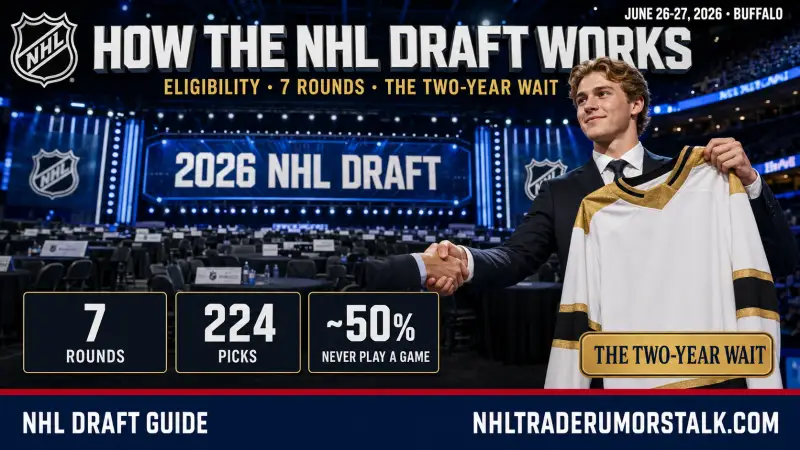
Connor Bedard needed about three and a half months to go from draft night to his first NHL game. Most kids drafted next to him in 2023 were back in junior or college that fall, and draft-value research found that roughly half of all drafted players never skate a single NHL shift. That gap is the part of how the NHL Draft works that nobody bothers to explain: getting your name called is the easy part. What comes after is The Two-Year Wait, and it decides almost everything.
The 2026 NHL Draft runs June 26 and 27 at KeyBank Center in Buffalo, with Penn State winger Gavin McKenna the projected No. 1 pick. Before that Friday night, here's the whole machine, start to finish: who's eligible, how the seven rounds and the lottery work, what an entry-level contract actually locks in, and why a drafted 18-year-old usually can't just step onto NHL ice.
| Figure | What it represents |
|---|---|
| ~3.5 months | Connor Bedard's gap from draft (June 28, 2023) to NHL debut (October 10, 2023), the rare generational talent who never waits |
| ~50% | Share of drafted players who never play a single NHL game, per a draft-value analysis by statistician Michael Schuckers |
One teenager plays opening night; half the class never arrives at all. That spread is the honest answer to how the NHL Draft works, and it's why the draft is a starting line, not a finish line.
Key Takeaways
- When and where: The 2026 NHL Draft is June 26-27 at KeyBank Center in Buffalo, seven rounds, with Gavin McKenna the projected first pick.
- Who's eligible: North American players must turn 18 by September 15 and be no older than 20 by December 31 of the draft year; non-North American players are eligible up to 21.
- Rights, not a roster spot: Getting drafted only grants a team your rights. Most prospects then spend years in junior, college or Europe, and roughly half never reach the NHL.
- The contract: An 18-to-21-year-old signs a three-year entry-level contract capped at a $1 million base salary for the 2026 class.
- Why the wait exists: A drafted major-junior player can't play in the AHL until he's 20, so he goes back to junior, by design, to protect the development leagues.
When and Where the 2026 Draft Happens
Mark the calendar for Friday, June 26, 2026. Round 1 goes that night at KeyBank Center in Buffalo, with Rounds 2 through 7 the next afternoon, Saturday, June 27. In the United States, Round 1 airs on ESPN and ESPN+, with Sportsnet and TVA Sports carrying it in Canada; the later rounds shift to NHL Network and ESPN+. It's Buffalo's fourth time hosting, after 1991, 1998 and 2016.
There's a format wrinkle worth knowing: the NHL went to a decentralized draft in 2025, where team executives stay at their home facilities while the prospects gather at the host site, and Buffalo is the first arena to run it that way. The headliner is Gavin McKenna, who put up 51 points in 35 games as a freshman at Penn State and is the expected No. 1 pick. The Toronto Maple Leafs won the draft lottery and hold that selection; the San Jose Sharks pick second. Our full first-round mock draft walks through where the rest of the board likely falls.
Who Can Be Drafted Into the NHL
The eligibility window is narrower than most people think, and it hangs on one date: September 15. A North American player is draft-eligible if he turns 18 on or before that day in the draft year and is not yet 21 (specifically, no older than 20 by December 31). For the 2026 draft, that means players born between January 1, 2006 and September 15, 2008. Non-North American players get one extra year of runway, staying eligible up to age 21.
So a 17-year-old phenom can't jump the line (the September 15 cutoff sees to that), and a 22-year-old North American who went undrafted and already played pro hockey at home doesn't go back into the draft, he becomes a free agent instead. A player picked but never signed can re-enter the draft later if he's still inside the age limit. The rules read like fine print, but they exist to keep the talent pool fair and to stop teams from hoarding rights on players they'll never sign.
How the Rounds and Draft Order Work
The modern draft is seven rounds, a format fixed since 2005, the year Sidney Crosby went first overall. With 32 teams, that's 224 selections before you account for any picks that have been traded or forfeited, and plenty change hands. Draft picks are currency now, which is why Ottawa just turned its captain into four of them, sending Brady Tkachuk to Florida for a haul of selections, and Florida had manufactured one of those picks hours earlier by trading Mackie Samoskevich to Seattle.
Order is the part fans argue about, because the 16 non-playoff teams enter a weighted lottery for the top picks, where the worst regular-season record gets the best odds but no guarantee, while everyone else slots in by reverse regular-season standings, with the Stanley Cup champion picking last. That's how the Sharks landed at No. 2 and how a bad season can become a franchise-changing pick. It's also why tanking debates never go away.
What Happens After You Get Drafted
Here's the first myth to kill: getting drafted does not make you a millionaire, and it does not make you an NHL player. It grants the team your exclusive signing rights, nothing more. When a drafted player does sign, an 18-to-21-year-old is locked into a three-year entry-level contract, the league's rookie-scale deal, capped at a $1 million base salary for the 2026 class before bonuses. Sign at 22 or 23 and it's a two-year ELC; at 24, one year.
The rights themselves have a clock, and how long it runs depends on where the player develops. For the 2026 draft, a major-junior (CHL) pick is held for two years, while European and college players are held longer. Starting with the 2027 draft, a new CBA standardizes that into an age-based window: a player drafted at 18 is held until the fourth June 1 after his draft, and a player drafted at 19 or older until the third. There's also the entry-level slide, a quirk that lets a team keep an 18- or 19-year-old's contract from burning a year if he plays fewer than 10 NHL games. Islanders prospect Cole Eiserman's ELC path is a clean example of how those timelines shape a rebuild.
Why Prospects Don't Play Right Away
Now the question every casual fan asks watching an 18-year-old shake the commissioner's hand: why isn't this kid in the NHL next October? Usually because the rules won't let him be anywhere useful. Under the NHL's agreement with the Canadian junior leagues, a drafted major-junior player isn't eligible for the AHL until he turns 20 or finishes four junior seasons. So if he's not ready for the NHL, he usually heads back to junior rather than the minors, where a college or European prospect could marinate instead. One exception arrives in 2026-27: under the new CBA, each team can loan a single 19-year-old CHL player to the AHL per season, though 18-year-olds stay ineligible.
That bottleneck is the whole reason development takes years. The average drafted forward doesn't reach the NHL until his early twenties, defensemen and goalies later still, and an analysis of draft value by statistician Michael Schuckers found that at every position, fewer than half of all picks (forwards around 50 percent, defensemen 41, goalies 46) ever play one NHL game. McKenna chose a year at Penn State for exactly this reason, to grind against grown men before turning pro.
Playing against 24-year-olds, there's no time and space. I thought it would make that jump to the next level a little bit easier.
— Gavin McKenna, ESPN (2025)
And even the ones who arrive don't always stick, because the gap between dominating juniors and surviving the NHL is brutal. Scouts will tell you the tools get a kid drafted, but something harder decides who lasts.
Most of these kids have never been a healthy scratch. They've played junior hockey. They've had success their whole life. Players that survive have some of those other traits: size, strength, skill, speed, shot. But what really differentiates them is the ability to overcome adversity and dig in and refuse to be denied. That's hard.
— Mark Dennehy, New Jersey Devils chief scout, NHL.com (2025)
Late-Round Steals and Instant Stars
The wait is exactly why the draft is the best gambling story in hockey. Detroit took Pavel Datsyuk 171st overall in 1998 and Henrik Zetterberg 210th in 1999, two seventh- and sixth-round picks who became a Hall of Famer and a Conn Smythe winner. Tampa Bay grabbed Nikita Kucherov 58th in 2011. None of them looked like franchise cornerstones on draft day, and that's the point.
The flip side is the generational talent who skips the wait entirely. Connor Bedard (2023) and Macklin Celebrini (2024) both debuted on October 10, opening night of the season right after each was drafted first overall. McKenna is built to be the next one. If he isn't in an NHL lineup by opening night 2026, I'll be stunned, but he'll still be the exception. The other 200-plus names called in Buffalo start their clocks the moment they pull on the sweater.
| Element | The rule |
|---|---|
| Dates | June 26 (Round 1) and June 27 (Rounds 2-7), 2026 |
| Host | KeyBank Center, Buffalo, decentralized format |
| Rounds / picks | 7 rounds, 224 base selections, 32 teams |
| Age window | 18 by Sept 15 to 20 by Dec 31 (non-North American up to 21) |
| Entry-level deal | 3 years for ages 18-21, $1M base cap for 2026 class |
| Projected No. 1 | Gavin McKenna (Penn State) |
Written by Mike Johnson, NHL Senior Editor, 15 years covering the league. Eligibility, round structure and entry-level rules were checked against the NHL-NHLPA Collective Bargaining Agreement language and Wikipedia's NHL Entry Draft record; the 2026 date, venue and broadcast details against the Buffalo Sabres' official announcement; both quotes were traced verbatim to ESPN and NHL.com with inline links. The draft-value figure (roughly half of drafted players never play an NHL game) comes from an analysis by statistician Michael Schuckers, consistent with peer-reviewed work on draft-pick value. The Two-Year Wait is my framework for the gap between getting drafted and reaching the NHL, introduced in this piece. Published June 23, 2026. Editorial review and fact-check: Sarah Chen, Hockey Operations Editor. Corrections: editorial@nhltraderumorstalk.com.
Sources and Reporting
- NHL Entry Draft record: eligibility window, round-format history, draft order
- Buffalo Sabres: 2026 dates, KeyBank Center venue, broadcast details
- 2026 NHL Entry Draft: eligible birthdates, lottery result, order of selection
- ESPN: Gavin McKenna projection, Penn State stats, development quote
- NHL.com: Mark Dennehy on the prospect-development gauntlet
The Verdict: The Two-Year Wait
So when McKenna's name gets called first on June 26, remember what the moment actually is. The draft hands a team his rights and a three-year, rookie-scale contract; it does not hand him an NHL career. He'll likely beat The Two-Year Wait the way Bedard and Celebrini did, in a lineup by October. But the 200-plus players picked behind him start a slower clock, and history says half of them never beat it at all. Draft night hands you a name on a card and a three-year window; everything that decides whether that name ever reaches an NHL box score happens in the years after.
Frequently Asked Questions
When is the 2026 NHL Draft?
The 2026 NHL Draft is held June 26 and 27, 2026, at KeyBank Center in Buffalo. Round 1 is Friday, June 26, with Rounds 2 through 7 on Saturday, June 27. It is Buffalo's fourth time hosting and the first arena to run the league's decentralized draft format. Gavin McKenna of Penn State is the projected No. 1 pick.
How does NHL Draft eligibility work?
A North American player is eligible if he turns 18 on or before September 15 of the draft year and is no older than 20 by December 31. For the 2026 draft, that covers players born between January 1, 2006 and September 15, 2008. Non-North American players are eligible up to age 21.
How many rounds are in the NHL Draft?
The NHL Draft has been seven rounds since 2005, the year Sidney Crosby went first overall. With 32 teams selecting once per round, that is 224 base selections before any picks are traded or forfeited. The 16 non-playoff teams enter a weighted lottery for the top picks; everyone else slots in by reverse regular-season standings.
Why don't drafted NHL players play right away?
Under the NHL's agreement with the Canadian junior leagues, a drafted major-junior player cannot play in the AHL until he turns 20 or finishes four junior seasons, so if he is not NHL-ready he returns to junior. College and European prospects develop in their own leagues. The average drafted forward does not reach the NHL until his early twenties.
What is an NHL entry-level contract?
An entry-level contract (ELC) is the league's mandatory rookie-scale deal. A player signing at age 18 to 21 gets a three-year ELC capped at a $1 million base salary for the 2026 class, plus bonuses. Players who sign at 22 or 23 get a two-year deal, and 24-year-olds a one-year deal.
Do all drafted players make the NHL?
No. A peer-reviewed study of draft value found that fewer than half of all drafted players at every position ever play a single NHL game. Getting drafted grants a team your signing rights, not a roster spot, which is why most prospects spend years developing before they arrive, if they arrive at all.
Related Stories
What Does PIM Mean in Hockey?
PIM means penalty minutes — the running total of penalty time a player has been assessed, built from 2-minute minors, 4 doubles, 5 majors, a...
By Mike Johnson · 10 min read
What Does Plus/Minus Mean in Hockey? +/- Explained
What does plus/minus mean in hockey? It is goal differential on the ice: +1 when your team scores at even strength, -1 when it allows one. H...
By Mike Johnson · 10 min read

How Long Is a Hockey Game? Periods, Times and Overtime
How long is a hockey game? An NHL game is only 60 minutes of play, three 20-minute periods, but it takes about two and a half hours of real...
By Mike Johnson · 9 min read
How NHL Standings Work: Points, ROW and Tiebreakers
How do NHL standings work? A win is worth two points, ties break on regulation wins then ROW, and point percentage can flip the order when a...
By Mike Johnson · 8 min read
Comments
Be the first to share your take.
Get NHL trade rumors in your inbox
One email per week, zero spam, verified rumors only.