What Does Plus/Minus Mean in Hockey? +/- Explained
What does plus/minus mean in hockey? It is goal differential on the ice: +1 when your team scores at even strength, -1 when it allows one. Here is how +/- is calculated, what counts as a good number, the records, and why a star on a bad team gets punished by it.
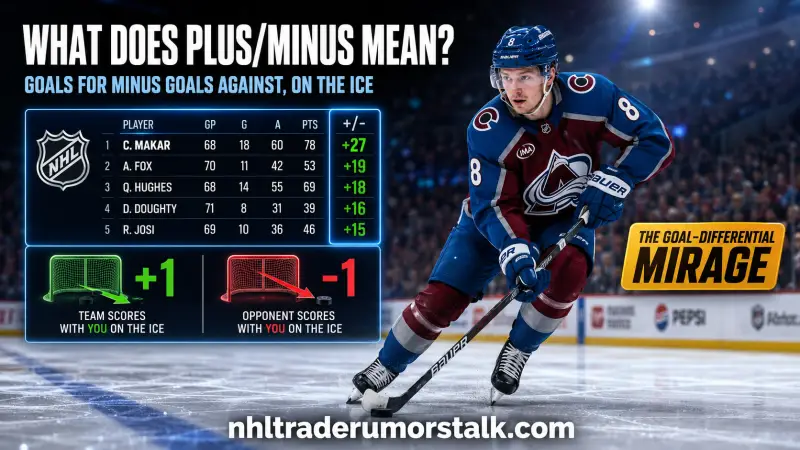
Bobby Orr once finished a season at plus-124, a number no skater has touched since 1971. That figure is the plus/minus stat at its flashiest, and plus/minus is the simplest line on any hockey box score: it counts the goals your team scores and allows at even strength while you are on the ice. Add one for a goal for, subtract one for a goal against, and the running total is your plus/minus. The catch is that the number says as much about your team as it does about you, and I call that blind spot The Goal-Differential Mirage.
Plus/minus (written +/-) is a running tally of even-strength and shorthanded goals scored and allowed while a player is on the ice. You get a +1 when your team scores and a -1 when it gets scored on. Power-play goals do not count, shorthanded goals do, and a strong season is anything comfortably in the plus. One warning up front: this is the player stat, not the betting puck line you see at a sportsbook.
| Figure | What it represents |
|---|---|
| +124 | Bobby Orr in 1970-71, the best single-season plus/minus in NHL history and untouched for more than 50 years |
| +722 | Larry Robinson's career plus/minus, the all-time record, built across the Montreal dynasty |
Both records belong to defensemen who skated for juggernaut teams, and that is the first clue to what plus/minus really measures. A great player on a great team piles up plus goals; the same player on a bad team bleeds minus ones. Keep that in mind before you judge anyone by this column alone.
Key Takeaways
- The basics: plus/minus is even-strength and shorthanded goals for minus goals against while you are on the ice. Score, you get +1; get scored on, you get -1.
- Special teams change the math: power-play goals count for nobody, but shorthanded goals count for everybody on the ice.
- The Goal-Differential Mirage: a star on a losing team can post an ugly number through no fault of his own, which is exactly why analysts stopped trusting it alone.
- A good number: anything in the plus is fine, and a season above +20 is genuinely strong. Elite years reach +30 or higher.
- It is not a betting line: the player stat has nothing to do with the +1.5 or -1.5 puck line at a sportsbook.
What does plus/minus mean?
Plus/minus measures goal differential while a player is on the ice. Every time your team scores at even strength or shorthanded, every skater on the ice for your side gets a plus. Every time your team gives one up in those situations, those skaters get a minus. Add the pluses, subtract the minuses, and the season-long total is the number you see in the box score next to +/-. It sits right alongside goals and assists in the same family of basic stats that drive how the standings work, the same cluster as our guides to how overtime works and how long a game lasts.
One thing to clear up before we go further, because the search results blur it. The player plus/minus has nothing to do with the puck line at a sportsbook, where a team is listed at -1.5 or +1.5 goals. Same symbols, completely different meaning. This guide is only about the on-ice player stat.
How plus/minus is calculated
The rules are simple once you see which goals count and which do not. Here is the full breakdown, straight from the league's own scoring definitions.
| On the ice for… | Effect |
|---|---|
| Even-strength goal your team scores | +1 for every teammate on the ice |
| Even-strength goal your team allows | -1 for every teammate on the ice |
| Shorthanded goal your team scores (killing a penalty) | +1 for the penalty-killers |
| Shorthanded goal your team allows (on the power play) | -1 for the power-play unit |
| Power-play goal, either team | No effect on anyone |
| Empty-net goal | Counts as even strength, unless the scoring team is on a power play |
| Penalty-shot or shootout goal | No effect |
The power-play rule is the one that surprises people. If your team scores with the man advantage, nobody on the ice gets a plus, because the stat is built to reward five-on-five play rather than special teams. Score while shorthanded, though, and you are rewarded, since killing a penalty and scoring anyway is the hardest goal in the sport. That single design choice is why two players with the same goal totals can carry wildly different plus/minus numbers.
What is a good plus/minus?
Any number in the plus means your team outscored the opposition while you played, so even a modest plus is a fine sign. A full season above +20 is genuinely strong, and the league's best two-way players push into the +30s and beyond in their peak years. Drop into the minus and it is worth a second glance, but not a panic, because the team around you matters enormously. A defenseman stuck on a 25-win club can post a brutal number while doing nothing wrong. The all-time floor is Bill Mikkelson's -82 for the 1974-75 Washington Capitals, a number that reflects an 8-67-5 expansion team far more than the player who wore it.
That is also why coaches read plus/minus in blocks rather than single games. One bad bounce, one empty-netter against, and the column swings. Over half a season the noise settles, and the number starts to track which players are on the right side of the goal column most nights. For context on how those goals pile into points and playoff spots, our breakdown of the standings and the 16-win playoff map show where it all lands.
The Goal-Differential Mirage
Here is the trap that makes plus/minus so slippery. The stat hangs a team result on an individual name. Skate for a powerhouse and you look elite; skate for a tire fire and you look finished, even if your actual play never changed. That illusion is the Goal-Differential Mirage, and the people who watch the game closest know it well. Brian Engblom, a three-time Cup winner on defense for Montreal and later an ESPN analyst, put the flaw plainly.
"Playing on a good team or a bad team impacts a player's plus/minus rating in a big way." — Brian Engblom, via ESPN
The mirage cuts both ways. A defensive specialist buried on a bad roster gets punished for goals he had little to do with, while a passenger on a stacked team coasts to a shiny plus. It is the same reason a club can win the league in the regular season and still flame out, the kind of gap our Presidents' Trophy breakdown dug into. Goal differential is real, but pinning all of it on one skater is where the number lies.
The all-time records and the lost award
The plus/minus record book is a monument to the dynasties of the 1970s and 1980s. The NHL began tracking the stat officially in the 1967-68 season, and almost every untouchable mark was set soon after by a defenseman on a champion. Larry Robinson and the Montreal teams that won six Stanley Cups in his era sit at the top, part of the same most-Cups history the franchise still owns.
| Record | Holder | Mark |
|---|---|---|
| Best single season | Bobby Orr (1970-71) | +124 |
| Second single season | Larry Robinson (1976-77) | +120 |
| Worst single season | Bill Mikkelson (1974-75) | -82 |
| Best career | Larry Robinson | +722 |
| Second career | Bobby Orr | +582 |
| Third career | Ray Bourque | +527 |
| Most Plus-Minus Awards | Wayne Gretzky | 3 |
The league even handed out a trophy for it. The NHL Plus-Minus Award ran from the 1982-83 season until it was quietly retired after 2007-08, with Pavel Datsyuk as its final winner. The fact that the league stopped awarding it tells you where the stat now sits in the hierarchy. Orr, for the record, led the NHL in plus/minus six times, all before the trophy even existed.
Why analysts moved past it
Modern hockey analysis treats plus/minus as a starting point rather than a verdict. The fix was to measure the process behind the goals rather than just the goals themselves. Corsi counts shot attempts for and against while a player is on the ice, which produces a far bigger sample than goals alone. Expected goals, or xG, goes further and weighs the quality of every chance, so a player who drives good shots and suppresses dangerous ones grades well even on a night the puck does not bounce his way.
| Metric | What it counts | What it fixes |
|---|---|---|
| Plus/minus | On-ice goals for and against, even strength and shorthanded | The baseline, but a small sample tied to team results |
| Corsi | On-ice shot attempts for and against | A far bigger sample than goals alone |
| Expected goals (xG) | The quality of every scoring chance for and against | Weighs chance danger and adjusts for usage and linemates |
Those numbers also adjust for the things plus/minus ignores: who you start your shifts against, how often you begin in the offensive zone, and the strength of your linemates. None of that erases plus/minus, which still flags who is on the right side of the goal column. It just stops the stat from being the final word. As one analytics writer summed up after a deep dive on two defensemen with misleading numbers, the takeaway is blunt.
"Plus/minus is not a perfect stat, and this analysis reinforces that." — Blaiz Grubic, via Sound Of Hockey
The smarter way to use it today is as a quick gut check, then dig into the underlying numbers, the way a sharp front office weighs a defenseman before paying him. Our look at Cale Makar versus Adam Fox and the Werenski Norris case lean on exactly that mix of old and new, and the dollars that follow are mapped in our salary cap guide.
This explainer was written by Mike Johnson, NHL Senior Editor, who has covered the league for 15-plus years. The calculation rules were checked against the NHL's official scoring definitions; every record was cross-checked against Hockey-Reference and the NHL record book. The "Goal-Differential Mirage" is our own framing for the stat's team-dependence, introduced in this piece. Published June 2026; last verified against live sources in June 2026. Editorial review: Sarah Chen, Hockey Operations Editor. Corrections: editorial@nhltraderumorstalk.com.
Sources and Reporting
- NHL.com: official scoring definitions for plus/minus and special-teams goals
- ESPN: Brian Engblom on why plus/minus can mislead
- Sound Of Hockey: a 2025 deep dive on misleading plus/minus numbers
- NHL Plus-Minus Award: award history, 1982-83 through 2007-08
- Hockey-Reference: career and single-season plus/minus leaders
The Verdict: The Goal-Differential Mirage
So what does plus/minus mean in hockey? It is goal differential while you are on the ice, even strength and shorthanded, scored as a simple plus or minus. Read it as a fast snapshot of who is on the right side of the goals, and it works. Read it as the final word on a player, and the Goal-Differential Mirage takes over, dressing up a team result as an individual one. The next time you see a defenseman at minus-20, check the standing of the team in front of him before you check his name. The column might be telling you about the roster, not the player.
Frequently Asked Questions
What does plus/minus mean in hockey?
Plus/minus is a running tally of goal differential while a player is on the ice. A skater earns a +1 every time the team scores an even-strength or shorthanded goal with them on the ice, and a -1 every time the team allows one in those situations. The season total, shown as +/-, is meant to capture whether a player is on the right side of the goals.
How is plus/minus calculated?
Add one for every even-strength or shorthanded goal your team scores while you are on the ice, and subtract one for every even-strength or shorthanded goal it allows. Power-play goals do not count for either team, shorthanded goals do count, empty-net goals are treated as even strength, and penalty-shot and shootout goals are excluded.
Do power-play goals count toward plus/minus?
No. A goal scored on the power play does not give the scoring team a plus or the defending team a minus, because plus/minus is built around even-strength play. The one special-teams exception is a shorthanded goal, which does count: the penalty-killers who score get a plus and the power-play unit gets a minus.
What is a good plus/minus in hockey?
Any number in the plus is a good sign, since it means your team outscored the opposition while you played. A full season above +20 is strong, and elite two-way players reach +30 or higher in their best years. A negative number is worth a look but not a verdict, because the strength of the team around a player heavily shapes it.
What is a bad plus/minus in hockey?
A deeply negative plus/minus, usually posted by a player stuck on a losing team. The worst single season in NHL history is Bill Mikkelson's -82 for the 1974-75 Washington Capitals, a team that went 8-67-5, which shows how much the stat reflects the roster around a player rather than the player alone.
Who has the best plus/minus in NHL history?
Bobby Orr holds the single-season record at +124, set in 1970-71 and untouched since. Larry Robinson holds the career record at +722, built across the Montreal dynasty, with Orr second at +582 and Ray Bourque third at +527.
Is plus/minus a good stat?
It is a useful quick snapshot of who is on the right side of the goals, but it is team-dependent and easy to misread, so analysts no longer treat it as the final word. Modern measures like Corsi (shot-attempt differential) and expected goals weigh the process behind the goals and adjust for usage and linemates.
What is the difference between plus/minus and the betting puck line?
They are unrelated despite sharing the plus and minus symbols. The plus/minus here is an on-ice player statistic that counts goals for and against. The puck line at a sportsbook, listed as -1.5 or +1.5, is a betting spread on the final margin and has nothing to do with the player stat.
When did the NHL start tracking plus/minus?
The NHL began tracking plus/minus as an official statistic in the 1967-68 season. The league also handed out an NHL Plus-Minus Award from 1982-83 until it was retired after 2007-08, when Pavel Datsyuk was the final winner.
Related Stories

How Long Is a Hockey Game? Periods, Times and Overtime
How long is a hockey game? An NHL game is only 60 minutes of play, three 20-minute periods, but it takes about two and a half hours of real...
By Mike Johnson · 9 min read

How NHL Standings Work: Points, ROW and Tiebreakers
How do NHL standings work? A win is worth two points, ties break on regulation wins then ROW, and point percentage can flip the order when a...
By Mike Johnson · 8 min read

How NHL Overtime Works
How does NHL overtime work? The regular season is a 5-minute 3-on-3 then a shootout; the playoffs are full 5-on-5 sudden death until someone...
By Mike Johnson · 9 min read

Most Stanley Cups by Team
The Montreal Canadiens own the most Stanley Cups with 24, ahead of Toronto (13) and Detroit (11). Here is the full all-time list by NHL fran...
By Mike Johnson · 9 min read
Comments
Be the first to share your take.
Get NHL trade rumors in your inbox
One email per week, zero spam, verified rumors only.