How NHL Standings Work: Points, ROW and Tiebreakers
How do NHL standings work? A win is worth two points, ties break on regulation wins then ROW, and point percentage can flip the order when a team has games in hand. Here is how to read every column, plus how the 16-team playoff field and its wild cards get set.
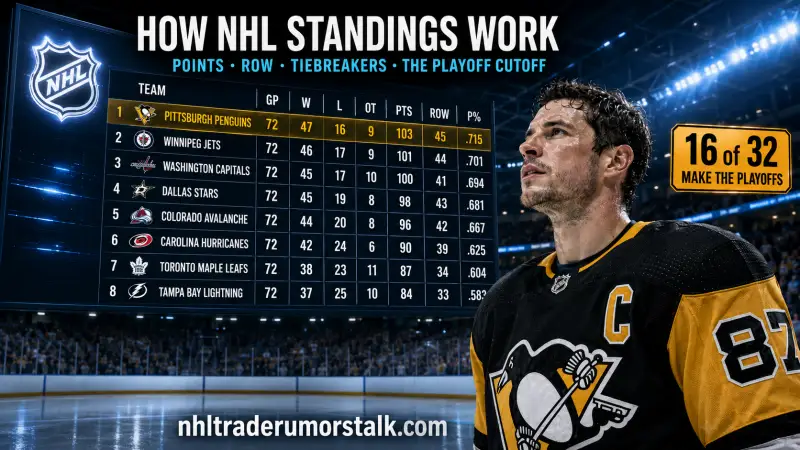
Two points. That is what every NHL win is worth in the standings, and knowing how those points stack, break ties, and set the playoff field is the gap between glancing at a table and actually reading it. Here is how NHL standings work, top to bottom: each team plays 82 games, a win is worth two points, an overtime or shootout loss is worth one, and a regulation loss is worth zero. The clubs with the most points in each division, plus the best leftovers, reach the playoffs. The catch is the column most fans skip past, point percentage, and I call that blind spot The Games-in-Hand Mirage.
NHL standings rank teams by total points: two for any win, one for an overtime or shootout loss, zero for a regulation loss. When points are level, the league breaks the tie by regulation wins first, then ROW. The top three teams in each of the four divisions make the playoffs, and two wild cards per conference fill the rest, for a 16-team field.
| Figure | What it represents |
|---|---|
| 2 | Points an NHL win adds to the standings, the currency that decides everything below it |
| 16 of 32 | Teams that reach the Stanley Cup Playoffs, the cutoff every point is chasing |
Those two points decide which 16 of 32 teams play in the spring, yet a club sitting lower on raw points can still be ahead once you account for games in hand, the quirk at the heart of how the standings can mislead.
Key Takeaways
- Points first: two for any win, one for an overtime or shootout loss, zero for a regulation loss. Total points rank the table.
- The Games-in-Hand Mirage: a team behind on points can be ahead on point percentage if it has played fewer games, so the points column alone can mislead.
- ROW breaks ties: after regulation wins, ROW (regulation plus overtime wins, shootout wins removed) is the next tiebreaker.
- 16 make it: top three per division plus two wild cards per conference, a fixed bracket with no re-seeding.
- The loser point feeds it all: that single point for losing in overtime is why the standings bunch so tightly.
How NHL points work (the quick version)
Every NHL game hands out two points to the winner. Lose in regulation and you get nothing. Lose in overtime or a shootout and you still bank one point, the famous loser point. So a game that runs past 60 minutes actually puts three points into the standings instead of two, which is why the table bunches up so tightly by March. That single mechanic powers everything else here, and we broke down the overtime side of it in full in our guide to how NHL overtime works. If the money side of roster math is more your speed, our salary cap guide and the NMC versus NTC breakdown cover those rules.
Because of that loser point, raw wins and losses do not tell the whole story, which is why the standings carry a separate column called ROW. It becomes one of the main tiebreakers later.
Reading every standings column
Open any standings page and the abbreviations come at you fast. Here is what each one means, left to right, on a standard NHL table.
| Column | What it means |
|---|---|
| GP | Games played, out of 82 in a full season |
| W / L | Wins (any kind) and regulation losses |
| OTL | Overtime or shootout losses, each worth one point |
| PTS | Total points, the number that sorts the table |
| P% | Point percentage: points divided by the maximum possible, the fair way to compare teams with different games played |
| ROW | Regulation plus overtime wins, with shootout wins stripped out, the second tiebreaker behind regulation wins |
| DIFF | Goal differential, goals for minus goals against |
Most nights you only need PTS and GP together. A team can lead its division on points but have played two more games than the club chasing it, and that is where casual readers get fooled.
The Games-in-Hand Mirage
Here is the trap, and even sharp fans fall for it in March. The standings sort by total points, so the team on top looks like the team in front. But points pile up one game at a time, and teams rarely sit at the same number of games played. A club two points back with two games in hand is not behind at all, it is ahead on the math that matters, point percentage.
Point percentage is just points divided by the maximum a team could have earned, two per game played. A team at 90 points in 70 games (.643) is outrunning a team at 92 points in 74 games (.622), even though the raw points column flips them. That is the Games-in-Hand Mirage, and it is why every serious standings page lets you sort by P%. The playoff race our 2025-26 wild-card tracker followed swung on exactly this kind of math, and so does the chase for the league's best record that shadowed our Presidents' Trophy curse breakdown.
How ties get broken
When two or more teams finish level on points, the NHL runs a fixed list of tiebreakers in order until one team comes out ahead. Note that the very first one is regulation wins, which is the league's way of rewarding teams that win in 60 minutes rather than leaning on the loser point and the shootout.
| Order | Tiebreaker |
|---|---|
| 1 | Regulation wins (RW), added as the top tiebreaker in 2019-20 |
| 2 | ROW: regulation plus overtime wins (shootout wins excluded) |
| 3 | Total wins (W) of any kind |
| 4 | Points earned in games between the tied teams |
| 5 | Goal differential across the full season |
Shootout wins sit out of the top tiebreakers on purpose, a rule the league added for 2010-11 so that beating someone in a skills competition would not count as much as winning while real hockey is being played.
How the 16-team playoff field is set
Sixteen of the 32 teams reach the playoffs, eight from each conference, and the route in is part division, part wild card. The top three teams in each of the four divisions qualify automatically, which locks in 12 spots. The last four go to the two wild cards in each conference, the highest-point clubs left over regardless of division. Then the bracket fixes in place, with no re-seeding between rounds and the higher seed hosting Games 1, 2, 5, and 7. Miss that cutoff and a year is gone, the kind of wait our Buffalo 14-year drought piece lived through. The full path from there is mapped in our 16-win playoff map and dated out in the playoff schedule and TV guide.
This is also the part fans argue about most, because the divisional bracket can throw two of the league's best teams at each other in Round 1. Sidney Crosby has said he would rather see straight 1-to-8 seeding.
"I like 1-to-8 just because I think the regular season is as difficult as it is, teams should be rewarded ... I like that version a little bit better." — Sidney Crosby, via theScore
General managers have pushed the same point. Minnesota's Bill Guerin, whose own roster math we tracked in the Wild Window Paradox, put the complaint bluntly.
"One of the top three teams should not be going home [in the first round]." — Bill Guerin, Minnesota Wild GM, via TSN
Gary Bettman has waved the criticism off, arguing the divisional format produces the best first round in sports and that the system works extraordinarily well, per theScore. Until that changes, the wild card and the division crown are the two doors into the bracket, and the points table is the only key.
This explainer was written by Mike Johnson, NHL Senior Editor, who has covered the league for 15-plus years. Every rule, column definition, and tiebreaker was checked against the NHL's official standings and tie-breaking procedure, theScore, TSN, and The Hockey News. The "Games-in-Hand Mirage" is our own framing for the point-percentage gap, introduced in this piece. Published June 2026; last verified against live sources in June 2026. Editorial review: Sarah Chen, Hockey Operations Editor. Corrections: editorial@nhltraderumorstalk.com.
Sources and Reporting
- NHL.com: official standings tie-breaking procedure
- theScore: Crosby on preferring 1-to-8 seeding
- TSN: Guerin on the divisional playoff format (March 2026)
- theScore: Bettman defends the format
- Sofascore: standings columns and seeding
- DIRECTV Insider: 16-team wild-card format
- 2026 Stanley Cup playoffs: bracket and qualification
The Verdict: The Games-in-Hand Mirage
So how do NHL standings work? Two points a win, one for the overtime loser, ranked by total points, broken by regulation wins and then ROW, and cut off at 16 teams through three division spots and two wild cards per conference. The piece that trips everyone up is the Games-in-Hand Mirage, so the next time your team sits third in the division, check the point-percentage column before you panic, because the club above it may have burned more games to get there. Want to test it? Pull up the standings tonight and sort by P% instead of points. The order will surprise you.
Frequently Asked Questions
How do NHL standings work?
NHL standings rank teams by total points: two points for any win, one for an overtime or shootout loss, and zero for a regulation loss. When teams are level on points, ties break by regulation wins first, then ROW. The top three teams in each division plus two wild cards per conference make the 16-team playoff field.
What does ROW mean in the NHL standings?
ROW stands for Regulation plus Overtime Wins. It counts a team's wins in regulation and overtime but excludes shootout wins. ROW has been a standings tiebreaker since the 2010-11 season, and since 2019-20 it sits second, behind regulation wins (RW).
What is point percentage in the NHL standings?
Point percentage is a team's points divided by the maximum it could have earned, which is two per game played. It is the fair way to compare teams that have played a different number of games, so a club with games in hand can rank higher by point percentage than by raw points.
How are NHL playoff teams decided?
Sixteen teams qualify, eight per conference. The top three in each of the four divisions get in automatically (12 spots), and the final four go to the two highest-point wild-card teams in each conference. The bracket is fixed with no re-seeding between rounds.
What is the NHL's first tiebreaker?
Regulation wins (RW). Added as the top tiebreaker in 2019-20, it rewards teams that win in 60 minutes rather than leaning on overtime, the shootout, or the loser point. If RW is also tied, the league moves to ROW, then total wins, then head-to-head points.
How many teams make the NHL playoffs?
Sixteen of the 32 NHL teams make the playoffs, eight from each conference. That is the top three teams in each of the four divisions (12 spots) plus two wild-card teams in each conference (4 spots), for a 16-team bracket.
What is an NHL wild card?
A wild card is a playoff berth for one of the two highest-point teams in a conference that did not finish in its division's top three. Each conference has two wild cards, and together they fill the last four spots in the 16-team field.
What is the difference between RW and ROW?
RW (regulation wins) counts only wins earned in regulation. ROW (regulation plus overtime wins) adds overtime wins but still excludes shootout wins. RW is the NHL's first tiebreaker, used since 2019-20, and ROW is the second, used since 2010-11.
Related Stories

How NHL Overtime Works
How does NHL overtime work? The regular season is a 5-minute 3-on-3 then a shootout; the playoffs are full 5-on-5 sudden death until someone...
By Mike Johnson · 9 min read

Most Stanley Cups by Team
The Montreal Canadiens own the most Stanley Cups with 24, ahead of Toronto (13) and Detroit (11). Here is the full all-time list by NHL fran...
By Mike Johnson · 9 min read

NHL Free Agency 2026: Time & How to Watch
NHL free agency 2026 opens at noon ET on Wednesday, July 1. How to watch live on NHL Network and the trackers, who is actually available (Al...
By James Wright · 8 min read

2027 Winter Classic: How to Watch
How to watch the 2027 NHL Winter Classic: the Utah Mammoth host the Colorado Avalanche at Rice-Eccles Stadium on December 31, 2026, in the M...
By Mike Johnson · 8 min read
Comments
Be the first to share your take.
Get NHL trade rumors in your inbox
One email per week, zero spam, verified rumors only.