How Long Is a Hockey Game? Periods, Times and Overtime
How long is a hockey game? An NHL game is only 60 minutes of play, three 20-minute periods, but it takes about two and a half hours of real time once you add the intermissions, the faceoffs, and three TV timeouts a period. Here is the full breakdown, plus overtime and every level from pro to youth.
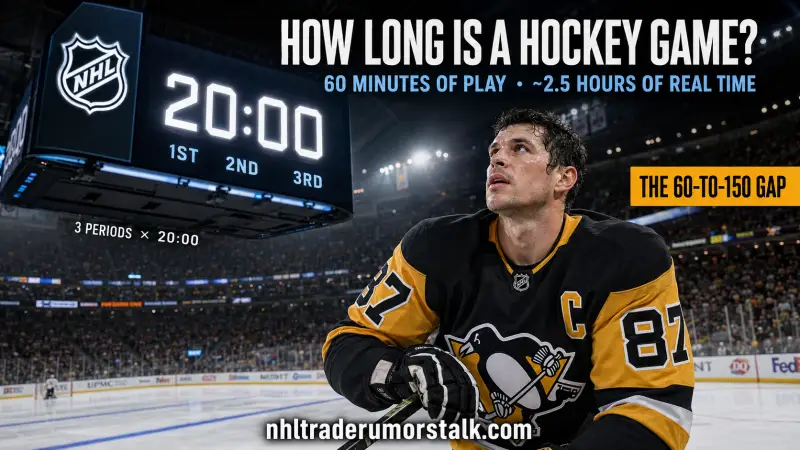
Sixty minutes. That is the entire official clock an NHL game runs, yet you will spend about two and a half hours watching it, because hockey freezes its clock on every whistle. Here is how long a hockey game actually takes, top to bottom: three 20-minute periods of play, two 18-minute intermissions, and a steady drip of stoppages and television timeouts that turn 60 minutes of action into roughly 150 minutes of real time. That stretch between the clock and your couch is what I call The 60-to-150 Gap.
A regulation NHL game is three 20-minute periods, or 60 minutes of play, split by two 18-minute intermissions. On the clock that is one hour; in real life it averages about two and a half hours (roughly 2h20 to 3h) once stoppages and TV breaks are counted. Overtime can add anything from a few minutes to several hours, and lower levels of hockey run shorter periods, so a youth or high-school game is well under two hours.
| Figure | What it represents |
|---|---|
| 60 | Minutes of official play in a regulation game, the only time the scoreboard clock counts |
| ~150 | Minutes of real time you actually spend, about two and a half hours from puck drop to final horn |
Those two numbers rarely match, and the distance between them catches casual fans off guard when they try to plan their night around a game. It is the same reason a tied game can run past midnight.
Key Takeaways
- 60 minutes of play, about 2.5 hours of life: a regulation NHL game averages roughly 2h20 to 2h40 from puck drop to final horn.
- The 60-to-150 Gap: hockey stops its clock on every whistle, so 60 minutes of action stretches to about 150 minutes of real time.
- The structure: three 20-minute periods plus two 18-minute intermissions, with three TV timeouts per period.
- Lower levels run shorter: high-school periods are about 17 minutes and youth periods 12 to 15, so those games finish in well under two hours.
- Overtime is the wild card: a regular-season game adds a quick five minutes plus a shootout, but a playoff game can run for hours.
How long is an NHL game?
A regulation NHL game lasts about two and a half hours of real time, even though it contains only 60 minutes of play. Most broadcasts and box scores land between 2 hours 20 minutes and 2 hours 40 minutes, and a game loaded with penalties, video reviews, or a long overtime can push past three hours. If you are planning when to tune in, our guide to how to watch the NHL and the 2026-27 schedule breakdown map out start times across the season, including marquee nights like the 2027 Winter Classic.
Only the 60 minutes of play stays fixed, while the intermissions, the faceoffs, and the commercial breaks are what turn a one-hour game into a half-evening. Understanding that split is the whole answer, so it gets its own name.
The 60-to-150 Gap, explained
Hockey runs on a stopped clock: the game clock counts down only while the puck is in play, and it freezes the instant a whistle blows. Every offside, icing, penalty, goal, and frozen puck stops time cold. Football works the same way, which is why a 60-minute football game also runs three hours. Soccer, by contrast, lets the clock run, so a 90-minute match finishes in under two hours.
Add up all those little freezes across a game and they nearly double the real time. Sixty minutes of action turns into roughly 150 minutes from puck drop to final horn, and that is the 60-to-150 Gap. The single 60-minute clock is doing honest work; it just is not measuring the parts of the night when nobody is skating.
Periods, intermissions, and TV timeouts
An NHL game breaks into three equal periods of 20 minutes each, separated by two intermissions. Here is where every minute of a typical night goes.
| Segment | What it adds |
|---|---|
| 3 periods of play | 60 minutes on the clock, the only official time |
| In-play stoppages | Faceoffs, penalties, reviews, and TV timeouts add roughly 50 to 60 minutes of real time on top of the 60 |
| 2 intermissions | About 36 minutes total, two breaks of 18 minutes each |
| Total | Around 2 hours 20 to 2 hours 40, an average near 2.5 hours |
The biggest scheduled chunk of that dead time is the commercial break. The NHL runs three television timeouts per period, each about two minutes long, at the first stoppage after the 14, 10, and 6-minute marks. They are skipped after a goal, after an icing, and during a power play, and the league holds them back in the final 30 seconds of the first two periods and the last two minutes of the third. Coaches notice how much they already eat into a night, and not all of them want more. Speaking when the league tested longer breaks, Tampa Bay coach Jon Cooper kept it short.
"TV timeouts are long as it is." — Jon Cooper, via Yahoo Sports
Intermissions matter for planning too. The 18-minute break is when the ice gets resurfaced, so the gap between periods is closer to 20 minutes once players leave and return. Plan your food run for the intermission, not for a stoppage, because a whistle in play rarely lasts more than a minute.
Does overtime add time?
It can, and this is where the real time gets unpredictable. In the regular season a tie triggers a single five-minute, three-on-three overtime, and if nobody scores the game goes to a shootout, so the whole extra session usually wraps inside 10 or 15 real minutes. The playoffs throw the clock out the window: postseason overtime is full 20-minute, five-on-five sudden-death periods that repeat until someone scores, with no shootout. The same sudden-death idea decides international hockey, the way the 2026 Olympic final ended on a golden goal in overtime. We break down every rule in our guide to how NHL overtime works, and the loser point it creates feeds straight into how the standings work. That is why a playoff night can turn into a marathon.
What is the longest NHL game ever?
The longest game in NHL history was March 24, 1936, a 1-0 Detroit win over the Montreal Maroons that needed six overtimes. Rookie Mud Bruneteau finally beat the Maroons at 16:30 of the sixth overtime, after 116 minutes and 30 seconds of extra hockey that ended near 2:25 in the morning. The modern benchmark is the 2020 Tampa Bay win over Columbus that Brayden Point ended 10:27 into the fifth overtime, a game that ran 6 hours and 13 minutes of real time while goalie Joonas Korpisalo made 85 saves. Point summed up the toll afterward.
"There's no way to prepare for a game that goes that long." — Brayden Point, via ESPN
Those marathons are rare, but they are why a single playoff ticket can never promise a finish time. For the dates and matchups that produce them, see our playoff schedule and TV guide and the 16-win playoff map, and the title run they decide is recapped in who won the 2026 Stanley Cup.
How long is a hockey game at every level?
The NHL number sits at the long end. Pro and college hockey share the 20-minute period, but the lower you go in age, the shorter the periods get and the faster the night ends. These figures vary by league and association, so treat them as typical ranges rather than fixed rules.
| Level | Periods | Real-world game |
|---|---|---|
| NHL / pro | 3 × 20 min | About 2h20 to 2h40 |
| College (NCAA) | 3 × 20 min | About 2 to 2.5 hours |
| Major junior (CHL) | 3 × 20 min | About 2.5 hours |
| High school (U.S.) | 3 × 15-17 min | About 1h45 to 2 hours |
| Youth (by age) | 3 × 12-15 min | About 1 to 1.25 hours |
| Beer league / rec | Often a running clock | A fixed 60 to 90-minute ice slot |
The big divider is the clock itself, because pro, college, and most competitive games use stop time, where the clock freezes on whistles, so they carry that full gap. Many youth and recreational leagues rent the ice for a set window and run the clock straight through except late in the game, which is why those games finish so much faster even with three periods.
This explainer was written by Mike Johnson, NHL Senior Editor, who has covered the league for 15-plus years. Period lengths, intermission times, and the television-timeout rule were checked against the NHL's official game structure and reporting from ESPN and The Associated Press; level-by-level figures reflect typical NCAA, CHL, high-school, and USA Hockey ranges and vary by association. The "60-to-150 Gap" is our own framing for the stopped-clock effect, introduced in this piece. Published June 2026; last verified against live sources in June 2026. Editorial review: Sarah Chen, Hockey Operations Editor. Corrections: editorial@nhltraderumorstalk.com.
Sources and Reporting
- NHL.com: longest game in NHL history (1936, Mud Bruneteau)
- ESPN: Lightning-Blue Jackets five-overtime game and Brayden Point
- Yahoo Sports: Jon Cooper on TV timeouts and the 4 Nations testing ground
- Overtime (ice hockey): regular-season and playoff overtime structure
- USA Hockey: youth program and period-length recommendations
The Verdict: The 60-to-150 Gap
So how long is a hockey game? On paper it is 60 minutes, three 20-minute periods, but in your living room it is about two and a half hours once you add the intermissions, the faceoffs, and three TV timeouts a period. That distance is the 60-to-150 Gap, the cost of a sport that stops its clock on every whistle. Block out roughly two and a half hours for an NHL night, a little less for college, and under two hours for youth and high-school games, then add a buffer in the playoffs, because the one game that breaks the pattern is the one nobody can plan around.
Frequently Asked Questions
How long is a hockey game?
A regulation NHL game is 60 minutes of play, split into three 20-minute periods, but it takes about two and a half hours of real time to watch. Most games run between 2 hours 20 minutes and 2 hours 40 minutes once intermissions, faceoffs, penalties, and TV timeouts are counted, and overtime can push a game past three hours.
How many periods are in a hockey game?
A hockey game has three periods. In the NHL, college, and major junior, each period is 20 minutes long, for 60 minutes of regulation play. High-school and youth levels use shorter periods, usually 12 to 17 minutes each.
How long are NHL intermissions?
NHL intermissions are 18 minutes long, and there are two of them, one after the first period and one after the second, for about 36 minutes total. The ice is resurfaced during each break, so the real gap between periods is closer to 20 minutes.
Why does a 60-minute hockey game take about two and a half hours?
Hockey uses a stopped clock that freezes on every whistle, so the 60 minutes of play is only part of the night. Two 18-minute intermissions, faceoffs, penalties, video reviews, and three TV timeouts per period stretch 60 minutes of action into roughly 150 minutes of real time. That stretch is what we call the 60-to-150 Gap.
How long is a hockey game on TV with commercials?
A televised NHL game usually runs about two and a half to three hours. The league takes three TV timeouts per period, each around two minutes, at the first stoppage after the 14, 10, and 6-minute marks, except after a goal or icing or during a power play.
Does overtime make a hockey game longer?
Yes. A regular-season tie adds a five-minute, three-on-three overtime and then a shootout, usually about 10 to 15 extra minutes of real time. Playoff overtime is full 20-minute sudden-death periods that repeat until someone scores, so a playoff game can run for several extra hours.
How long is a college, high-school, or youth hockey game?
College and major-junior games use the same three 20-minute periods as the pros and run about 2 to 2.5 hours. High-school games use roughly 15 to 17-minute periods, depending on the state, and last about 1 hour 45 minutes to 2 hours. Youth games use 12 to 15-minute periods and finish in about 1 to 1.25 hours, and exact lengths vary by association.
What is the longest NHL game ever?
The longest game in NHL history was March 24, 1936, when Detroit beat the Montreal Maroons 1-0 on Mud Bruneteau's goal at 16:30 of the sixth overtime, after 116 minutes 30 seconds of extra play. The modern benchmark is the 2020 Lightning win over Columbus that Brayden Point ended in the fifth overtime, a game that ran 6 hours 13 minutes of real time.
Related Stories
How NHL Standings Work: Points, ROW and Tiebreakers
How do NHL standings work? A win is worth two points, ties break on regulation wins then ROW, and point percentage can flip the order when a...
By Mike Johnson · 8 min read
How NHL Overtime Works
How does NHL overtime work? The regular season is a 5-minute 3-on-3 then a shootout; the playoffs are full 5-on-5 sudden death until someone...
By Mike Johnson · 9 min read

Most Stanley Cups by Team
The Montreal Canadiens own the most Stanley Cups with 24, ahead of Toronto (13) and Detroit (11). Here is the full all-time list by NHL fran...
By Mike Johnson · 9 min read

NHL Free Agency 2026: Time & How to Watch
NHL free agency 2026 opens at noon ET on Wednesday, July 1. How to watch live on NHL Network and the trackers, who is actually available (Al...
By James Wright · 8 min read
Comments
Be the first to share your take.
Get NHL trade rumors in your inbox
One email per week, zero spam, verified rumors only.