What Is a Penalty Kill in Hockey?
What is a penalty kill in hockey? The short-handed team's stand against the power play, four against five. The rules that help the underdog (legal icing), the box-diamond-wedge formations, what a good PK percentage is, and the short-handed goal.
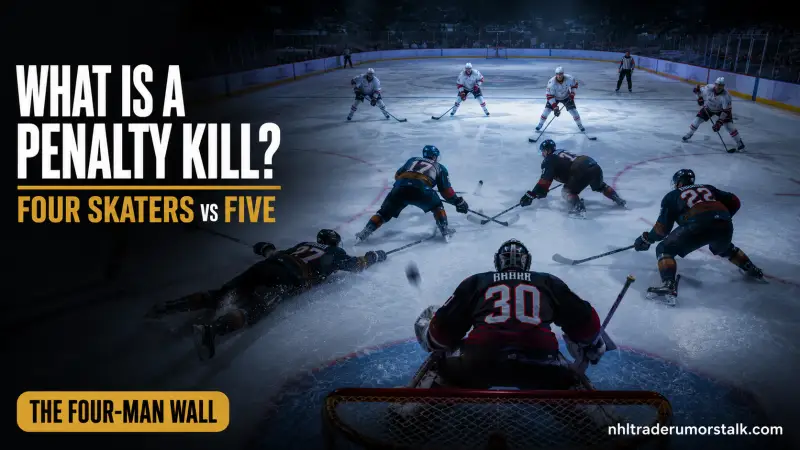
Four skaters line up against five. They are down a man, pinned in their own end, and the other team has the puck and a plan. Most sports would call that a losing position. Hockey calls it a job. This is the penalty kill in hockey, the short-handed team's stand against the power play, and the strangest part is what the rulebook does next: it quietly hands the outnumbered side weapons the other team never gets. Call it the Four-Man Wall.
The kill is hockey's underdog math made visible. Down a skater, on the wrong end of the odds, and yet across the NHL roughly four of every five penalties get killed. Here is what a penalty kill actually is, the rules that tilt back toward the defenders, the shapes the wall takes, and the moment it stops defending and attacks.
- The definition: the defensive effort of a team playing short-handed while a teammate serves a penalty.
- The math: usually four skaters against five, or three against five on a two-man disadvantage.
- The edge: a short-handed team is allowed to ice the puck, a luxury the power play never has.
- The payoff: a short-handed goal is a two-goal swing that flips the whole sheet.
What a penalty kill actually is
A penalty kill happens whenever a team is short-handed because one of its players is in the box. The most common version is a two-minute minor, which drops the offending team to four skaters against five for the length of the penalty. Stack two minors and it becomes a five-on-three, three skaters against five, the most dangerous 120 seconds in the sport. The killing team's only goal is to survive: keep the puck out until the clock runs the penalty off, and the teammate steps back onto the ice.
The clock has a catch. On a minor, a power-play goal ends the penalty early, the box door opens, and the penalized player returns. On a five-minute major, it does not. A team can score twice, three times, and the major still runs its full five. That single distinction is why a high-sticking double-minor and a five-minute major for high-sticking are completely different nights for the kill. It is the inverse of the power play the other team is running, and the two explainers are best read as a pair.
The weapons only the kill gets
Here is the part that surprises people who assume the short-handed team is simply hanging on. The rulebook actively helps it. The biggest gift is legal icing. A team at full strength that fires the puck the length of the ice gets whistled for icing and a faceoff in its own zone. A short-handed team does not. It can rim the puck 200 feet, kill five seconds of chase, and change its tired forwards, with no penalty at all.
A short-handed team may shoot the puck the length of the ice without being whistled for icing; the call is waved off for as long as the team is below full strength. (NHL Official Rules, Rule 81.6, "Numerical Strength")
That rule is older than most franchises. The NHL introduced icing in 1937, then amended it in 1939 specifically to let penalty-killing teams clear the puck down the ice. Nearly nine decades later it is still the single biggest reason a four-man unit can survive: the long clear plus the free line change resets the whole kill. The power play, meanwhile, has to carry the puck in cleanly and hold the zone, the same way it has to respect the offside line on every entry.
The Four-Man Wall takes shape
With those tools, the kill organizes into a shape. There are three the NHL leans on, and which one a team picks depends on what the power play is showing.
| Formation | The shape | Best against |
|---|---|---|
| The Box | Two forwards high, two defensemen low, one per quadrant | Spread-out power plays; simplest to teach |
| The Diamond | One at the net, one high-slot, two on the flanks | The 1-3-1; chokes the middle slot |
| The Wedge+1 | A triangle in the slot plus one sweeper up top | Modern power plays; the NHL favorite |
The Box is the classroom version: easy to understand, but a power play only has to shift into a 1-3-1 to pull it apart. The Diamond packs the front of the net and forces shots to the perimeter. The Wedge+1, now the most common look in the league, keeps a tight triangle low and adds a fourth man up high who steers the play like an air-traffic controller. Whatever the shape, the principles are the same: block lanes, win the clear, protect the slot in front of a goalie who is suddenly facing an extra shooter, the same crease the goalie-interference rule is built to protect.
How a kill is measured
The number that grades it is penalty-kill percentage: the share of penalties a team survives without allowing a goal. The scale is tight. An elite kill runs around 85 percent or higher. League average sits near 80. Slip under about 77 percent and a team is firmly in the bottom third of the league's 32 clubs. Three or four percentage points is the entire difference between a strength and a liability, and it can decide a playoff series. Killing penalties is also why the penalty minutes a team takes matter so much: every trip to the box is a test of the wall.
When the wall attacks
The kill is not purely defense. Its best moment is the short-handed goal, when the outnumbered team scores anyway. A short-handed goal is a two-goal swing in everything but the scoreboard: the team that should have scored gets scored on, and the building flips. It counts for a player's plus-minus too, one of the few goals that does while a team is down a man. And unlike a power-play goal, a short-handed goal does not end the penalty, the killing team scores and stays short-handed, daring them to do it again.
The feats live in the margins. Former Flyers captain Mike Richards holds the record for most career three-on-five goals with three, scoring against a two-man disadvantage, which is the hardest goal in hockey to manufacture. Those are the moments a great kill is built on: not just survival, but the threat that the four-man wall might come the other way, the same disruptive instinct that powers a good agitator drawing the penalty in the first place.
The Four-Man Wall holds
The penalty kill is the rare place in sports where being outnumbered is the assignment, not the accident. Down a skater every single shift, the killing team still wins the battle four times out of five, because the rulebook lets it ice the puck, change on the fly, and turn a long clear into a breath. That is the Four-Man Wall: a unit built to lose on paper that quietly refuses to. The next time your team takes a penalty, do not watch the power play. Watch the four men who are supposed to be in trouble, and count how often the wall is still standing when the door swings open.
How we checked this: the short-handed icing provision (Rule 81) and its 1939 origin are verified against the NHL Official Rules and multiple rule histories; penalty-kill percentage benchmarks are drawn from 2025-26 NHL team stats (NHL.com, ESPN); the short-handed-goal and three-on-five record are verified against published NHL records; formation descriptions follow standard coaching references.
Frequently Asked Questions
What is a penalty kill in hockey?
A penalty kill is the defensive effort of a team playing short-handed while one of its players serves a penalty. The most common version is four skaters against five during a two-minute minor. The killing team's goal is to prevent a power-play goal until the penalty expires and the player returns.
Why is icing allowed on the penalty kill?
A short-handed team is permitted to ice the puck, while a full-strength team is whistled for it. The NHL added this exception in 1939 so penalty-killing teams could clear the puck the length of the ice. It lets the kill burn time and change tired players, which is the single biggest reason a four-man unit can survive.
What is a good penalty kill percentage?
Penalty-kill percentage is the share of penalties a team survives without allowing a goal. An elite kill runs around 85 percent or higher, league average sits near 80 percent, and anything under about 77 percent lands a team in the bottom third of the NHL.
What are the main penalty kill formations?
The three common shapes are the Box (two forwards high, two defensemen low), the Diamond (one at the net, one high-slot, two on the flanks), and the Wedge+1 (a low triangle plus a high sweeper), which is the most popular look in the modern NHL. The choice depends on what the power play is running.
Does a short-handed goal end the penalty?
No. A short-handed goal does not end the penalty, so the team scores and stays short-handed. Only a power-play goal ends a minor penalty early, sending the penalized player back to the ice. A five-minute major never ends early, no matter how many goals are scored.
Related Stories
What Is GAA in Hockey?
What is GAA in hockey? Goals against average is goals per 60 minutes, the oldest goalie stat and the most misleading. How it is calculated,...
By Mike Johnson · 7 min read
Hockey Positions Explained
Hockey positions explained: six players per side, five skaters and a goalie. What the center, wingers, defensemen, and goalie each do, how l...
By Mike Johnson · 6 min read

What Is a Pest in Hockey?
What is a pest in hockey? An agitator who chirps and goads stars into dumb penalties, usually without fighting. How a pest differs from an e...
By Mike Johnson · 8 min read

What Is a Healthy Scratch in Hockey?
What is a healthy scratch in hockey? A fully fit player the coach leaves out of the lineup, watching from the press box in a suit, not injur...
By Mike Johnson · 8 min read
Comments
Be the first to share your take.
Get NHL trade rumors in your inbox
One email per week, zero spam, verified rumors only.