What Is Goalie Interference? NHL Rule 69 Explained
What is goalie interference in hockey? Plain-English NHL Rule 69 guide: the inside-vs-outside-crease test, how the 1999 Brett Hull goal rewrote the standard, the coach's challenge, and why the league's "conclusively wrong" threshold means most challenges fail.
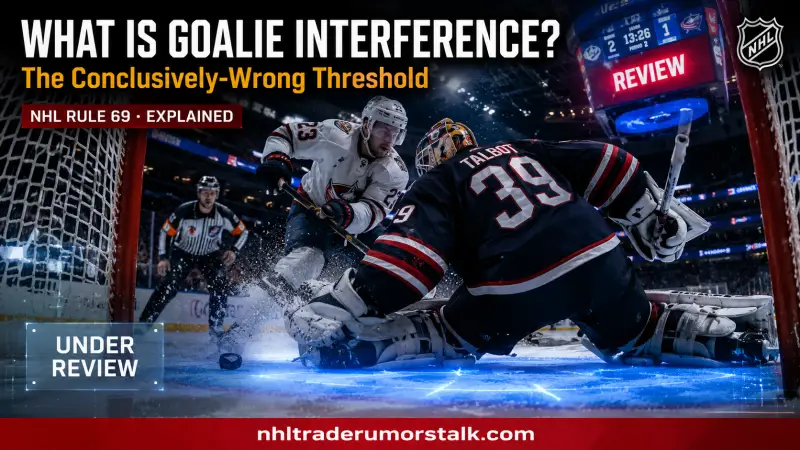
Nine times the Pittsburgh Penguins threw the challenge flag for goaltender interference in 2025-26. Nine times they lost. No call in hockey makes a coach feel more robbed, or a building scream louder at a replay screen, than this one, and the league knows it. Officials are told to leave the call on the ice unless video proves it conclusively wrong, which is exactly why the play fans treat as a coin flip almost never flips. So what is goalie interference in hockey, why does the same contact look like an obvious overturn from the couch and a clean goal on the ice, and how did one Brett Hull skate in 1999 set the whole standard? Here is the rule through one idea: The Conclusively-Wrong Threshold.
Goalie interference is the league's most contested non-penalty review. It is also separate from the strict crease rule we covered before. The crease defines the painted territory; goaltender interference defines the conduct, and the standard for overturning the call on the ice is deliberately high.
| Figure | What it represents |
|---|---|
| 35.2% | League-wide success rate on goaltender-interference coach's challenges in 2025-26, down from 55.4% the year before, meaning almost two-thirds of those challenges failed |
| 0 of 9 | Pittsburgh Penguins' challenge record in 2025-26, the worst in the NHL; no other team challenged interference more than five times |
One number shows the league-wide rate at which a challenge actually changes the call; the other shows what happens to a team that keeps risking it.
Key Takeaways
- What it is: goalie interference is governed by NHL Rule 69, which protects the goalkeeper's ability to move freely in his goal crease and defend the net.
- Position is not the test: being inside or outside the crease does not by itself determine the call; the test is whether the attacker impaired the goalie or made deliberate contact.
- The Conclusively-Wrong Threshold: on review, the call on the ice stands unless video makes the original verdict conclusively wrong.
- The 1999 fork: Brett Hull's Cup-winning skate in the crease ended the position-only standard and pushed the league toward today's judgment-based rule.
- The coach's challenge: introduced for the 2015-16 season; a failed challenge today costs the team a two-minute minor for delay of game.
What Goalie Interference in Hockey Actually Means
NHL Rule 69 is titled Interference on the Goalkeeper, and its opening line frames the whole judgment: a goalkeeper should have the ability to move freely within his goal crease without being hindered by the actions of an attacking player. Everything else in the rule, every clause about position, contact, intent and incidental brushes, is downstream of that principle. The rule was the original goaltender-interference standard introduced for the 1991-92 season and has been refined repeatedly since.
The single most misunderstood part of the rule is that it does not turn on where the attacker stood. Rule 69 says explicitly that an attacker's position, inside or outside the crease, does not by itself determine the call. The test is whether his positioning or contact impaired the goalie's ability to defend, or whether he initiated deliberate contact. Inside the crease, any initiated contact that impairs the goalie disallows the goal; outside the crease, incidental contact is permitted if the attacker made a reasonable attempt to avoid the goalie. Our crease explainer covers the physical zone; this is the conduct standard.
How the 1999 Brett Hull Goal Rewrote the Standard
Until June 19, 1999, the NHL ran a much harder rule: any attacking skate in the painted crease when a goal was scored killed the goal, regardless of contact. Then Brett Hull scored the Stanley Cup-winning goal for the Dallas Stars in triple overtime with his skate planted in the crease. The league ruled the goal good on a separate possession standard, the controversy never fully went away, and the strict skate-in-the-crease rule was scrapped soon after. The modern intent-based language of Rule 69 took its current shape across the next two rulebook overhauls.
The Coach's Challenge for goaltender interference arrived in June 2015 and went live for the 2015-16 season. Toronto's Mike Babcock made the first one in NHL history on October 7, 2015 against Montreal, overturning a Jeff Petry goal because Tomas Plekanec's stick had hit goalie Jonathan Bernier's mask. Toronto still lost the game. The point is the system was now reviewable.
Inside the Coach's Challenge
Once a coach signals a challenge, the on-ice referees consult video at the scorer's bench and confer with the NHL Situation Room in Toronto. The final authority sits with the referees, and the standard for overturning is the high one the commissioner has stated bluntly.
Goaltender interference is, again, a judgment call, which is why you go with the call on the ice unless it's conclusively wrong.
— Gary Bettman, NHL Commissioner (press conference, Apr 21 2026), The Hockey News
That standard is why the league-wide success rate sat at 35.2 percent in 2025-26 and why a coach can challenge nine times and lose nine. It is also why insiders now openly counsel restraint: by the 2026 Stanley Cup Final, Pierre LeBrun was advising coaches not to challenge interference at all unless the evidence was overwhelming.
Reading the Call as a Fan
From the seats, three checks line up with how the league actually decides. First, did the attacker initiate contact or did the goalie move into him while playing the puck? Second, even on incidental contact outside the crease, did the attacker make a reasonable attempt to avoid the goalie? Third, did the attacker impair the goalie's ability to defend, whether the contact was inside the crease or not? If the answers favor the defending team on one or more of those, the goal is disallowed. If the on-ice ruling already addressed it, video will only flip it on conclusive evidence.
That is the rule coaches sometimes refuse to accept in the moment, and it is the rule that defined an entire Pittsburgh season.
I still feel like it's goalie interference. And it seems like it changes day to day right now.
— Dan Muse, Pittsburgh Penguins head coach (postgame, Mar 6 2026), The Hockey News
Goaltender interference sits at the center of how big goals get judged. The same officiating logic threads through the crease itself, icing, offside, the power play, fighting, how overtime is decided, and even how long a hockey game runs once every review is added in.
Written by Mike Johnson, NHL Senior Editor, with 15 years covering the league. The Rule 69 mechanics, the 1999 Brett Hull fork, the 2015-16 Coach's Challenge launch and the 2025-26 challenge data were checked against the NHL Official Rulebook on media.nhl.com, NHL.com archives, The Hockey News press conference and postgame reports, Scouting The Refs and the Yahoo Sports pre-Final commentary. Both quotes were traced verbatim to their sources with inline links. The Conclusively-Wrong Threshold is my framework for Rule 69's overturn standard, introduced in this piece. Published June 24, 2026. Editorial review and fact-check: Sarah Chen, Hockey Operations Editor. Corrections: editorial@nhltraderumorstalk.com.
Sources and Reporting
- NHL Official Rules 2024-25 (PDF): Rule 69 (Interference on the Goalkeeper)
- The Hockey News: Gary Bettman press conference (Apr 21 2026)
- The Hockey News: Dan Muse postgame, Penguins-Sabres (Mar 6 2026)
- Goal crease (Wikipedia): Brett Hull 1999 controversy and the post-1999 rule history
The Verdict: The Conclusively-Wrong Threshold
Coaches will keep challenging, because in the moment it feels impossible not to. Most of them will keep losing, because Rule 69 was never built to be a hunch you can win at the bench. The Conclusively-Wrong Threshold asks one cold question of every disputed goal: not whether you would have called it differently, but whether the video proves the on-ice ruling wrong beyond argument. Until a coach can answer that with real certainty, the smart play is the one insiders now mutter before they reach for the flag. Why risk it?
Frequently Asked Questions
What is goalie interference in hockey?
Goalie interference is governed by NHL Rule 69 (Interference on the Goalkeeper). The opening principle is that a goalkeeper should have the ability to move freely within his goal crease without being hindered by the actions of an attacking player. A goal can be disallowed when an attacker, by his positioning or contact, impairs the goalie's ability to defend, or when he initiates deliberate contact, whether inside or outside the crease.
Does an attacker have to be inside the crease for interference?
No. Position alone does not determine the call. Inside the crease, any initiated contact that impairs the goalie disallows the goal. Outside the crease, incidental contact is permitted only if the attacker made a reasonable attempt to avoid the goalie. The test is the conduct, not the paint.
Why are so many goaltender-interference challenges denied?
Because the league's standard for overturning a call on the ice is deliberately high. NHL Commissioner Gary Bettman put it bluntly: "you go with the call on the ice unless it's conclusively wrong." That is why the league-wide success rate on goaltender-interference challenges was just 35.2 percent in 2025-26, down from 55.4 percent the prior year.
When was the goalie-interference coach's challenge introduced?
For the 2015-16 NHL season, after the Board of Governors approved it in June 2015. The very first Coach's Challenge in NHL history was Toronto coach Mike Babcock on October 7, 2015 against Montreal, overturning a Jeff Petry goal because Tomas Plekanec's stick had struck goalie Jonathan Bernier's mask.
What is the difference between the crease rule and goalie interference?
The crease is the painted blue zone (the 6-foot semicircle in front of the net). The strict skate-in-the-crease rule was scrapped after the 1999 Brett Hull Cup-winning goal. Goalie interference is the conduct-based standard that replaced it: did the attacker impair the goalie's ability to defend or initiate deliberate contact? Same play, two different rules.
Related Stories
Gavin McKenna vs Connor Bedard
Gavin McKenna vs Connor Bedard: Bedard set the bar with 143 junior points and a Calder, but they are different players entirely. The honest...
By Mike Johnson · 7 min read
How Much Will Gavin McKenna Make?
How much will Gavin McKenna make? The projected No. 1 pick already earns a reported ~$700K in college NIL, but the NHL entry-level system ca...
By Mike Johnson · 8 min read
NHL Waivers Explained: The 24-Hour Window
NHL waivers explained: the 24-hour noon-to-noon ET claim window, why the worst team in the league claims first, the age-and-games exemption...
By Mike Johnson · 8 min read
What Does the C on a Hockey Jersey Mean?
What does the C on a hockey jersey mean? Plain-English guide to NHL Rule 6: the three-inch captain's letter, the alternate A, the one rulebo...
By Mike Johnson · 8 min read
Comments
Be the first to share your take.
Get NHL trade rumors in your inbox
One email per week, zero spam, verified rumors only.