What Is a Pest in Hockey?
What is a pest in hockey? An agitator who chirps and goads stars into dumb penalties, usually without fighting. How a pest differs from an enforcer, the lineage from the original Rat to Brad Marchand, and the night Sean Avery annoyed the NHL into a new rule.
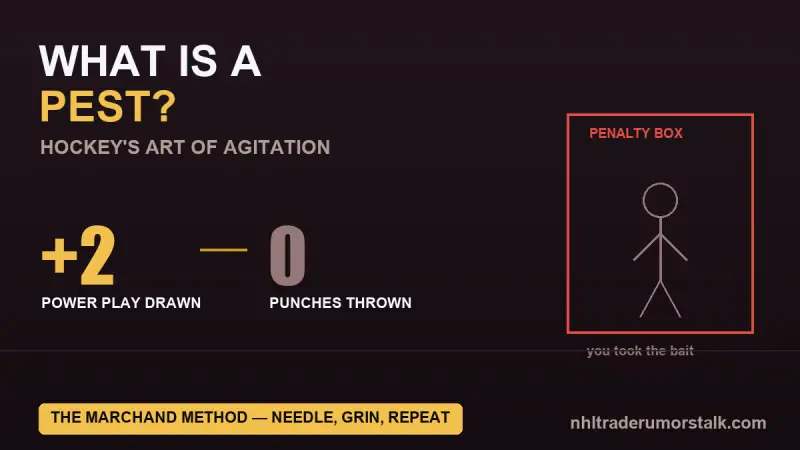
There is a particular grin you only see in hockey. It belongs to the player skating away from a scrum while his victim sits steaming in the penalty box, having just taken a dumb retaliation penalty that will cost his team the next two minutes. The grin says: I did that, and you fell for it. That player is a pest in hockey, also called an agitator, and getting under your skin is not a personality flaw. It is the job. The best ever turned it into a craft we will call the Marchand Method.
A pest is one of the most misunderstood roles in the sport, constantly confused with the enforcer and dismissed as a goon. It is neither. Here is what a pest actually does, how the role differs from a fighter, the lineage that runs from the original Rat to a 100-point agitator, and the night a pest annoyed the league into writing a brand-new rule.
- The definition: a pest antagonizes opponents to draw penalties and knock them off their game, usually without fighting.
- The key distinction: an enforcer fights and protects; a pest needles and then avoids the fight.
- The toolbox: chirping, face-washing, slashing when the referee is not looking, and goading stars into retaliating.
- The modern truth: the best pests today are top-six scorers, not fourth-line goons.
What a pest actually is
A pest, or agitator, is a player whose purpose is to antagonize. He chirps, he face-washes (a glove shoved in an opponent's face), he slashes and hooks in the half-second the referee is screened, and above all he goads. The goal is twofold: draw the opponent into a retaliatory penalty that hands his team a power play, and rattle a star badly enough that he stops thinking about scoring. The terms pest and agitator mean the same thing. A "rat" is the same role with the dial turned up, a pest willing to cross the line the rest only flirt with.
Crucially, the pest does all this without necessarily fighting. When the giant defenseman he just face-washed wants to drop the gloves, the classic pest turtles, covers up, and takes the instigator to the box with him. That single instinct, picking the fight and then refusing it, is what separates the role from the one it is forever mistaken for.
Pest vs enforcer vs rat
The enforcer is the opposite player. His job is to fight, to answer dirty hits, and to physically protect his stars, the reason fighting remains a permitted penalty in the first place. He wants to drop the gloves. The pest wants you to take a penalty trying to make him.
| Role | Main job | Wants to fight? |
|---|---|---|
| Pest / agitator | Draw penalties, irritate stars off their game | No, often turtles to draw the instigator |
| Enforcer | Fight, answer dirty play, protect teammates | Yes, by design |
| Rat | A pest who will cross the line others won't | Rarely, baits and backs off |
This is the most common error fans and even broadcasters make. Brad Marchand and Matthew Tkachuk are pests, not enforcers. Tom Wilson and Brady Tkachuk, by contrast, are power forwards who pest on the side, big bodies who hit and score and will actually fight, which makes them a different animal from the finesse agitator. Calling a 218-pound, 30-goal hitter a "pure pest" is a category error, the inverse of mistaking a needler for a goon, the way an errant high stick is a different crime from a clean check.
The original Rat
Every great pest is measured against the first one. Ken Linseman, a slippery center for the Flyers, Oilers, Bruins and Maple Leafs from 1978 to 1992, was "The Rat," a nickname pinned on him for both his appearance and his low, scurrying skating stride, and earned for a genius at baiting opponents into stupid penalties. He won a Cup with the 1984 Oilers and made an art of the foul he never took himself.
Decades later the title was handed down, almost literally, to the next great Boston pest. Brad Marchand inherited "The Rat" from Linseman, and the older man gave the comparison his blessing:
There have been so many times since my career ended where I've heard people being compared to me. But he's probably the first one that plays closest to me that also has really good skills.
Those three words, "really good skills," trace the whole evolution of the role: the fourth-line nuisance grew up into a scorer.
The Marchand Method
Brad Marchand is the modern archetype, the "super-pest," because he proved the role could belong to an elite player. Listed at five foot nine and 180 pounds, he built an agitation game precisely because he had to claw his way into a league of bigger men. Then he scored 100 points in 2018-19. In a 2020 NHLPA player poll, his peers voted him the league's dirtiest player and, in a perfect summary of the craft, both the best and the worst trash-talker in hockey at the same time.
That's what I had to do to make the NHL. That was my role.
That is the Marchand Method in his own words: agitation as a survival skill, refined until it wins games. One myth deserves cleaning up, though. The nickname "Little Ball of Hate" did not start with Marchand. Broadcaster Glenn Healy hung it on Pat Verbeek back in 1995, a spin on Ray Ferraro's "Big Ball of Hate," and it only became Marchand's when President Obama revived it during Boston's 2012 White House visit. Marchand simply wore it better than anyone since.
His heir is Matthew Tkachuk, who married the same needle to genuine star scoring, and who explained the pest's logic with the cheerful ruthlessness the role demands:
If he doesn't want to get hit, then stay off the tracks.
The rule a pest wrote
The clearest proof that agitation is a real and powerful skill is that the NHL once changed its rulebook overnight to stop one act of it. On April 13, 2008, in a first-round playoff game, Rangers agitator Sean Avery stood directly in front of Devils goalie Martin Brodeur, turned his back to the play, and waved his stick and arms in the goaltender's face to screen and distract him. It was perfectly legal. Avery was not penalized, and he scored on the same power play. Brodeur, the most accomplished goalie alive, was almost speechless:
I've played for 15 years in this league. I've been watching games for 33 years. I had never seen that in my life.
The league had not seen it either. The very next day, NHL Director of Hockey Operations Colin Campbell issued an interpretation of the existing unsportsmanlike-conduct rule making that kind of goalie-screening an immediate two-minute minor. It is unofficially called the "Avery Rule," though it was never a brand-new rule, just a hasty patch to the code around the crease. Avery, fittingly, led the NHL in penalty minutes twice. He is also, not coincidentally, the same Brodeur-tormentor whose era produced the trapezoid behind the net: that goaltender attracted rule changes the way a porch light attracts moths.
Why the pest survived when the enforcer died
Here is the twist that confuses people. The old-school fighter is nearly extinct. Fights fell from roughly 1.3 a game in the late 1980s to about 0.5 by 2012, gutted by the post-lockout speed of the game, the instigator rule, the salary cap, and a hard new understanding of brain trauma. The pure goon priced himself out of the league.
The pest did the opposite. It evolved. Because agitation is mental rather than violent, it grafted neatly onto skill, and the modern roster is full of scorers who irritate: Marchand, Matthew Tkachuk, Sam Bennett, Brendan Gallagher, Nazem Kadri, Travis Konecny. The Florida Panthers won championships with Tkachuk and Bennett doing exactly this, and the family business runs deep, as anyone who watched the Tkachuk brothers go to war with Toronto or followed Brady Tkachuk's move to Florida can attest. Embellishment, the dive to sell a call, got reined in by Rule 64 and its fines, but the core of the role only got more valuable.
The Marchand Method endures
The enforcer fought because the rules let him. The pest annoys because the rules cannot quite stop him. One role kept hockey honest with its fists; the other keeps it honest by exposing every opponent who lacks the discipline to ignore a grin. That is the Marchand Method: turning the other team's temper into your power play, a skill the league has tried to legislate against for fifty years and never managed to kill. The next time a star takes a needless penalty and a small man skates away smiling, you are not watching a goon. You are watching the hardest-working irritant in sports do his job perfectly.
How we checked this: role definitions and the pest-versus-enforcer distinction are drawn from established hockey references; the Linseman, Marchand, Matthew Tkachuk and Brodeur quotes are verified word-for-word at Yahoo Sports, Sports Illustrated and ESPN; the Avery Rule details (April 13, 2008 game, interpretation issued the next day by Colin Campbell, now part of Rule 75) and the fighting-decline figures are verified against ESPN and league records.
Frequently Asked Questions
What is a pest or agitator in hockey?
A pest (used interchangeably with "agitator") is a player whose job is to antagonize opponents, through chirping, face-washing, slashing when the referee is screened, and goading stars into retaliating, in order to draw penalties and knock opponents off their game. The modern "super-pest," like Brad Marchand or Matthew Tkachuk, adds real scoring on top of the agitation.
What is the difference between a pest and an enforcer?
An enforcer's job is to fight and physically protect teammates by answering dirty play. A pest does the opposite: he needles opponents into taking penalties and then often "turtles" to avoid the fight he provoked. As Wikipedia puts it, enforcers are different from pests, players who seek to agitate opponents without necessarily fighting them.
Who was the original "Rat" in hockey?
Ken Linseman, a center who played 15 NHL seasons (1978-1992) for the Flyers, Oilers, Bruins and Maple Leafs and won a Cup with the 1984 Oilers, was the original "The Rat." The nickname referenced both his appearance and his low, scurrying skating stride. Brad Marchand later inherited the nickname as the next great Boston agitator.
What is the "Avery Rule"?
On April 13, 2008, Rangers agitator Sean Avery stood in front of Devils goalie Martin Brodeur with his back to the play and waved his stick and arms to screen and distract him. It was legal at the time and Avery was not penalized. The next day, NHL Director of Hockey Operations Colin Campbell issued an interpretation of the unsportsmanlike-conduct rule (now Rule 75) making such face-screening a two-minute minor. "Avery Rule" is an unofficial nickname, not a new standalone rule.
Does the pest role still matter in today's NHL?
Yes, arguably more than ever, even as the old fighting "enforcer" has nearly disappeared. The role evolved: because agitation is mental rather than violent, it grafted onto skill, and today's most effective pests are top-six scorers like Brad Marchand, Matthew Tkachuk and Sam Bennett who can both score and irritate.
Related Stories

What Is a Healthy Scratch in Hockey?
What is a healthy scratch in hockey? A fully fit player the coach leaves out of the lineup, watching from the press box in a suit, not injur...
By Mike Johnson · 8 min read
What Is the Trapezoid in Hockey?
What is the trapezoid in hockey? The restricted area behind the net where the goalie may play the puck, and the only line on the rink drawn...
By Mike Johnson · 7 min read

What Is a Hat Trick in Hockey?
What is a hat trick in hockey? Three goals by one player in a single game. But the name came from 1858 cricket, the tradition from a 1946 To...
By Mike Johnson · 8 min read

Tallest, Biggest and Heaviest NHL Players
The tallest, biggest, heaviest and smallest NHL players, verified all-time and for 2026: Chara's unbeaten 6-foot-9 ceiling, the contested 26...
By Mike Johnson · 10 min read
Comments
Be the first to share your take.
Get NHL trade rumors in your inbox
One email per week, zero spam, verified rumors only.