What Is GAA in Hockey?
What is GAA in hockey? Goals against average is goals per 60 minutes, the oldest goalie stat and the most misleading. How it is calculated, what it secretly excludes, why a great goalie can post an ugly one, and the 0.92 record that cannot fall.
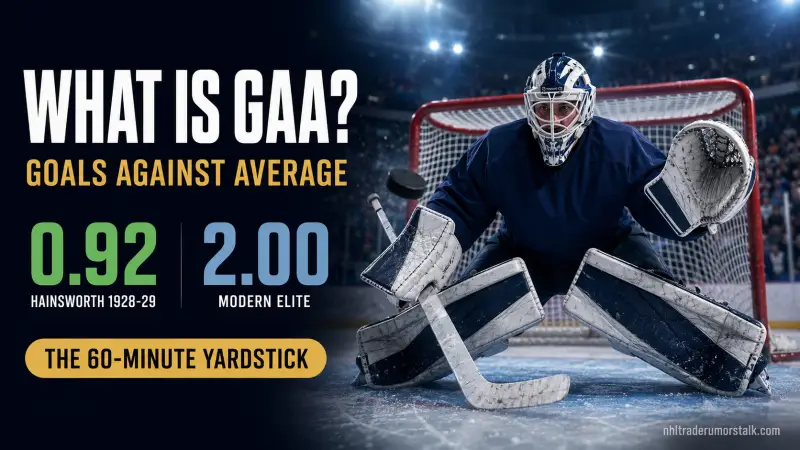
0.92. That is the lowest goals against average any NHL goalie has ever posted over a full season, set by George Hainsworth in 1928-29, and almost a century later nobody has come close. It is also the perfect trap, because GAA is the oldest and most-quoted goalie number in hockey, and it is the one that quietly lies to you. GAA in hockey measures goals per sixty minutes, a clean little number we will call the 60-Minute Yardstick, and the catch is that it grades the five skaters in front of the goalie almost as much as the goalie himself.
Goals against average is simple to compute and easy to misread. It answers one question, how many goals a goalie surrenders per full game of ice time, and then leaves out everything about how hard those goals were to stop. Here is exactly what GAA is, what it secretly excludes, why a great goalie can post an ugly one, and the record that will almost certainly never fall.
- The formula: goals against times 60, divided by minutes played, the goals a goalie allows per full game.
- The benchmark: under 2.50 is very good, under 2.00 over a full season is excellent.
- The catch: GAA depends on the team in front of the goalie, not just the goalie.
- The record: Hainsworth's 0.92 in 1928-29 is an artifact of a vanished era and is effectively unbreakable.
What GAA in hockey actually measures
The math is grade-school. Take the goals a goalie allows, multiply by 60, and divide by the minutes he played. A goalie who gives up 2 goals over a full 60-minute game has a 2.00 GAA. Give up 2 goals but only play 40 minutes and the rate climbs to 3.00, because GAA is a rate per sixty minutes, not a raw count. That is the whole 60-Minute Yardstick: it puts every goalie on the same per-game scale no matter how much they played.
What surprises people is what the number leaves out. Overtime counts, both the minutes and any goal. But two kinds of goals never touch a goalie's GAA at all.
Empty-net and shootout goals are not counted in a goaltender's goals against average; overtime goals and ice time are. (NHL scoring rules, goals against average)
The empty-net exclusion is the fair one: when a coach pulls the goalie for an extra attacker, the goalie is on the bench, so a goal into the open net is not his to wear. Shootout goals do not count either, because the shootout is a tiebreaker, not part of the run of play. So the 60-Minute Yardstick only measures what happens while the goalie is actually in his net, which sounds airtight until you realize what it still cannot separate.
Why GAA grades the team, not just the goalie
Here is the lie. GAA cannot tell the difference between a goalie and the team bleeding shots in front of him. Put an elite goalie behind a leaky defense that surrenders 38 high-danger chances a night and his GAA will look mediocre, even if he is the only reason the score is not 7-2. Put an average goalie behind a smothering checking team and his GAA will sparkle. The number rewards the sweater, not always the save.
That is why GAA has a smarter cousin: save percentage. Save percentage divides saves by shots faced, so it grades a goalie per shot instead of per game, and it cares a lot less about how many shots the team allows. An elite save percentage sits at .915 or higher. The two numbers usually agree, but when they fight, trust the save percentage, the same way you would trust a skater's underlying play over a raw plus-minus number that swings on his linemates.
The newest layer goes further still. Goals saved above expected, or GSAx, weighs the quality of every shot, so stopping a point-blank chance counts for more than a routine save from the boards. It is the stat that finally isolates the goalie from his defense. Think of the position itself, the most specialized job in the six on the ice, defended inside the crease and out to the trapezoid, and you see why one blunt number was never going to capture all of it.
| Figure | What it represents |
|---|---|
| 0.92 | George Hainsworth, 1928-29, the lowest single-season GAA in NHL history |
| 2.00 | The modern bar: a GAA under 2.00 over a full season is considered excellent |
Both numbers are measured on the same yardstick, yet they describe two different sports almost a hundred years apart, which is the whole story of why the record below cannot fall.
The GAA record that cannot fall
Hainsworth's 0.92 in 1928-29 came with 22 shutouts in a 44-game season for the Montreal Canadiens. Read that again: he shut out the opponent in half his starts. The catch is the era. Forward passing in the offensive zone was barely legal yet, scoring was strangled, and the league changed the passing rules the very next season, which sent goals soaring overnight. Hainsworth's record is not a goaltending feat you can chase so much as a fossil from a game that no longer exists.
That is why every modern goalie is really chasing 2.00, not 0.92. A sub-2.00 season today, against a league built to score, is the real-world ceiling of the 60-Minute Yardstick. The number on the page is the same; the world it is measured in is not.
From a GAA trophy to best goalie
For most of NHL history, GAA was not just a stat, it was an award. The Vezina Trophy originally went to the goalie or goalies on the team that allowed the fewest goals, which made it essentially a GAA prize. That changed in 1981-82. The Vezina became a vote by general managers for the best goalie overall, and a new award, the Jennings Trophy, took over the old job of honoring the fewest goals against. The league had effectively admitted that the lowest GAA and the best goalie are not always the same name, which is the entire argument of this article in trophy form.
You can still see it every spring in the Vezina race and in how teams pay for goaltending: a strong GAA helps a goalie's case and his next contract, like the deals at the heart of the goalie market, but no smart front office stops at the surface number. They check the save percentage, the workload, and how much of that shiny GAA was really the team. A goalie grinding through a brutal penalty kill all night will carry a worse GAA than one who never sees a 5-on-3, and the rate alone will never tell you which had the harder job, the same blind spot the goalie-interference debates expose about judging a crease from the box score.
The 60-Minute Yardstick, read right
GAA is the first goalie number you learn and the last one you should trust on its own. It is a clean rate, goals per sixty minutes, and as a quick gut-check it works fine: under 2.50 is good, under 2.00 is excellent, and 0.92 belongs to a dead era. But the moment it matters, who is actually the better goalie, the 60-Minute Yardstick hands the question to save percentage and GSAx and steps back. So quote GAA all you want at the bar. Just remember it is measuring the team as much as the man, and the next time a goalie's average looks ugly, ask how many shots he was facing before you blame him.
How we checked this: the GAA formula and its empty-net and shootout exclusions (overtime included) are verified against the published NHL scoring rules and the goals-against-average definition; the all-time single-season record (George Hainsworth, 0.92 GAA, 22 shutouts, 1928-29 Montreal Canadiens) is verified against Hockey-Reference and Hall of Fame records; the Vezina-to-Jennings change (1981-82) is verified against NHL trophy history.
Frequently Asked Questions
What is GAA in hockey?
GAA stands for goals against average, the number of goals a goaltender allows per 60 minutes of ice time. It is the oldest and most-quoted goalie statistic, calculated as goals against times 60, divided by minutes played. A lower GAA is better.
How is GAA calculated?
Multiply a goalie's total goals against by 60, then divide by the minutes he played. Overtime goals and minutes count toward the total, but empty-net goals (scored while the goalie is pulled) and shootout goals are excluded, because the goalie is not in net for either.
What is a good GAA in hockey?
In the modern NHL, a GAA under 2.50 is considered very good and a GAA under 2.00 over a full season is excellent. League average sits higher, and the figure shifts with the era and how many shots a goalie's team allows.
Is GAA or save percentage the better goalie stat?
Save percentage is usually more telling because it grades a goalie per shot faced, while GAA depends heavily on how many shots and chances the team in front allows. Modern analysts go further with goals saved above expected (GSAx), which also weighs shot quality.
What is the lowest GAA in NHL history?
George Hainsworth posted a 0.92 GAA for the Montreal Canadiens in 1928-29, with 22 shutouts in 44 games. It is the lowest single-season GAA ever and is effectively unbreakable, set in a low-scoring era before forward passing in the offensive zone opened up the game.
Related Stories

Hockey Positions Explained
Hockey positions explained: six players per side, five skaters and a goalie. What the center, wingers, defensemen, and goalie each do, how l...
By Mike Johnson · 6 min read

What Is a Penalty Kill in Hockey?
What is a penalty kill in hockey? The short-handed team's stand against the power play, four against five. The rules that help the underdog...
By Mike Johnson · 7 min read

What Is a Pest in Hockey?
What is a pest in hockey? An agitator who chirps and goads stars into dumb penalties, usually without fighting. How a pest differs from an e...
By Mike Johnson · 8 min read

What Is a Healthy Scratch in Hockey?
What is a healthy scratch in hockey? A fully fit player the coach leaves out of the lineup, watching from the press box in a suit, not injur...
By Mike Johnson · 8 min read
Comments
Be the first to share your take.
Get NHL trade rumors in your inbox
One email per week, zero spam, verified rumors only.