What Is the Trapezoid in Hockey?
What is the trapezoid in hockey? The restricted area behind the net where the goalie may play the puck, and the only line on the rink drawn to stop one man. The dimensions, the delay-of-game penalty, the Brodeur Rule origin, and the NCAA's 2026 adoption.
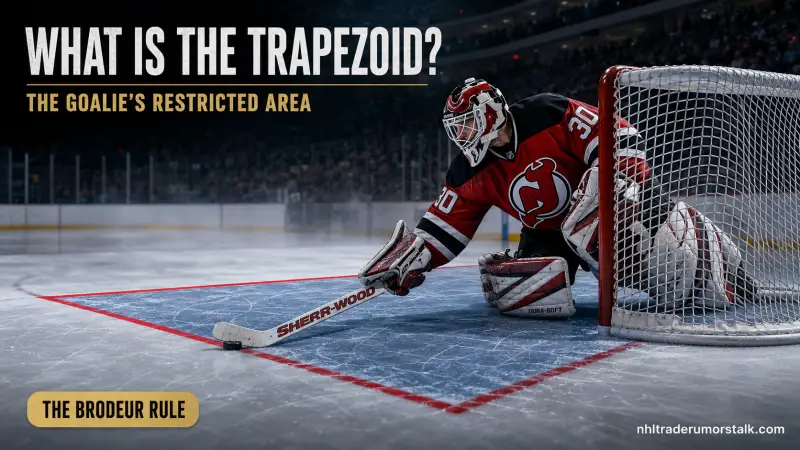
Watch a goaltender skate behind his own net to corral a dump-in, and you will see him stop short of the corner like a dog hitting the end of a leash. He is not being cautious. He is obeying a line painted on the ice for one reason: the league decided a goalie was too good at his job. That painted shape is the trapezoid in hockey, the restricted area behind the goal line, and we call it the Brodeur Boundary for a reason.
To the casual eye it is a faint red outline most fans never think about. To anyone who studies the game, it is the only marking on an NHL rink drawn to neutralize a single player. This is what it is, where the lines actually run, the penalty for crossing them, and why a 21-year-old rule is about to redraw college hockey too.
- The short version: a goalie may handle the puck behind the goal line only inside the trapezoid; touch it in the corners and his team takes a two-minute penalty.
- The point of it: it was added after the 2004-05 lockout to blunt puck-handling goalies who functioned as a third defenseman and killed the dump-and-chase.
- The nickname: goalies call it the Brodeur Rule, after the man it was built to slow down.
- The 2026 twist: the NCAA approved an NHL-style trapezoid for Division I men's hockey starting in 2026-27.
What the trapezoid actually is
The trapezoid is a four-sided zone centered behind the net, marked on the ice by a two-inch red line. Its two parallel edges are the goal line and the end boards, and it fans outward from the narrower goal-line edge to the wider edge at the boards. Inside that shape, a goaltender can play the puck freely. The instant he plays it behind the goal line but outside the trapezoid, in either corner, it is an infraction.
Here is the part people get backwards. The rule does not say a goalie cannot play the puck behind his net. He absolutely can, and he does it constantly. The restriction applies only to the two corners, the dead zones the trapezoid deliberately leaves out. A goalie who races to the corner to beat a forechecker is exactly the behavior the line was drawn to stop. This is also why the painted crease in front of the net and the trapezoid behind it are often confused, even though they govern opposite ends of the goalie's territory.
The exact lines (where they run)
The geometry is precise, and the single most common error is mixing up the two parallel edges. The goal-line edge is the narrow one. The end-boards edge is the wide one. The NHL widened the shape in 2014, so the current numbers differ from the original 2005 version.
| Edge of the trapezoid | Original (2005-06) | Current (since 2014-15) |
|---|---|---|
| Base along the goal line | 18 ft | 22 ft |
| Base along the end boards | 28 ft | 28 ft (unchanged) |
| Depth (goal line to boards) | 11 ft | 11 ft (unchanged) |
| Where the lines start from each post | 6 ft | 8 ft |
The goal posts sit six feet apart, so when the lines begin eight feet out from each post, the goal-line base measures 22 feet across. The official rulebook language is blunt about it:
A goalkeeper shall not play the puck outside of the designated area behind the net. This area shall be defined by lines that begin six feet from either goal post and extend diagonally to points twenty-eight feet apart at the end boards.
That text predates the 2014 widening, which moved the start point to eight feet, but the structure is what matters: a narrow base at the goal line, a wide base at the boards, the corners carved off.
The Brodeur Boundary: why it exists
For most of hockey history a goalie who left his crease to handle the puck was a novelty. Then Martin Brodeur turned it into a weapon. The New Jersey Devils goaltender read dump-ins like a fourth skater, sprinting behind the net to intercept the puck and snap a breakout pass before the forecheck could arrive. A team that tried to grind it out with dump-and-chase found Brodeur had already cleared the zone. Marty Turco did the same in Dallas, and Ron Hextall had pioneered the puck-moving style before either of them.
The league's answer, after the 2004-05 lockout wiped out a season, was geometry. If goalies could not be stopped from handling the puck, the rink would simply make the most valuable real estate off-limits. His own longtime teammate Ken Daneyko later told NHL.com exactly what happened:
His puck-handling ability almost made him like a third defenseman and they ended up making a rule for Marty because he was too good at it.
That is the whole story of the Brodeur Boundary in one sentence. The rule was tested in the AHL during 2004-05 before the NHL adopted it for 2005-06, part of the same post-lockout package that brought in the shootout and tighter obstruction rules to revive scoring. It sits in the same family of goalie-specific rules as goalie interference under Rule 69, each one drawing a hard edge around what happens near the crease.
The penalty for crossing the line
Handle the puck in the forbidden corner and the call is a two-minute minor for delay of game. Because the goaltender stays in his net, a teammate serves the penalty, and the offending team kills two minutes a man down. In a tight game that hands the opponent a power play for nothing more than a goalie's old habit, which is precisely why netminders now pull up at the edge of the trapezoid as if there were a wall there. A single careless touch can swing a period, the same way an offside or icing whistle can erase a scoring chance in the other direction.
The 2014 widening
The first version of the trapezoid was narrow enough that goalies and coaches complained it created dangerous puck battles in the corners, where defensemen now had to retrieve everything with forecheckers bearing down. So for 2014-15 the NHL pushed the goal-line base out by two feet on each side of the net, expanding the legal area from 253 square feet to 275, a gain of 22 square feet. It did not undo the rule. It just gave the goalie a little more room to help his defense without erasing the corners entirely.
| Era | Legal play area behind the net |
|---|---|
| 2005-06 to 2013-14 | 253 sq ft |
| 2014-15 to today | 275 sq ft (+22) |
2026: the trapezoid goes to college
For two decades the trapezoid was an NHL signature. That is changing. In May 2026 the NCAA Division I Men's Ice Hockey Rules Subcommittee approved adopting an NHL-style trapezoid for the 2026-27 season, pending final ratification, with Division III set to follow in 2027-28. It arrives alongside other moves to align college hockey with the pro game, including allowing hand passes in the defensive zone.
The significance is quiet but real: a shape invented to cage one Hall of Fame goaltender is now spreading to the level that feeds the NHL Draft. Today's college goalies, many of whom will turn pro inside a few years, will learn the boundary before they ever reach an NHL crease. The men chasing those jobs on the goalie free-agent market already live inside it.
The Brodeur Boundary endures
Most rules in hockey are written against a behavior. The trapezoid was written against a person. Brodeur retired in 2015 as the winningest goaltender in NHL history, and the line built to slow him down outlived his career, survived a widening, and is now migrating to college rinks. Every time a modern goalie freezes at the corner instead of making the smart play his instincts beg for, he is paying a small tax on someone else's greatness. That is the Brodeur Boundary, and it is the closest the rulebook has ever come to a compliment. Even a casual fan tracking a full game's worth of stoppages will now know why the goalie stops at that faint red line.
How we checked this: dimensions and rule language are drawn from the NHL Official Rules and corroborated against the NHL rules reference; the Brodeur attribution and Ken Daneyko quote are verified word-for-word at NHL.com; the 2026 NCAA adoption is sourced to the NCAA's May 21, 2026 announcement and College Hockey News.
Frequently Asked Questions
What is the trapezoid in hockey?
The trapezoid is the restricted area marked behind each net where the goaltender is allowed to play the puck. It is a four-sided red outline, narrower at the goal line and wider at the end boards. A goalie may handle the puck inside it, but if he plays the puck behind the goal line in either corner (outside the trapezoid), his team is assessed a two-minute minor for delay of game.
Why is it called the Brodeur Rule?
The rule is nicknamed after New Jersey Devils goaltender Martin Brodeur, an elite puck-handler who acted as a third defenseman, racing behind his net to intercept dump-ins and start breakouts. The NHL added the trapezoid after the 2004-05 lockout largely to neutralize goalies like Brodeur (and Dallas's Marty Turco) who were killing the dump-and-chase. As teammate Ken Daneyko put it, "they ended up making a rule for Marty because he was too good at it."
What happens if a goalie plays the puck outside the trapezoid?
It is a two-minute minor penalty for delay of game. Because the goaltender stays in his net, a teammate serves the penalty, and the team plays two minutes shorthanded. The restriction applies only behind the goal line and only in the corners outside the trapezoid; a goalie can still play the puck freely inside the trapezoid and anywhere in front of the goal line.
What are the dimensions of the NHL trapezoid?
Since 2014-15, the base along the goal line measures 22 feet, the base along the end boards measures 28 feet, and the depth from the goal line to the boards is 11 feet, marked by a two-inch red line. The lines begin eight feet from each goal post. The original 2005 version was narrower, with an 18-foot goal-line base and lines starting six feet from each post.
Is college hockey getting the trapezoid?
Yes. In May 2026 the NCAA Division I Men's Ice Hockey Rules Subcommittee approved adopting an NHL-style trapezoid for the 2026-27 season, pending final ratification, with Division III set to follow in 2027-28. It is part of a broader push to align college hockey with NHL rules.
Related Stories
What Is a Pest in Hockey?
What is a pest in hockey? An agitator who chirps and goads stars into dumb penalties, usually without fighting. How a pest differs from an e...
By Mike Johnson · 8 min read

What Is a Healthy Scratch in Hockey?
What is a healthy scratch in hockey? A fully fit player the coach leaves out of the lineup, watching from the press box in a suit, not injur...
By Mike Johnson · 8 min read

What Is a Hat Trick in Hockey?
What is a hat trick in hockey? Three goals by one player in a single game. But the name came from 1858 cricket, the tradition from a 1946 To...
By Mike Johnson · 8 min read

Tallest, Biggest and Heaviest NHL Players
The tallest, biggest, heaviest and smallest NHL players, verified all-time and for 2026: Chara's unbeaten 6-foot-9 ceiling, the contested 26...
By Mike Johnson · 10 min read
Comments
Be the first to share your take.
Get NHL trade rumors in your inbox
One email per week, zero spam, verified rumors only.