What Does the C on a Hockey Jersey Mean?
What does the C on a hockey jersey mean? Plain-English guide to NHL Rule 6: the three-inch captain's letter, the alternate A, the one rulebook privilege it grants, why no goalie can wear it (the 1948 Durnan Rule), and the Yzerman / Crosby 19-season record.

Steve Yzerman wore Detroit's C for 19 seasons. He retired with it stitched onto the corner of his banner in the rafters, the only credential a captain truly takes with him. Down the road in Pittsburgh, Sidney Crosby is matching that 19-year mark in 2025-26, his C the longest unbroken thread in a Penguins room that has cycled coaches, GMs, even Mario Lemieux himself. A single white letter, roughly three inches tall, has carried more weight in this league than almost any trophy. So what does the C on a hockey jersey actually mean, what does the rulebook grant the player who wears it, and why has no goalie been allowed to since 1948? Here is the answer through one idea: The Three-Inch Title.
The captaincy in hockey predates the letter by decades. The Montreal Canadiens named Jack Laviolette their first captain in 1909-10. The NHL only standardized the on-jersey letter for the 1947-48 season, and the rule that did it has changed remarkably little since. Today it lives in NHL Rule 6.
| Figure | What it represents |
|---|---|
| 3 inches | The minimum height of the captain's C on the front of the sweater under NHL Rule 6, in contrasting color, conspicuously placed, and unchanged since 1947-48 |
| 19 seasons | The longest captaincy in NHL history: Steve Yzerman wore Detroit's C for 19 seasons (1986-87 to 2005-06, 1,303 games); Sidney Crosby matches that 19-season mark for Pittsburgh in 2025-26 |
One number is the formal specification of the credential; the other shows just how long one player can carry it.
Key Takeaways
- What it is: the C designates the team captain under NHL Rule 6; the A designates an alternate captain, and a team may have one captain and up to two alternates (or three alternates and no captain).
- The privilege: only the captain (or an alternate when the captain is off the ice) may discuss rule interpretations with the referee, and only when the referee invites the discussion.
- The Three-Inch Title: Rule 6 sets the letter at roughly three inches, contrasting color, conspicuous placement on the front of the sweater.
- No goalies allowed: the 1948-49 Durnan Rule bars goaltenders from exercising captain or alternate-captain privileges on the ice, and it remains in force today.
- The record: Yzerman wore Detroit's C for 19 seasons; Crosby matches the mark for Pittsburgh in 2025-26.
What the C on a Hockey Jersey Actually Means
NHL Rule 6 covers Captain and Alternate Captains. Each team may designate one captain and up to two alternates. If a team chooses not to name a captain at all, it may designate three alternates instead, which is exactly what some clubs do during transitional seasons. The C goes on the captain's sweater; the A goes on each alternate's. The size and placement specification has not budged in three quarters of a century.
The captaincy itself is older than the letter. The Montreal Canadiens picked their first captain in 1909-10. Through the next four decades, who wore the title was a clubhouse matter, with no jersey marker required. The 1947-48 standardization formalized it because referees and officials wanted a single, visible point of contact on the ice. That practical need is the whole reason the rulebook treats the C as a credential rather than an honorific.
The Privilege the Rulebook Grants
Only the captain, or an alternate when the captain is not on the ice, has the privilege of discussing rule interpretations with the referee. The rulebook scopes this further: the discussion happens when the referee invites it. Any player can be spoken to by an official, but only the captain has the formal channel for questioning a call. That is the entire content of the on-ice credential.
The credential matters more than fans usually realize. A coach cannot enter the ice to argue. A non-captain who keeps barking at the referee can draw a misconduct. The captain is the team's designated representative, and the C is how every official on the ice knows, at a glance, who that is. Our penalty-minutes guide shows how quickly an unauthorized argument escalates on the scoresheet.
Why No Goalie Can Wear It: the 1948 Durnan Rule
The most famous quirk in the whole rule traces back to one goaltender. Bill Durnan was named the Canadiens' captain for the second half of 1947-48 after Toe Blake's career-ending injury. Durnan was a Hall-of-Fame goalie, and he also turned out to be a relentless arguer with referees. He left his crease repeatedly to argue calls, slowing the game and infuriating officials. The NHL responded for 1948-49 with a one-sentence amendment that has lasted ever since: no goalkeeper shall be entitled to exercise the privileges of captain or alternate captain on the ice.
Durnan was the sixth and final goalie to wear a C on his sweater in NHL history. The other five were John Ross Roach (Toronto, 1924-25), George Hainsworth (Montreal, 1932-33), Roy Worters (NY Americans, 1932-33), Alex Connell (Ottawa, 1932-33), and Charlie Gardiner (Chicago, 1933-34). The 1948 rule did not erase the past; it closed the door on any goalie joining the list. Decades later, Roberto Luongo was named Vancouver's captain for 2008-09 and 2009-10, but defenseman Willie Mitchell served as the on-ice captain because the Durnan Rule still applied. Luongo's C was a ceremonial exception, not a Rule 6 one.
Irvin gave me a little more responsibility than most goaltenders by naming me captain. I looked a little stupid if there was a bad call against us — me with all those pads and the big stick, chasing after the referee.
— Bill Durnan, Montreal Canadiens goaltender and last NHL goalie to wear a captain's C, NHL.com
The 19-Season Captaincies: Yzerman and Crosby
Length of service is where the credential becomes legacy. Steve Yzerman captained the Detroit Red Wings for 19 seasons across 20 calendar years, from 1986-87 to 2005-06 and 1,303 games, the longest captaincy in NHL history and the longest in any major North American pro sport. Yzerman's tenure outlasted three head coaches and helped deliver three Stanley Cups. The C on his retired-number banner in Detroit is a permanent reminder of what the letter can mean.
Sidney Crosby matches that 19-season mark for Pittsburgh in 2025-26, his 19th year wearing the Penguins' C since he was named captain on May 31, 2007. At the time, Crosby was the youngest captain in league history at 19 years, 9 months and 24 days. Connor McDavid is the youngest ever, named in October 2016 at 19 years, 266 days, after Gabriel Landeskog had also dipped below Crosby's mark in 2012. Alexander Ovechkin is entering his 17th season wearing Washington's C, the third-longest active tenure behind Crosby.
As a young player, especially then, it wasn't that common for guys to get letters at a young age. It's a lot of responsibility, and it's an honor.
— Sidney Crosby, Pittsburgh Penguins captain, on receiving an A as a rookie, DK Pittsburgh Sports
The C also sits inside the larger fabric of how hockey teams are built and judged. The same rulebook decides icing, offside, the power play, fighting, the crease, overtime, and how standings shake out, and the captain is the player formally tasked with carrying every one of those conversations on his team's behalf.
Written by Mike Johnson, NHL Senior Editor, with 15 years covering the league. The Rule 6 mechanics, the 1947-48 letter standardization, the 1948-49 Durnan Rule, the six-goalie historical list, the Luongo ceremonial exception and the Yzerman / Crosby tenure records were checked against the NHL Official Rulebook, NHL.com archives, The Hockey News and Wikipedia's captain-of-ice-hockey entry. Both quotes were traced verbatim to NHL.com and DK Pittsburgh Sports with inline links. The Three-Inch Title is my framework for the on-ice credential, introduced in this piece. Published June 24, 2026. Editorial review and fact-check: Sarah Chen, Hockey Operations Editor. Corrections: editorial@nhltraderumorstalk.com.
Sources and Reporting
- NHL.com: Bill Durnan Hall-of-Fame career and the 1948-49 Durnan Rule
- The Hockey News: NHL captains entering 2025-26 (tenure rankings, current C-wearers)
- Captain (ice hockey), Wikipedia: full historical list of goalie-captains and Luongo ceremonial detail
- DK Pittsburgh Sports: Crosby on receiving an A as a rookie
The Verdict: The Three-Inch Title
Look back at the Yzerman banner in Detroit, the Crosby C entering its 19th winter in Pittsburgh, and the Durnan name still attached to the rule that closed the door behind him. None of those stories happens without three inches of stitched fabric on the front of a sweater. The Three-Inch Title is the quietest honor in hockey, a credential the league has been carefully formalizing since 1947-48, and the rare thing in this sport that gets heavier the longer a player carries it.
Frequently Asked Questions
What does the C on a hockey jersey mean?
The C designates the team captain under NHL Rule 6. It must be approximately three inches tall, in contrasting color, and placed conspicuously on the front of the sweater. Only the captain (or an alternate captain when the captain is off the ice) has the privilege of discussing rule interpretations with the referee, and only when the referee invites the discussion.
What is the difference between C and A on hockey jerseys?
C is the captain; A is an alternate captain. Each team may have one captain and up to two alternates. A team with no captain may instead designate three alternates. The captain has the formal on-ice privilege; alternates exercise that privilege only when the captain is not on the ice.
Why don't goalies wear the C anymore?
Because of the 1948-49 "Durnan Rule." Montreal goaltender Bill Durnan wore the C in 1947-48 and repeatedly left his crease to argue calls with referees, so the NHL passed a one-line rule: no goalkeeper shall be entitled to exercise the privileges of captain or alternate captain on the ice. The rule remains in force today. Roberto Luongo was named Vancouver's captain in 2008-09 and 2009-10, but as a ceremonial exception only; defenseman Willie Mitchell served as the on-ice captain.
Who has been NHL captain for the longest?
Steve Yzerman captained the Detroit Red Wings for 19 seasons (1986-87 to 2005-06) across 1,303 games, the longest captaincy in NHL history and the longest in any major North American professional sport. Sidney Crosby matches the 19-season mark for Pittsburgh in 2025-26.
When did the NHL start putting the C on jerseys?
For the 1947-48 NHL season. Captains existed long before that. The Montreal Canadiens named Jack Laviolette their first captain in 1909-10, but the on-jersey letter standardization at three inches, contrasting color, conspicuously placed on the front of the sweater dates to the 1947-48 season.
Related Stories

Gavin McKenna vs Connor Bedard
Gavin McKenna vs Connor Bedard: Bedard set the bar with 143 junior points and a Calder, but they are different players entirely. The honest...
By Mike Johnson · 7 min read

How Much Will Gavin McKenna Make?
How much will Gavin McKenna make? The projected No. 1 pick already earns a reported ~$700K in college NIL, but the NHL entry-level system ca...
By Mike Johnson · 8 min read
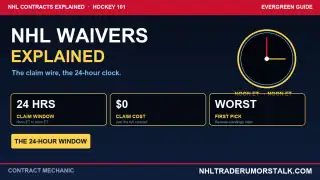
NHL Waivers Explained: The 24-Hour Window
NHL waivers explained: the 24-hour noon-to-noon ET claim window, why the worst team in the league claims first, the age-and-games exemption...
By Mike Johnson · 8 min read

NHL Entry-Level Slide Rule: The 9-Game Window
NHL entry-level slide rule explained: CBA Article 9.1(d), the 10-game cutoff (playoffs included), the September-to-December age trap, what s...
By Mike Johnson · 8 min read
Comments
Be the first to share your take.
Get NHL trade rumors in your inbox
One email per week, zero spam, verified rumors only.