NHL Waivers Explained: The 24-Hour Window
NHL waivers explained: the 24-hour noon-to-noon ET claim window, why the worst team in the league claims first, the age-and-games exemption table from CBA Article 13, and why a $0 claim still scares general managers across the league.
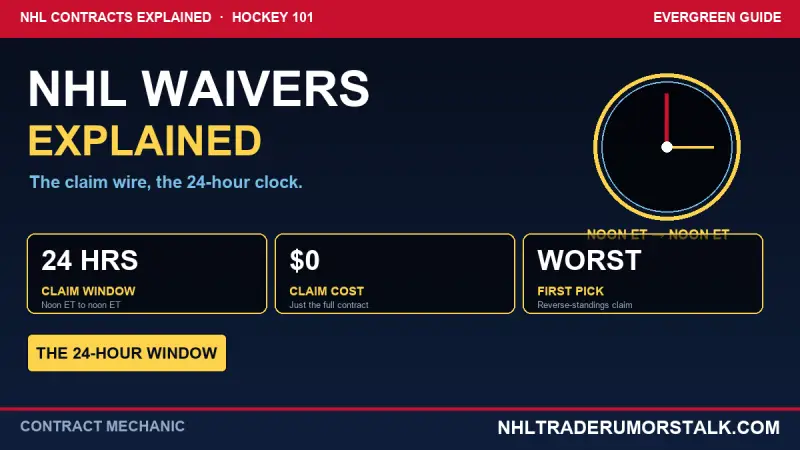
The phone call always comes around noon. A player learns his name went on the daily waiver list, and from that minute he has 24 hours of not really knowing where he lives anymore. Any of the other 31 NHL teams can take him for $0 in compensation, with the team currently in last place picking first. Most players quietly clear and report to the AHL. Some never do. Brandon Bussi, an undrafted 27-year-old goalie, sat on Florida's wire in October 2025 and woke up the next day a Carolina Hurricane on his way to a 31-win season. So what are NHL waivers and how do they actually work, who gets to skip the wire, and why does a claim that costs $0 still scare every GM in the room? Here is the rule through one idea: The 24-Hour Window.
Waivers are the one true tax on a long NHL career. They sit inside Article 13 of the Collective Bargaining Agreement, and they exist to stop teams from stockpiling proven NHL talent in the AHL beyond what the cap and roster math fairly allow. The mechanism is simple, the consequences are not.
| Figure | What it represents |
|---|---|
| 24 hours | The exact length of the claim window: the daily waiver list publishes at noon ET, and the other 31 teams have until noon ET the next day to submit a claim |
| 5 years OR 160 games | The waiver-exemption ceiling for a skater who first signs his Entry-Level Contract at age 18; exemption ends at whichever comes first (goalies signed at 18: 6 years OR 80 games) |
One number is how fast the claim window slams shut; the other is how long a young player gets to stay safely hidden before the wire matters.
Key Takeaways
- What it is: waivers are the 24-hour claim window required to demote most NHL players to the AHL; any of the other 31 teams can claim the player for $0 in compensation.
- The price: a claiming team assumes the existing contract in full (full salary, full cap hit) and must put the player on its active roster.
- Worst-first: claim priority runs in reverse standings order; the team with the lowest points percentage at the moment of the claim wins the player.
- Exemptions: a young player is exempt from waivers until he hits an age-and-games ceiling from the CBA Article 13 table.
- The boomerang: once a player has played 10 games or been on the active roster 30 days since clearing waivers, his team must re-waive him to send him down.
What NHL Waivers Actually Are
Waivers are the league's gatekeeping system for moving a player from the NHL roster down to the AHL. Article 13 of the CBA splits them into three types. Regular waivers are the standard kind: any non-exempt player loaned to the AHL during the Playing Season Waiver Period, which begins 12 days before opening night and runs through the regular season's end, must clear first. Unconditional waivers cover terminations and buyouts (the buyout window runs June 15-30). Re-entry waivers were eliminated when the CBA was ratified in January 2013, despite older blog posts still describing the half-salary recall mechanism that used to apply.
The list itself is published once a day at noon Eastern. Every NHL general manager and capologist sees the same names at the same moment, and the clock starts. Our salary-cap explainer walks through how a claimed contract immediately rewires the new team's cap math; the wire is the moment that math goes live.
How the 24-Hour Window Runs
From noon ET on day one to noon ET on day two, any of the other 31 teams can submit a claim. If multiple teams claim the same player, the team with the lowest points percentage at that moment wins. Before November 1, the previous season's final standings are used; starting November 1, the current standings take over. That is the part most fans miss: the bottom of the league actually holds the most sway in October because they get first dibs on anyone the contending clubs try to shuffle out.
When the window closes, two things can happen. If a player clears with no claims, his team can loan him to the AHL. If a player is claimed, the new team takes the existing contract as-is and puts him on the active roster. Players quietly clear all the time. Plenty get picked off the wire too. The most consequential claim of the 2025-26 season was Brandon Bussi, claimed by Carolina off Florida's wire in October, who went 31-6-2 with a .894 save percentage covering for the injured Pyotr Kochetkov.
Washington knows that it's going to be hard to sneak him through.
— Elliotte Friedman, Sportsnet insider, on Capitals goaltender Clay Stevenson's 2025 trip through waivers, Russian Machine Never Breaks
Who Skips the Waiver Wire
Not every player has to face the wire. CBA Article 13 sets an exemption table by signing age, and exemption ends at whichever ceiling comes first: a number of years, or a number of games played. A skater who first signs his Entry-Level Contract at age 18 is exempt for five years or 160 NHL games. At 19, the window is four years or 160 games. By age 25 or later, exemption is essentially one year or one game. Goaltenders get a wider window: a goalie signed at 18 is exempt for six years or 80 NHL games, scaling down with signing age. Our ELC slide-rule explainer covers the related 10-game cutoff that shapes the same young roster.
One important wrinkle: for players age 20 and older, all professional games count toward the games threshold, not only NHL games. AHL, KHL, SHL and Liiga games all accrue. The same is not true under 20, when only NHL games move the dial. And once a player has cleared waivers once, his new exemption from re-clearing expires when he has played 10 NHL games OR spent 30 days on the active roster since the last time he cleared. Hit either threshold and the team must re-waive him to send him down.
The $0 Cost That Still Scares GMs
A regular waiver claim costs the new team nothing in compensation. No draft pick, no cash, no future considerations. The claiming club simply assumes the existing contract in full and puts the player on its active roster. The $125 fee mentioned in CBA Article 13.16 is paid only on unconditional-waiver buyout claims, which is why it is essentially symbolic.
What scares general managers is everything that comes after the $0. A claimed player cannot be quietly demoted: if the new team later tries to send him to the AHL, he goes back through the wire again, exposing the same asset all over. That second pass deters most of the would-be moves. Teams place players on waivers for one reason above all others, and the cap-flexibility argument has been the standard explanation for two decades.
As with every decision we make regarding the operation of our team, we made this decision with the objective of increasing our odds of success. Part of the ingredients necessary for success in the NHL is team depth. In order to have team depth, you need to properly manage your cap space.
— Julien BriseBois, Tampa Bay Lightning General Manager, on placing Tyler Johnson and Luke Schenn on waivers, NHL.com
Waivers sit in the middle of the contract layer of the NHL. The same CBA decides how the salary cap works, how the entry-level slide rule preserves a contract year, how the draft feeds the pipeline, and the on-ice rulebook covering icing, offside, the power play and how standings tip the worst-first claim priority in October.
Written by Mike Johnson, NHL Senior Editor, with 15 years covering the league. The 24-hour claim window, the worst-first standings logic, the age-and-games exemption table, the 10-games-or-30-days re-clear threshold and the elimination of re-entry waivers in the January 2013 CBA were checked against the NHL.com Carolina Hurricanes Transaction Primer, Flames Nation's line-by-line CBA Article 13 read-through and Pro Hockey Rumors' 2025-26 claim retrospective. Both quotes were traced verbatim to NHL.com and the Russian Machine Never Breaks transcript of Elliotte Friedman's 32 Thoughts podcast. The 24-Hour Window is my framework for the claim mechanic, introduced in this piece. Published June 24, 2026. Editorial review and fact-check: Sarah Chen, Hockey Operations Editor. Corrections: editorial@nhltraderumorstalk.com.
Sources and Reporting
- NHL.com (Hurricanes Transaction Primer): noon-ET claim window, reverse-standings priority, re-clear thresholds
- NHL.com: Jan 12 2021 waiver wire (Perry, Tyler Johnson, Schenn) + BriseBois quote
- Flames Nation: CBA Article 13 walkthrough (exemption table, 12-day pre-season period, $125 fee)
- Pro Hockey Rumors: 2025-26 claim retrospective (Bussi, Glendening, Reinhardt)
The Verdict: The 24-Hour Window
A waiver day looks, from the outside, like just another transaction wire. From inside the locker room it is a phone that might ring, a city that might change, a family that might pack. The 24-Hour Window is the rule that makes a veteran replaceable and an unknown into a starter overnight, all without a single dollar changing hands. The league's smartest GMs respect it because they know how easily it can take a player from them, or hand them one they did not see coming.
Frequently Asked Questions
What are NHL waivers?
Waivers are the 24-hour claim window required to demote most NHL players to the AHL. The daily waiver list publishes at noon Eastern, and the other 31 NHL teams have until noon ET the next day to claim the player for $0 in compensation. A claiming team simply assumes the existing contract in full and puts the player on its active roster. Waivers are codified in CBA Article 13.
How does the NHL waiver claim priority work?
Claim priority runs in REVERSE standings order: the team with the lowest points percentage at the moment of the claim wins the player. Before November 1, the previous season's final standings are used; starting November 1, the current season's standings take over. So the worst team in the league actually has first dibs on anyone shuffled through the wire.
Does it cost a draft pick or money to claim a player off waivers?
No. A regular waiver claim costs the claiming team $0, with no draft pick, no cash, and no future considerations. The team simply assumes the player's existing contract in full and adds the player to its active roster. The $125 fee mentioned in CBA Article 13.16 applies only to unconditional-waiver buyout claims, and is paid by the claiming team.
When is a player exempt from waivers?
Until he hits an age-and-games ceiling from CBA Article 13. A skater who first signs his ELC at 18 is exempt for 5 years OR 160 NHL games, whichever comes first. At 19 it is 4 years or 160 games. By 25 or older, exemption is essentially 1 year or 1 game. Goalies signed at 18 get 6 years or 80 games. For players 20 and older, all professional games (AHL, KHL, SHL, Liiga) count toward the threshold.
Did the NHL get rid of re-entry waivers?
Yes. Re-entry waivers and their half-salary recall mechanism were eliminated in the CBA ratified in January 2013. Older articles still describe them, but they have not applied for over a decade. The three current waiver types are regular waivers (for demotion to the AHL during the Playing Season Waiver Period), unconditional waivers (for terminations and buyouts), and the standard claim mechanism in between.
Related Stories
Gavin McKenna vs Connor Bedard
Gavin McKenna vs Connor Bedard: Bedard set the bar with 143 junior points and a Calder, but they are different players entirely. The honest...
By Mike Johnson · 7 min read
How Much Will Gavin McKenna Make?
How much will Gavin McKenna make? The projected No. 1 pick already earns a reported ~$700K in college NIL, but the NHL entry-level system ca...
By Mike Johnson · 8 min read

What Does the C on a Hockey Jersey Mean?
What does the C on a hockey jersey mean? Plain-English guide to NHL Rule 6: the three-inch captain's letter, the alternate A, the one rulebo...
By Mike Johnson · 8 min read
NHL Entry-Level Slide Rule: The 9-Game Window
NHL entry-level slide rule explained: CBA Article 9.1(d), the 10-game cutoff (playoffs included), the September-to-December age trap, what s...
By Mike Johnson · 8 min read
Comments
Be the first to share your take.
Get NHL trade rumors in your inbox
One email per week, zero spam, verified rumors only.