What Is a Zamboni? How It Works
A Zamboni shaves, sweeps, washes, and floods a rink with hot water in one slow 9.7 mph pass. Here is how the ice resurfacer actually works, what one costs, and what the drivers make.
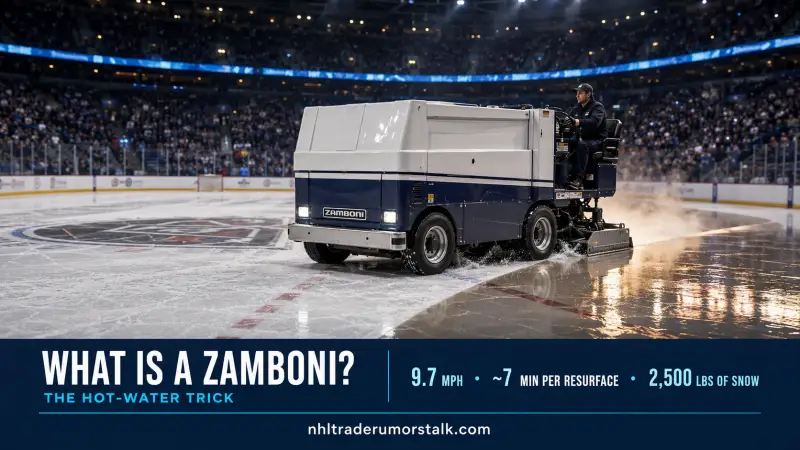
Every NHL intermission, a machine the size of a small truck rolls onto the ice at about 9.7 mph, shaves off close to 2,500 pounds of shredded ice, and lays a fresh film of water that freezes glass-smooth before the players come back out. That machine is a Zamboni, the most famous ice resurfacer on the planet and one of the only pieces of arena equipment that gets its own cheer.
So what is a Zamboni, how does it actually work, how fast does it go, what does it cost, and what do the drivers earn? Here is the whole machine, taken apart.
| Figure | What it represents |
|---|---|
| 90 min · 5 people | Resurfacing a rink by hand before 1949, scraping and flooding with a crew and hoses |
| ~15 min · 1 driver | The same job once Frank Zamboni's first machine arrived in 1949 |
Key Takeaways
- The name is a brand: "Zamboni" is a registered trademark of Frank J. Zamboni & Co.; the generic machine is an ice resurfacer. Calling an Olympia a Zamboni is technically wrong.
- Four moves, one pass: it shaves the worn ice, sweeps the shavings into a tank, washes grit from the skate grooves, then floods a thin layer of hot water that freezes smooth. That last step is the Hot-Water Trick.
- Slow on purpose: top speed is about 9.7 mph, and one resurface takes roughly seven minutes while removing close to 2,500 pounds of snow.
- It is not cheap: small tractor-pulled units start near $10,000, but full-size arena machines run into the low six figures, and electric models cost more still.
- The drivers are folk heroes: most earn modest hourly wages, and one of them, David Ayres, once strapped on the pads and won an NHL game in goal.
What Is a Zamboni, Exactly?
A Zamboni is a self-propelled machine that strips the chewed-up top layer off a sheet of ice and lays down a clean new one in a single slow lap. The man behind it was Frank Joseph Zamboni Jr. (1901-1988), who ran an ice rink called Iceland in Paramount, California. Keeping that sheet smooth was brutal work. Before his invention, resurfacing the ice meant a crew of five scraping, sweeping, and hosing for an hour and a half, according to the National Inventors Hall of Fame.
Zamboni spent years bolting together tractors, blades, and tanks until, by 1949, his Model A worked. The U.S. Patent Office granted him patent No. 2,642,679 for an "Ice Rink Resurfacing Machine" on June 23, 1953, and he built the rest of them through Frank J. Zamboni & Co., which he incorporated in 1949. The machine got its first famous customer in 1950 when figure-skating star Sonja Henie saw it at Paramount and ordered a pair for her traveling ice show, one of which toured Europe.
One thing to get right, especially if you are new to the sport: "Zamboni" is a brand name, the same way "Kleenex" is. The company holds it as a registered trademark, and the generic term for the device is an ice resurfacer. Several other makers build them, which is why a stickler will tell you that not every resurfacer gliding across NHL ice is actually a Zamboni.
How a Zamboni Works, Step by Step
Under all the charm, a Zamboni does four jobs in one pass, and the order matters.
First it shaves. A long, razor-sharp blade tucked inside a unit called the conditioner is lowered hydraulically to the ice, and its own weight presses it down hard enough to slice a thin layer off the surface. Next it collects. A horizontal screw, or auger, gathers those shavings, the stuff hockey people call snow, and feeds them to a vertical auger that lifts the pile up into a big tank on top of the machine. Third, on models built for it, the conditioner sprays wash water down into the deep cuts left by skate blades, then a squeegee and vacuum suck the dirty water back up to be filtered and reused. Last, the machine lays down a film of hot water, spread behind the conditioner by a simple cloth towel, that settles into the remaining grooves and freezes into a fresh sheet. When the lap is done, the driver dumps the snow tank, often into a heated pit that melts it back into water.
The driver is doing more than steering, too. Speed, blade depth, and water flow all have to be dialed to the room.
"There's a lot of stuff to worry about when you're driving. There's making sure the blade is in the right position, putting the right amount of water out depending on the conditions." — Jim Schmuke, St. Louis Blues ice-resurfacer driver, St. Louis Magazine (June 2009)
That clean sheet is what lets the goalie's crease and every blue line read sharp under the lights.
The Hot-Water Trick: Why Hot Water Makes Better Ice
Here is the part that trips people up. A Zamboni floods the rink with hot water, not cold, and the hotter sheet freezes into harder, clearer ice. It sounds backwards, and it is the single cleverest thing the machine does.
Crews give two reasons. The first is solid physics: hot water slightly melts the worn ice underneath it, so the new layer bonds to the old one instead of sitting on top like a loose skin. The second is the reasoning operators have passed down for decades, that warmer water carries less dissolved air, so it freezes with fewer trapped bubbles and ends up clearer and denser. The temperature is no small thing either. The flood water usually runs around 140 to 145 degrees Fahrenheit (60 to 63 Celsius), and NHL crews push it hotter still. Use cold water and you get a softer, cloudier, slower sheet. Use hot, and you get glass. Call it the Hot-Water Trick: the counterintuitive move that turns a bucket of warm water into the fastest ice in the building.
Speed, Time, and the Numbers
A Zamboni feels stately because it is. It is geared low and governed, so even flat out it barely outpaces a jog. Here is what one machine does on a standard 200-by-85-foot NHL sheet.
| Figure | What it measures |
|---|---|
| 9.7 mph | Top speed (a Model 500, clocked by Road & Track for the company's own fun-facts page) |
| ~7 minutes | Time to resurface a full NHL sheet, per NHL.com |
| ~2,500 lbs | Compacted snow scraped off and hauled away each resurface |
| ~1,500 lbs | Water laid back down to freeze into the new sheet |
| ~3/4 mile | Distance the machine drives in a single resurface (about 2,000 miles a year) |
| ~3 times | How often the ice is resurfaced during a game: after warm-up, then in each intermission |
Those two 18-minute breaks are exactly why you have time to grab a beer, because resurfacing is baked into how long a hockey game runs. The ice itself sits somewhere around three-quarters of an inch to an inch and a half thick, kept down in the low 20s Fahrenheit so it stays hard and fast. That hardness is what makes an icing call or a tight offside review look crisp on replay, and it is what keeps the painted lines, including the goalie's trapezoid, from smearing under a night of skate traffic.
How Much Does a Zamboni Cost?
This is the question everyone asks, and the honest answer is that the company will not print a sticker price. Zamboni says plainly that because the sizes and options vary so much by arena, so does the cost, and buyers have to ask for a quote. Still, the brackets are knowable.
| Type | Rough price |
|---|---|
| Small tractor-pulled unit (Model 100) | ~$10,000 and up |
| Full-size arena machine | Low six figures, roughly $100,000 to $300,000 |
| Electric vs gas premium | One 2023 town purchase ran $92,400 gas vs $155,600 electric |
The brand puts its full-size machines "up to or in the low six figures," and reputable estimates push the top professional and battery-electric models past $250,000. For perspective, the first machine Frank Zamboni actually sold was a Model B, bought by the Pasadena Winter Garden in 1950 for $5,000, real money at the time. The original 1949 Model A prototype was never sold; it still sits on display at his Paramount Iceland rink. The expensive part is not nostalgia. It is the hydraulics, the augers, the heated water system, and increasingly the batteries, all built to run for decades.
What the Drivers Make, and the One Who Made History
Driving the ice is a craft, but it is not a path to wealth. Pay swings a lot by venue and source, so treat any single figure as an estimate. Most ice-resurfacer drivers earn somewhere in the range of $14 to $18 an hour, with aggregator data stretching from the low teens into the mid-$20s. NHL-building estimates tend to land higher on an annual basis, commonly cited around $29,000 to $37,500, though no team publishes a payroll for the job.
What the role lacks in salary it makes up for in the best story in hockey. On February 22, 2020, a 42-year-old named David Ayres, who drove the ice resurfacer for the AHL's Toronto Marlies, was sitting in the building as the night's emergency backup goaltender. When both Carolina goalies went down, Ayres dressed for the Hurricanes, walked into an NHL net against the team his own employer was tied to, and won. Carolina beat Toronto 6-3, Ayres stopped 8 of the 10 shots he faced, and he became the first emergency backup ever credited with a victory. A Zamboni driver finished the night as the winning goalie, his save percentage forever stamped into the record book.
The Verdict: The Hot-Water Trick
Strip away the cheers and the between-periods t-shirt toss, and a Zamboni is gloriously simple: shave the old ice, sweep the snow, wash the grooves, flood with hot water. Frank Zamboni turned a 90-minute chore for five people into a fifteen-minute lap for one in 1949, and today's machines do it in about seven. But the genius hiding in plain sight is that final warm flood. The next time one rolls out and the crowd starts to clap, watch the back of the machine. That thin, steaming sheet of water is the Hot-Water Trick at work, and it is the reason the next shift gets to skate on glass.
Written by Mike Johnson, NHL Senior Editor. Mechanism and company facts were checked against Zamboni's own how-it-works and FAQ pages and the National Inventors Hall of Fame; speed, timing, and NHL-use figures against NHL.com; and the cost and salary ranges against named outlets and a real municipal purchase, with diverging figures reported as ranges rather than single numbers. Published June 29, 2026. Corrections: editorial@nhltraderumorstalk.com.
Sources and Reporting
- Zamboni.com: how the machine works, fun facts, and official pricing guidance.
- NHL.com: the Zamboni's NHL debut and resurfacing specs.
- National Inventors Hall of Fame: Frank Zamboni, the patent, and the invention story.
- Wikipedia: Ice resurfacer: the mechanism, the trademark, and competing brands.
- St. Louis Magazine: a day in the life of an NHL ice-resurfacer driver.
- Kingstonist: a real 2023 gas-vs-electric resurfacer purchase.
Frequently Asked Questions
How does a Zamboni work?
A Zamboni does four jobs in one slow pass. A blade shaves a thin layer off the worn ice, augers sweep the shavings into a tank, water washes grit out of the deep skate grooves, and a film of hot water is laid down behind the machine to freeze into a smooth new sheet.
How fast does a Zamboni go?
Not fast. The top speed of a Zamboni is about 9.7 mph, clocked on a Model 500. The machines are geared low and governed on purpose, so even flat out one barely outpaces a jog. A single resurface of an NHL sheet takes roughly seven minutes.
How much does a Zamboni cost?
Zamboni does not publish set prices, but the brackets are knowable. Small tractor-pulled units start near $10,000, while full-size arena machines run into the low six figures, roughly $100,000 to $300,000. Battery-electric models cost the most, often $50,000 or more above a comparable gas machine.
Why does a Zamboni use hot water?
Hot water makes better ice. It slightly melts the worn layer underneath so the new sheet bonds to it, and crews believe warmer water carries less dissolved air, so it freezes clearer and harder with fewer trapped bubbles. The flood water usually runs about 140 to 145 degrees Fahrenheit.
How much do Zamboni drivers make?
Most ice-resurfacer drivers earn modest wages, commonly around $14 to $18 an hour, with NHL-venue estimates landing higher on an annual basis. The most famous of them, David Ayres, drove a resurfacer for the Toronto Marlies and won an NHL game in goal for Carolina on February 22, 2020.
Related Stories

How Do Faceoffs Work in Hockey?
A faceoff looks like a coin flip, but it is a governed 50/50 battle: nine exact spots, a center on the dot, and a rule that ejects him when...
By Mike Johnson · 9 min read

What Is Save Percentage in Hockey?
Save percentage is hockey's go-to goalie stat, but it counts a point-blank chance and a 55-foot floater as the same shot. Here's the SV% for...
By Mike Johnson · 9 min read

What Is GAA in Hockey?
What is GAA in hockey? Goals against average is goals per 60 minutes, the oldest goalie stat and the most misleading. How it is calculated,...
By Mike Johnson · 7 min read
Hockey Positions Explained
Hockey positions explained: six players per side, five skaters and a goalie. What the center, wingers, defensemen, and goalie each do, how l...
By Mike Johnson · 6 min read
Comments
Be the first to share your take.
Get NHL trade rumors in your inbox
One email per week, zero spam, verified rumors only.