Samoskevich Traded to Seattle for No. 25 Pick
Florida traded Mackie Samoskevich to Seattle for the 2026 No. 25 pick and a conditional 2027 second, hours before flipping that first-rounder to Ottawa in the Brady Tkachuk deal. Inside the enabler trade, the cap math, and what Seattle actually got.
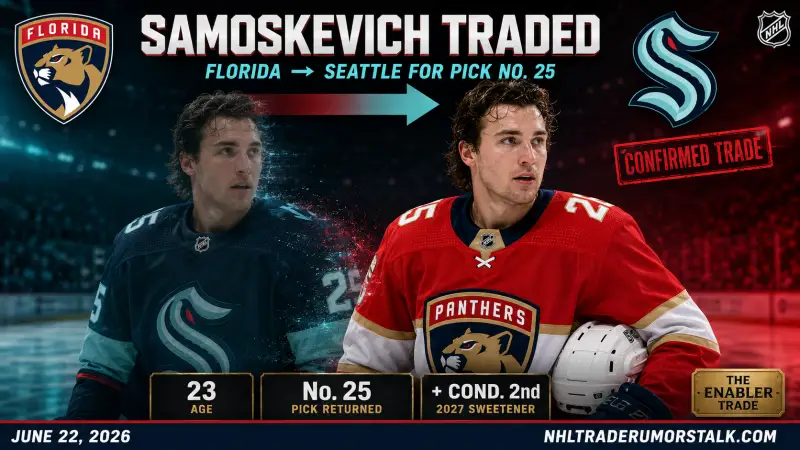
Twenty-five. That was the draft-pick number Florida acquired from Seattle on Sunday, June 22, 2026, and the very same pick the Panthers shipped to Ottawa hours later as part of the Brady Tkachuk return. The piece that connects the two transactions has a name and a contract status: 23-year-old restricted free-agent winger Mackie Samoskevich, the Florida Panthers' 24th overall pick from 2021 and a 2025 Stanley Cup champion in his rookie season.
Seattle GM Jason Botterill sent Florida the No. 25 selection (originally Tampa Bay's) along with a conditional 2027 second-round pick, the better of Winnipeg's or Columbus's selections the Kraken control. Florida, hours later, packaged that 25th-overall pick with their own No. 9 plus a 2027 second and a 2029 first to land the Ottawa captain. The Samoskevich trade is the toll Florida paid to assemble the Tkachuk ammunition. Welcome to The Enabler Trade.
This isn't just a salary dump or a cap shuffle. Mackie Samoskevich is a real young NHL forward with a 2025 Stanley Cup ring, a right-handed shot, and a market that would have priced him out of the Panthers' depth chart. He's also the precise asset Botterill has been hunting since Lane Lambert took the Kraken bench, and the Florida ledger entry that made Brady Tkachuk possible. You can read both moves as one transaction with a four-hour seam in the middle.
| Figure | What it represents |
|---|---|
| 4 picks | Draft picks Florida sent Ottawa for Brady Tkachuk: No. 9 plus No. 25 plus 2027 second plus 2029 first, top-10 protected |
| 1 forward | RFA Florida surrendered to assemble the asset stack: Mackie Samoskevich, 23, 2025 Cup winner |
One player became four picks, and four picks became one superstar captain. That is the asset arithmetic of an enabler deal in the cap era.
- The trade: Florida sent Samoskevich to Seattle for the 2026 No. 25 pick (originally Tampa Bay's) plus a conditional 2027 second-rounder, the better of Winnipeg's or Columbus's selections the Kraken hold.
- The Enabler Trade: The No. 25 pick spent only hours as a Panthers asset before being flipped to Ottawa as part of the Brady Tkachuk return.
- The fit: Samoskevich, 23, is a right-handed scoring winger with two Stanley Cup rings, a Michigan connection to Matty Beniers, and a projected market north of his QO.
- The cap math: Samoskevich was due a $813,750 qualifying offer on July 1, and Dom Luszczyszyn at The Athletic projected market value at six years, $6.7M AAV, beyond what Florida could match against an offer sheet.
- What it tells us about Florida: Bill Zito treated young, controllable scoring talent as a draft asset. Some teams move picks for players; the Panthers moved a player to acquire a pick to acquire a player.
How Florida made the smaller trade first
Late Saturday night, Mackie Samoskevich heard he was about to be moved. Hours later, Florida and Seattle finalized the smaller of two June 22 deals: Samoskevich to the Kraken for the 25th overall pick and a conditional 2027 second-rounder. By that afternoon, the Brady Tkachuk megadeal closed with Ottawa, and the No. 25 selection Florida had just acquired was already shipped east.
The sequence of those two trades matters more than any single line in either announcement, because Florida could not have walked into the Tkachuk negotiation offering the 25th-overall pick if they didn't first own it. So Bill Zito built the Tkachuk return out of two transactions: their own No. 9 pick plus a 2027 second plus a 2029 top-10-protected first they always had, and the 25th-overall pick they had to manufacture by trading Samoskevich. The asset that didn't exist on the Panthers' books Sunday morning was, by Sunday evening, the second-most-valuable piece in the biggest deal of the summer.
"For me, there's the fact that, at such a young age, he's been able to win a Stanley Cup already, and he's been a part of a very successful organization in Florida. I just love his age, love his speed and I love his shot. So, I think he'll fit in very well with the style of play that we're trying to play on an everyday basis here." — Jason Botterill, Seattle Kraken official statement (June 22, 2026)
Botterill's framing reads almost defensive, because he's telling Seattle fans why the GM gave up a top-25 pick for a player who finished 2025-26 with 32 points. The honest answer is more interesting than the polite one. He paid the price because right-handed, 23-year-old, cost-controlled wingers with Cup pedigree don't trade for second-round picks; they trade for first-rounders.
What Seattle actually got
Strip out the asset gymnastics and you have a young forward Florida invested a 2021 first-round pick in, who has now played 156 NHL games with 27 goals and 36 assists. The 2025-26 line was 12-20-32 in 77 games, averaging 14:28 per night and pulling roughly two minutes of power-play time on a Panthers depth chart stacked with Sam Reinhart, Matthew Tkachuk, Carter Verhaeghe, and now Brady. He shot 161 times, finishing fourth on the Panthers, and added 136 hits for a frame listed at 5-foot-11, 180 pounds.
The market on Samoskevich is wider than the box score suggests, because his qualifying offer of $813,750 sits comically below what any objective model says he's worth, a gap the 2026 free-agent board has been telegraphing for weeks. CapWages projected roughly $3M AAV. Evolving Hockey landed at four years, $4.7M AAV if he stayed in Florida, or six years, $5.25M elsewhere. Dom Luszczyszyn's public Athletic model put market value at six years, $6.7M. Botterill is now the one who gets to sit at the negotiating table and figure out which of those numbers is closer to right.
| Season | GP | G | A | P | TOI |
|---|---|---|---|---|---|
| 2023-24 (debut) | 7 | 0 | 0 | 0 | n/a |
| 2024-25 (rookie, won Cup) | 72 | 15 | 16 | 31 | 13:20 |
| 2025-26 | 77 | 12 | 20 | 32 | 14:28 |
| NHL career | 156 | 27 | 36 | 63 | n/a |
There's a Michigan story tucked inside this trade too, and Botterill leaned into it. Samoskevich played two seasons at the University of Michigan, one of them alongside Matty Beniers, the Kraken's No. 1 center and a former second-overall pick. Lane Lambert now has a top-six right-shot scoring option who already knows his pivot's game from a couple thousand miles east. The Kraken have been short on right-handed forwards with shot quality for most of their existence. Samoskevich solves that for, conservatively, the next six years.
The No. 25 pick's one-day hop
Track this single asset and you have a one-paragraph history of how the modern NHL trade market works. The 25th overall pick in the 2026 NHL Draft belonged to Tampa Bay Lightning when the regular season ended. Seattle acquired it in a prior Lightning trade. Florida acquired it on Sunday morning, June 22, in the Samoskevich deal. Ottawa walked away with it on Sunday afternoon as part of the four-piece Brady Tkachuk return. Four owners, two trades, less than a calendar day.
That is a real thing that happened to a real piece of paper. Tampa drafted at the deadline, Seattle accumulated, Florida converted, Ottawa harvested. The pick will be exercised at the Sphere on Friday, June 26, and the player selected at No. 25 will be drafted, ultimately, because Mackie Samoskevich exists.
Why Florida couldn't just qualify him
As of Sunday, Florida had eleven forwards under contract and was about to add Brady Tkachuk at $8.205M against the cap, leaving the Panthers with roughly $7M in space and two starting-goaltender questions pending July 1 with Sergei Bobrovsky and Daniil Tarasov both due to become UFAs. Adding Samoskevich at his projected $5-6M extension was structurally hard. Letting him hit RFA at $813,750 and risk an offer sheet at the Luszczyszyn ceiling of $6.7M was more dangerous still, because Florida would have had to match a number that essentially handed back the cap room they were trying to preserve for the goaltender.
"Definitely a lot of excitement. There were a lot of emotions yesterday, but it always ended with excitement because I knew I was going to a good situation and good team." — Mackie Samoskevich, NHL.com (June 22, 2026)
So Zito did what cap-era GMs do when the math gets ugly: he converted the player into a transferable asset before the qualifying-offer deadline locked him into a one-way decision. Sell Sunday, and Samoskevich is a 25th-overall pick plus a 2027 conditional second. Wait until July 1, qualify, and any creative team with cap room could turn him into a coin flip via offer sheet. Seattle, holding roughly $22.5M after the Bobby McMann re-signing, was exactly that creative team. Botterill effectively told Zito: trade him now for a real return, or watch me offer-sheet him in nine days.
Zito picked the real return. (I've been wrong about Florida's offseason moves before, but this one is hard to argue against.)
What Seattle wins beyond the player
The Kraken trade for Samoskevich does not just slot a right-handed winger into a top-six hole. It signals that Botterill's rebuild is past the cap-floor era described in our cap-floor teams tracker, and into the buy-young-controllable-talent era that Ron Francis used to talk about as president of hockey ops. Adding a 23-year-old former first-rounder with team-control on a long contract is exactly the asset profile Seattle has been short on. The 2026-27 cap math works comfortably even at the Luszczyszyn $6.7M model, because Seattle isn't spending it on a 32-year-old free-agent winger.
| Factor | Score /10 | Read |
|---|---|---|
| Player fit (RH scoring winger) | 9 | Solves a six-year roster gap in one move |
| Cap controllability | 8 | RFA with team-friendly leverage on first long-term deal |
| Price (No. 25 plus cond. 2027 2nd) | 6 | Steep, but not the value-trap a UFA winger would have been |
| Age plus Cup pedigree | 10 | 23 years old, a 2025 ring, peak years ahead |
| Overall | 82/100 | The cleanest young-talent swing of Botterill's tenure |
Seattle paid first-round currency for a second-round-statline player, but the math works because Mackie Samoskevich's next contract will be a Kraken contract, signed by a 23-year-old with a Cup already on his résumé, not by a 32-year-old winger getting top dollar at peak age. For Seattle this is the asset acquisition of the summer.
The Verdict: The Enabler Trade
Pretend for a second that the Brady Tkachuk deal never happened, and you have a perfectly sensible Sunday trade: Florida moves a cap-tight young RFA they couldn't affordably retain, Seattle pays first-round currency to buy six years of a top-six scoring winger. Both sides win. Both sides probably do this deal in isolation. Mackie Samoskevich gets a real role, a Michigan reunion, a long contract.
The story is what happens four hours later. Bill Zito took the No. 25 pick he just acquired and the No. 9 pick he already owned, added two future picks, and used the bundle to pry Brady Tkachuk loose from Ottawa's four-team list. Without the Samoskevich trade, Florida doesn't walk into that Senators conference room with that asset stack. Without that asset stack, Steve Staios doesn't pull the trigger. The Enabler Trade isn't a footnote in the Tkachuk transaction; it is the transaction, run twice, with a player's career split across the seam. The next call Zito makes tells us how often he will run this same play.
Sources and reporting
- NHL.com: official trade announcement, Botterill plus Samoskevich quotes
- Seattle Kraken: official team release with Botterill GM context
- Florida Panthers: official release confirming pick numbers plus conditional second
- PuckPedia trade #1130: pick origin chain plus conditional terms documented
- PuckPedia player page: contract status, QO ($813,750), career stats
- Sound of Hockey: Kraken cap context post-McMann, roughly $22.5M remaining
- The Hockey News: Florida-side breakdown of the asset return
- TSN: RFA framing plus draft-week timing context
- Daily Faceoff: insider corroboration of the conditional 2027 second
Frequently Asked Questions
Why did the Florida Panthers trade Mackie Samoskevich?
Florida traded Mackie Samoskevich to Seattle on June 22, 2026, primarily to acquire the No. 25 overall pick in the 2026 NHL Draft, which they then flipped to Ottawa hours later as part of the Brady Tkachuk return. With eleven forwards under contract and a projected $5-6M extension for Samoskevich, Florida could not affordably both retain him and re-sign goaltender Sergei Bobrovsky.
What did Seattle Kraken send Florida for Mackie Samoskevich?
The Kraken sent Florida the No. 25 overall pick in the 2026 NHL Draft (originally Tampa Bay Lightning's selection, which Seattle had previously acquired) and a conditional 2027 second-round pick, defined as the better of Winnipeg Jets' or Columbus Blue Jackets' selections that Seattle controls.
Is Mackie Samoskevich a free agent?
Samoskevich is a restricted free agent eligible to become an RFA on July 1, 2026, with a qualifying offer of $813,750. The Seattle Kraken now hold his rights and are expected to negotiate a long-term extension, with public projections ranging from CapWages' $3M AAV estimate to Dom Luszczyszyn's six-year, $6.7M projection at The Athletic.
Did Mackie Samoskevich win a Stanley Cup?
Yes, in 2025. Samoskevich won the Stanley Cup with the Florida Panthers as a rookie at the end of the 2024-25 season. He was not part of the 2024 championship roster, spending most of that season with the AHL's Charlotte Checkers, and finished his rookie 2024-25 regular season with 15 goals and 16 assists in 72 games.
Did Samoskevich and Matty Beniers play together at Michigan?
Yes. Samoskevich and Beniers were teammates for one season at the University of Michigan in 2021-22, the year Michigan reached the Frozen Four. Beniers was drafted second overall by Seattle in 2021 and is the Kraken's No. 1 center; Samoskevich was the next pick at 24th overall to Florida.
Where did the No. 25 pick originally come from?
The 25th overall selection in the 2026 NHL Draft originally belonged to the Tampa Bay Lightning. Seattle acquired it in a prior Lightning trade. Florida then acquired it from Seattle in the Samoskevich deal on June 22, 2026, and immediately included it in the Brady Tkachuk trade with Ottawa later the same day. The pick will be exercised on Friday, June 26 at the Sphere in Las Vegas.
Who is the Seattle Kraken general manager?
Jason Botterill has been the Kraken's general manager since April 22, 2025, when he was promoted from assistant GM after Ron Francis moved up to president of hockey operations. Botterill previously served as the Buffalo Sabres' GM from 2018 to 2020 and joined Seattle's front office in January 2021.
Related Stories

Brady Tkachuk Traded to Florida Panthers
Brady Tkachuk has been traded to the Florida Panthers, reuniting him with brother Matthew. Ottawa landed the No. 9 and No. 25 picks plus two...
By Mike Johnson · 8 min read

Canucks Fire Foote: Malhotra Leading
Vancouver fired head coach Adam Foote on May 19, 2026 after a 25-49-8 season. Manny Malhotra leads the candidate list. The Voice Mandate exp...
By Mike Johnson · 9 min read

Jamie Benn Fine 2026: Max NHL Punishment Explained
Jamie Benn fined $2,604 for cross-checking Hartman in Game 5. CBA Article 18 math, three-incident pattern in five games, and the 2023 Stone...
By Mike Johnson · 8 min read

Canucks GM Candidates 2026: 8 Names, Finalists in 48 Hours
The Vancouver Canucks GM search just narrowed to eight named candidates. Bill Scott is the frontrunner. Shane Doan is the wild card. Don Tay...
By Mike Johnson · 10 min read
Comments
Be the first to share your take.
Get NHL trade rumors in your inbox
One email per week, zero spam, verified rumors only.