What Is a Delayed Penalty in Hockey?
A delayed penalty is not a penalty yet. It is the referee holding the whistle after a foul until the penalized team touches the puck, which is why the goalie sprints off for an extra attacker and why a rare own-goal can still count. Here is how NHL Rule 15 really works.
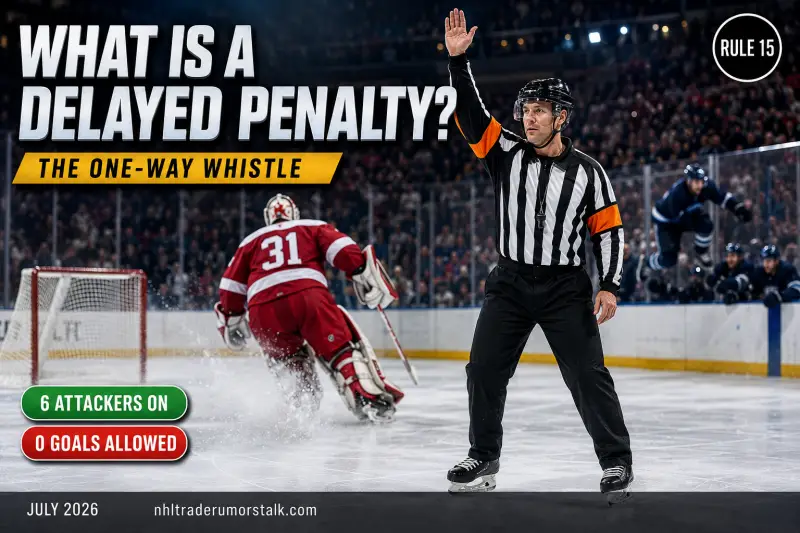
The referee's arm shoots straight up. Play keeps going. And the goalie? He's already sprinting for the bench like the ice is on fire. If you've watched hockey for five minutes or fifty years, you've seen this exact sequence and probably never had anyone explain it. That's a delayed penalty, and under NHL Rule 15 it isn't really a penalty yet. It's a promise the referee is holding until one specific thing happens.
Here's the whole idea in one breath. The official spotted a foul on the team that does not have the puck. Instead of stopping play, he lets the team that got fouled keep going until the offending team touches it. Whistle. Then the penalty gets served. That window, a few seconds and sometimes twenty, is where all the strange stuff lives, including a goalie leaving an empty net on purpose and a goal that can count for the team being punished.
| Figure | What it represents |
|---|---|
| 6 | Skaters the fouled team can put on the ice once its goalie sprints off, a temporary six-on-five with no downside in open play |
| 0 | Goals the penalized team can legally score in that window; the instant it touches the puck, the whistle ends the play |
That gap between six and zero is the entire point of what I call the one-way whistle: for a few seconds, the rules only work in one direction.
Key Takeaways
- It's a held whistle, not a penalty: the referee signals a foul but lets play run until the offending team touches the puck (NHL Rule 15).
- The one-way whistle: the fouled team can attack freely, so it yanks the goalie for a sixth skater; the penalized team can't score without ending the play.
- The trap: with the net empty, a bad pass by the fouled team into its own goal counts, and it's credited to the penalized side.
- Score and the minor vanishes: if the fouled team scores first, a pending minor is wiped, but majors still get served (Rule 15.2).
- Not "delay of game": that's a separate two-minute minor for puck-over-glass (Rule 63), and it's a different thing from a delayed penalty.
What a delayed penalty actually is
Start with the trigger. A referee can only call a penalty when he sees a foul, and hockey moves fast, so the league built in a pause. Rule 15, "Calling of Penalties," says that when a player fouls an opponent while his own team does not control the puck, the referee raises his arm and holds the whistle. Play runs on. The moment the offending team gains possession of the puck, the whistle finally blows and the penalty is assessed.
Why hold it at all? Fairness. If the whistle blew instantly, the team that just got fouled would lose whatever scoring chance it was building. So the league lets that chance play out. The fouled team gets a free look at the net, and the clock on the penalty simply waits.
Notice the exact trigger, because everything downstream hangs on it. The play does not end when the fouled team stops skating, or after a set number of seconds. It ends when the penalized team touches the puck. Until that happens, the referee's arm stays up and the fouled team can do whatever it wants. That's a very different animal from a normal stoppage like icing, where the linesman blows it dead the moment icing is confirmed.
Why the goalie sprints to the bench
Now the part everybody notices and nobody explains. The second that arm goes up, the fouled team's goalie bolts for the bench, and a sixth attacker jumps on. It looks reckless. It's the opposite.
Think it through. The penalized team can't score, because the only way it puts the puck in the net is by first touching the puck, and touching the puck ends the play. So the fouled team's own goal is, for these few seconds, un-scoreable-upon in normal play. Pulling the netminder for an extra skater is close to free. You get a six-on-five with a full net's worth of safety behind you. This is the same logic behind pulling the goalie at the end of a game, except the risk math is far kinder here, which is exactly why coaches do it without thinking twice.
Most of the time nothing dramatic comes of it. The fouled team buzzes, the penalized team pokes the puck, the whistle blows, and the power play begins with a fresh faceoff. But sometimes the extra attacker buries one, and then things get interesting.
The one way it backfires
Here's the twist that trips up even longtime fans. The empty net the fouled team just created can bite the fouled team. If one of its own players, reaching for a pass or trying to settle the puck, accidentally sends it into that empty net, the goal counts. And it counts for the team that was about to be penalized.
The rulebook is blunt here, because Rule 78.5 on disallowed goals states that during the delayed calling of a penalty, the offending team cannot score unless the non-offending team shoots the puck into its own net. A deflection off the penalized team, or any action by a penalized player, wipes the goal out. But a clean own-goal by the fouled team stands, and it's credited through the last-touch rule to a player on the penalized side.
This is not a hypothetical, and the cleanest example came on January 8, 2022. During a delayed penalty against the Minnesota Wild, the Washington Capitals had their goalie on the bench for the extra attacker. Carl Hagelin, trying to move the puck from near the far boards, sent it nearly the length of the ice into his own empty net. Because a Washington player put it there untouched, it counted. The goal went to Minnesota's Marcus Foligno as the last Wild player to have handled the puck. It was Foligno's 100th career goal, and he never took a shot on the play.
Goalies have landed on the happy end of this too. In 2013, New Jersey's Martin Brodeur was credited with a goal when a Carolina player fired the puck into his own empty net on a delayed call and Brodeur was the last Devil to touch it. One of hockey's rarest stat lines, a goaltender goal, came straight out of this rule.
Score, and the penalty vanishes
Flip the situation. What if the fouled team, with or without the extra attacker, actually scores a normal goal before the whistle? Then the pending minor penalty simply disappears. The league's reasoning is that the fouled team already got the thing a power play is meant to give it, a goal, so making the other team sit two minutes on top of that would be double payment.
"If the penalty to be imposed is a minor penalty and a goal is scored on the play by the non-offending side, the minor penalty shall not be imposed but major and match penalties shall be imposed in the normal manner regardless of whether or not a goal is scored." — NHL Official Rules, Rule 15.2
Read that closely, because it draws a hard line by penalty type. A minor gets wiped. A five-minute major does not; it gets served no matter how many goals go in. And on a double-minor, only the first of the two minors washes out, so the offender still owes the second two minutes. If you've ever watched a team score on a delayed call and then wondered why the other side went to the box anyway, that's your answer: it was a major, or the leftover half of a double-minor, and only then does the penalty kill actually start.
Delayed penalty vs delay of game vs Rule 26
Three phrases sound almost identical and mean completely different things, and search results mix them up constantly. Sort them once and you'll never confuse them again.
| Term | What it actually is | Rule |
|---|---|---|
| Delayed penalty | The held whistle after a foul, until the penalized team touches the puck. Not a penalty by itself. | Rule 15 |
| Delay of game | An actual two-minute minor, most often for shooting the puck over the glass from your own zone. | Rule 63 |
| "Delayed penalties" | A timing rule for when a team already has two players in the box and a third takes a penalty. | Rule 26 |
The one on the left is the arm-up sequence we've been talking about. Delay of game is a real infraction that sends a player to the box, unrelated to the held whistle. And Rule 26, confusingly also titled "Delayed Penalties," only deals with the bookkeeping of stacking penalties so a team never drops below three skaters. Same words, three different rules. When the goalie sprints off with no whistle, it's Rule 15 every time.
The verdict: the one-way whistle
The delayed penalty is one of those rules that looks chaotic and is actually elegant once you see the trigger. The whistle is holstered until the penalized team touches the puck, so for a few seconds the fouled team plays with house money: pull the goalie, attack, and the worst normal outcome is a faceoff. The only real danger is self-inflicted, a puck into your own empty net, and even that is rare enough to be a highlight when it happens. So the next time an arm goes up and a goalie takes off running, watch the puck, not the net. The whole thing ends the instant the wrong team touches it, and the faceoff that follows tells you the one-way whistle just closed.
Written by Mike Johnson, NHL Senior Editor, who has spent 15-plus years explaining the sport's rulebook to new and lifelong fans. Every rule reference here was checked against the current NHL Official Rules (Rules 15, 26, 63, and 78), and the two on-ice examples were traced to contemporaneous game reporting. Published July 2, 2026. Editorial review: Sarah Chen, Hockey Operations Editor. Corrections or questions: editorial@nhltraderumorstalk.com.
Sources and reporting
- NHL Official Rules 2024-25: Rule 15 (calling of penalties), Rule 15.2 (goal on a delayed minor), Rule 26, Rule 63, Rule 78.5.
- Wikipedia: Penalty (ice hockey): the arm signal and the whistle-on-possession mechanic.
- Wikipedia: Extra attacker: pulling the goalie during a delayed penalty and the last-touch crediting rule.
- Scouting The Refs: officiating reference for NHL rule numbers and procedures.
- Russian Machine Never Breaks: the Hagelin own-net goal, credited to Marcus Foligno, January 8, 2022.
- Winging It In Motown: a plain-language walkthrough of the delayed-penalty rule.
Frequently Asked Questions
Why does the goalie leave the net on a delayed penalty?
Because the penalized team can't score until it touches the puck, and touching the puck ends the play. That makes the fouled team's net effectively safe, so it pulls the goalie for a sixth attacker to press its advantage at almost no risk.
Does a goal count on a delayed penalty?
Yes. If the fouled team scores, the goal counts and a pending minor penalty is wiped out. The rare exception is an own-goal: if the fouled team accidentally puts the puck into its own empty net, that also counts, credited to the penalized side.
Can the penalized team score during a delayed penalty?
Not in normal play. The only way the penalized team can shoot is to first touch the puck, and that immediately stops play. The one path to a goal for the penalized side is the fouled team scoring on its own empty net.
What is the difference between a delayed penalty and delay of game?
A delayed penalty is the referee holding the whistle after a foul (Rule 15). Delay of game is a separate two-minute minor, usually for shooting the puck over the glass from your own zone (Rule 63). They sound alike but are unrelated.
What happens on a double minor if a goal is scored?
Only the first of the two minors is wiped out by the goal. The offending player still serves the second two-minute minor. A five-minute major is never washed out by a goal and is always served in full.
Related Stories
How Do Line Changes Work in Hockey?
A line change is hockey's strangest routine: you swap players while the puck is live, but only inside a five-foot pocket beside your own ben...
By Mike Johnson · 10 min read
What Is the Long Change in Hockey?
The long change is not jargon, it is bench geography. Teams switch ends each period but keep the same bench, so in the second period a tired...
By Mike Johnson · 9 min read
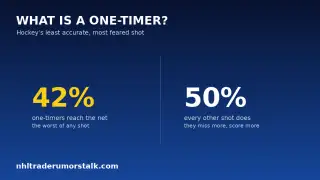
What Is a One-Timer in Hockey?
A one-timer reaches the net just 42% of the time, the worst of any shot, yet it is the most dangerous weapon in hockey and the shot Ovechkin...
By Mike Johnson · 11 min read
What Is the Five-Hole in Hockey?
The five-hole is the gap between a goalie's legs, the only one of the goalie's five holes hockey ever agreed on a name for. Here is what it...
By Mike Johnson · 8 min read
Comments
Be the first to share your take.
Get NHL trade rumors in your inbox
One email per week, zero spam, verified rumors only.