NHL Cap Space 2026: Who Can Actually Sign Tuch?
A quarter-billion in unspent cap room sits across the NHL — and almost none of it belongs to a team that wants to win. The War Chest Index ranks all 32 by who can actually sign Alex Tuch on July 1.
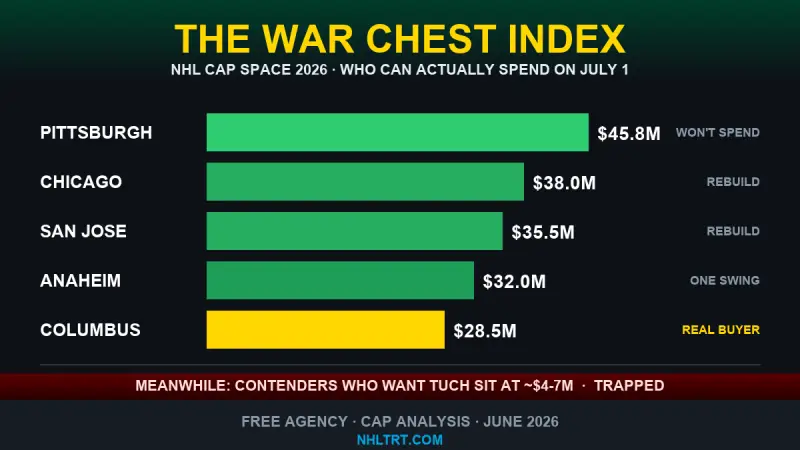
There is roughly a quarter-billion dollars of unspent cap room sitting across the NHL three weeks before the market opens, and almost none of it belongs to a team that wants to win in 2026-27. That is the problem with reading a cap-space sheet from the top down. The clubs holding the biggest stacks of money are the ones least interested in spending it on a 29-year-old winger, and the clubs desperate for that winger are the ones scraping the ceiling. We built the War Chest Index to measure the gap between having the money and being willing to use it, because on July 1 those are two completely different things.
| Team | Projected cap space | Realistic July 1 posture |
|---|---|---|
| Pittsburgh Penguins | $45.8M | Disciplined — youth first, no splash |
| Chicago Blackhawks | $38.0M | Floor-shopping, not Cup-shopping |
| San Jose Sharks | $35.5M | Short-term deals, asset flips |
| Anaheim Ducks | $32.0M | Selective — one real swing |
| Columbus Blue Jackets | $28.5M | Genuine buyer with a need |
Read that column on the right and the whole point of the War Chest Index lands at once: the four richest teams in the league are reset projects, and the first one that actually wants a top-six winger sits fifth.
Key Takeaways
- Money is in the wrong hands: Pittsburgh ($45.8M), Chicago ($38.0M) and San Jose ($35.5M) lead the league in space, and all three are rebuilding rather than buying.
- The thinnest class in five years: after the Kaprizov, Eichel and McDavid extensions, the elite UFA tier is gone — Daily Faceoff's Top 50 is led by a winger, not a center.
- The War Chest Index: our score weights cap space by contention window and roster need, because $45.8M on a rebuild is worth less in June than $9M on a contender.
- Tuch is the prize: Alex Tuch should roughly double his $4.75M cap hit, and the teams that can fit that number are not the teams sitting on the most cash.
- The market tips to defense: with only a few top-line forwards available, the real July 1 money flows to the blue line, where the board is deep.
What the War Chest Index Measures
A raw cap-space list tells you who is allowed to spend. It does not tell you who will. The War Chest Index is our attempt to fix that by scoring each team on three inputs instead of one: projected cap space against the $104 million ceiling, the team's realistic contention window, and whether the roster actually has a hole a free agent would fill. A rebuilding club with $40 million and no urgency scores low. A contender with $9 million and a glaring second-line need scores high. The index is a willingness number dressed up as a money number.
That distinction matters more in 2026 than in a normal summer, because the spending environment changed in two directions at once. The cap jumped a record $8.5 million to $104 million, the largest single-year increase since 2005, which on paper hands everyone more room. But the player supply collapsed at the same time. The names that would normally headline a class — Kirill Kaprizov, Jack Eichel, Connor McDavid — all signed extensions, stripping the top tier bare. More room chasing fewer stars is how you get a market where teams overpay for the third-best option, and the War Chest Index is built to flag who is most likely to be that team.
For the mechanics underneath all of this — how bonus structure, retention and the floor interact — our 2026 salary cap guide walks through the rules the index assumes you already know.
The Loaded-but-Unwilling: Rebuilders Sitting on the Cash
Start at the top, because the top is a trap. Pittsburgh leads the league with a projected $45.8 million in space, and Kyle Dubas has spent the spring telling anyone who asks that the number is not an invitation.
Pittsburgh's front office has cautioned against a free-agency spending spree, prioritizing younger, higher-end talent over expensive veterans on July 1. — reporting on the Penguins' cap plan, NHL Insight (June 2026)
That is the correct read of a roster mid-transition. Dubas is not going to hand a 29-year-old a seven-year deal to finish ninth; he would rather carry the space, stay flexible, and convert it into trade flexibility or a retained-salary broker fee at the deadline. So the league's biggest war chest belongs to a team that has all but announced it won't open it. On the index, Pittsburgh's $45.8 million is worth a fraction of its face value.
Chicago ($38.0M) and San Jose ($35.5M) tell the same story in different accents. Both are years from contention, both will be active, and neither will be active in the way a free agent hopes. Their July 1 looks like one-year prove-it deals and absorbing other teams' mistakes for a sweetener — useful work, but not the kind that signs Alex Tuch. Anaheim's $32.0 million gives the Ducks room for one real swing if they choose to take it, and Columbus, fifth on the raw list at $28.5 million, is the first name where the money and the motive finally point the same way. All five of these clubs also share a quieter obligation: every one of them has to clear the $76.9 million cap floor, which guarantees they spend something even when the smart move is patience.
The Contenders Who Want In and Can't Fit It
Now flip the sheet over. The teams that would happily give Tuch his raise are the ones with almost no room to give it. A typical Cup-window roster in 2026 is carrying $90 million-plus in commitments against the $90.4 million midpoint, which leaves a few million for the entire summer — re-signings, depth, and a UFA splash all competing for the same sliver. That is the cruelty of a rising cap: contenders extended their own cores to stay ahead of it, and now the room they gained is already spoken for.
This is why the trade market and the free-agent market are bleeding into each other earlier than usual. A capped-out contender that wants to add has to subtract first, which is the exact pressure driving the summer's loudest rumors — the Larkin-Robertson swap math in Dallas is a contender trying to manufacture the room a free agent would otherwise fill, and the unresolved Robertson contract gap is the pressure point underneath it. When a team can't buy, it trades, and the players most likely to move are the ones whose contracts a buyer can stomach. The War Chest Index treats that creativity as a tax: a team forced to clear space before it adds is a team paying twice for the same upgrade.
The escape hatch a few of these clubs will reach for is the offer sheet, and the names worth poaching are mapped on our 2026 offer-sheet board. But offer sheets cost picks, and the compensation tiers climb fast once the salary crosses into eight figures, so the tool that looks like a shortcut is really just spending the same money in a different currency.
Where the July 1 Money Actually Flows
The supply problem reshapes where the dollars land. With the elite center tier extended out of existence, the forward market thins to a single genuine prize.
The 2026 free-agent class projects as the thinnest elite tier in five years, led by a winger rather than a center, with the deepest talent sitting on the blue line. — Daily Faceoff Top 50 UFAs (2026)
Alex Tuch is that winger. He played the past several seasons on a team-friendly $4.75 million cap hit, and every projection has him at least doubling it this summer, somewhere in the $9.5-to-$10.25 million range on term — exactly the kind of number a rebuilder won't pay and a contender can't fit. Where he signs is the single best stress test of the War Chest Index, which is why we broke the bidding down separately in our Tuch destinations breakdown. The goalie market is even thinner: at 37, Sergei Bobrovsky is the most attractive name available and reportedly wants to stay near his $10 million cap hit, a price only a handful of teams can justify for a netminder in his late thirties.
So the smart money slides to the blue line, the one position with real depth. John Carlson, Darren Raddysh and Rasmus Andersson headline a dozen legitimate top-four defensemen on the board, per ESPN's free-agency rankings, and that is where a clever GM finds value without an auction. A team that misses on Tuch can still meaningfully improve by spending its War Chest on defense, where supply finally works in the buyer's favor. For the full board by position, our 2026 free-agent list tracks all 50 names; the arbitration-eligible group and the buyout candidates reshape the supply further once those windows open.
The Full War Chest Index Tiers
Collapse all three inputs — space, window, need — and the league sorts into four postures rather than a single ranking. Cap space gets a team into the conversation; the other two decide whether it does anything.
| Posture | Who fits | What it means |
|---|---|---|
| Aggressors | Columbus, Anaheim (if it swings), one cap-clearing contender | Real money and a real need — the teams that drive the first 48 hours |
| Tinkerers | Most of the playoff field | $3-7M to spend, will add depth and one mid-tier name, no headliner |
| Trapped | Capped-out contenders | Want to add, must subtract first — trade market, not free agency |
| Forced spenders | Pittsburgh, Chicago, San Jose | Have to reach the $76.9M floor but won't chase stars to do it |
The takeaway is not that any single team is about to win the summer. It is that the War Chest Index and the raw cap-space list disagree almost everywhere they matter, and the disagreement is the story. The richest teams won't spend, the teams that want to spend can't, and the prize everyone would chase — Tuch — fits cleanly on almost none of them. That is how a record cap produces a quiet July 1, and why the signing-bonus and trade math ends up doing more work than the free-agent frenzy this year.
Track every signing and cap move as it lands on our live trade and free-agency board.
Sources and Reporting
- Daily Faceoff: Top 50 UFA board, thin-market framing, Bobrovsky and defense-tier depth
- ESPN: free-agency rankings and tiers, Tuch and Andersson valuations
- NHL Insight: Penguins cap space and Kyle Dubas's stated spending discipline
- The Hockey Writers: how the extension wave reshaped the 2026 class
- PuckPedia: team cap-space and contract verification
The Verdict: The War Chest Index
If you only read the cap-space sheet, you would expect Pittsburgh, Chicago and San Jose to run the summer. They won't. The War Chest Index says the teams that move the market are the ones where money, window and need finally line up — a short list led by Columbus, by whichever Cup contender clears the room to fit Tuch, and by the clubs willing to spend on the deep defense tier instead of bidding against themselves for a winger. The money exists. The willingness is rare. On July 1, willingness is the only number that signs anyone.
Frequently Asked Questions
Which NHL team has the most cap space for 2026 free agency?
The Pittsburgh Penguins lead the league with a projected $45.8 million in cap space for 2026-27, ahead of the Chicago Blackhawks ($38.0M) and San Jose Sharks ($35.5M). All three are rebuilding teams, which is the central point of the War Chest Index: the clubs with the most room are the least likely to spend it on a marquee free agent.
What is the NHL War Chest Index?
It is our framework for ranking teams by spending power rather than raw cap space. It weights a team's projected cap room against the $104 million ceiling by two more factors: the team's realistic contention window and whether its roster has a hole a free agent would fill. A rebuilder with $40 million scores low; a contender with $9 million and a clear need scores high.
Who is the top UFA in 2026 free agency?
Alex Tuch of the Buffalo Sabres is the consensus top unrestricted free agent. He played on a team-friendly $4.75 million cap hit and is projected to roughly double it, into the $9.5-to-$10.25 million range on term. The 2026 class is the thinnest elite tier in five years after Kirill Kaprizov, Jack Eichel and Connor McDavid all signed extensions.
Why will the 2026 NHL free agency be quiet despite the record cap?
Because the cap rose a record $8.5 million to $104 million at the same time the star supply collapsed. The teams with the most space are rebuilding and won't chase veterans, while contenders extended their cores and have little room left. More money chasing fewer players pushes spending toward the deep defense tier and the trade market instead of a free-agent frenzy.
Related Stories
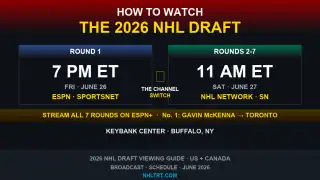
How to Watch the 2026 NHL Draft
Round 1 is June 26 at 7 p.m. ET, Rounds 2-7 are June 27 — but the channel changes between days. The full how-to-watch guide for the 2026 NHL...
By Mike Johnson · 6 min read

Who Is Gavin McKenna? The No. 1 Pick
A Yukon kid who dominated two leagues two years apart, now the consensus No. 1 for 2026. Inside Gavin McKenna's game, his NHL comps, and the...
By Mike Johnson · 9 min read
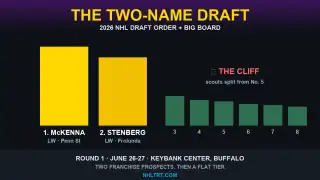
2026 NHL Draft Order: McKenna, Stenberg & the Two-Name Draft
McKenna and Stenberg are the only two locks in a top-heavy class. Inside the projected 2026 first-round order, the big board, the cliff afte...
By Mike Johnson · 6 min read
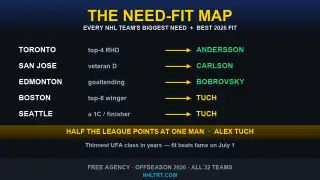
NHL 2026: Every Team's Biggest Need & Dream UFA Fit
A thin free-agent class makes 2026 about fit, not fame. The Need-Fit Map names all 32 teams' biggest hole and the realistic target who fills...
By Mike Johnson · 8 min read
Comments
Be the first to share your take.
Get NHL trade rumors in your inbox
One email per week. Zero spam. Verified rumors only.