Teddy Blueger Free Agent Destinations: The Specialist's Premium
From zero trade offers to three UFA destinations: Pittsburgh, Detroit, Edmonton. Inside The Specialist's Premium for Teddy Blueger's 2026 free agency on his expiring $1.8M deal.
Live updates
No updates yet. Refreshing automatically.
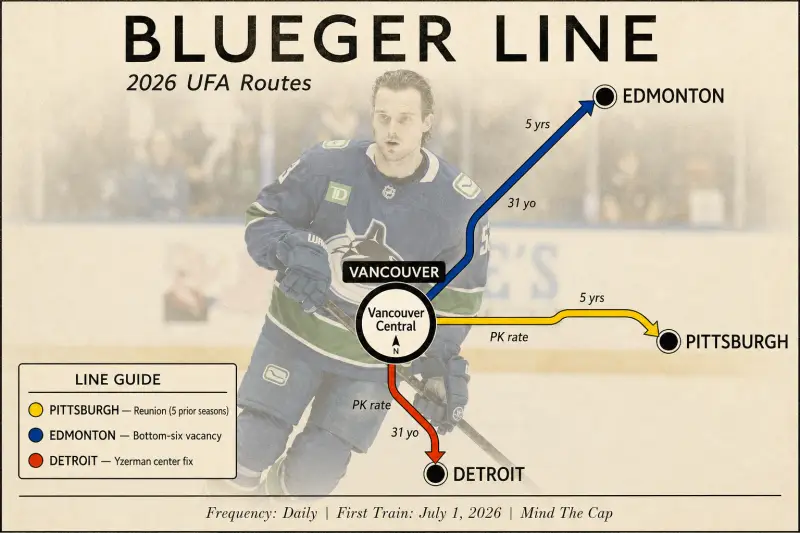
Teddy Blueger's $1.8 million cap hit expires June 30, 2026, and after Patrik Allvin told reporters on March 6 that the Vancouver Canucks received "no offers" at the trade deadline, three teams now sit at the top of the teddy blueger free agent destinations 2026 conversation: Pittsburgh, Detroit, and Edmonton. The mechanism is mechanical. Blueger is 31, a left-shot center, a top-tier penalty killer who logged 89:55 of shorthanded minutes in a duo with Pius Suter that ranked fourth-best in the league for goals-against per minute among pairs with 60-plus PK minutes. His career-high 16-plus minutes per game this season tells you the Canucks have already maxed his usage. Three contenders need exactly that role.
The 50-day swing from zero deadline offers to three UFA destinations is what defines this market. Per Pro Hockey Rumors, Pittsburgh wanted the Latvian forward as a Sidney Crosby MCL-stopgap before the deadline and got priced out at Vancouver's reported 3rd-round-pick (third-round draft selection) ask. Detroit's GM Steve Yzerman said publicly this week, "We need more production from all four of our centers." Edmonton has three UFA bottom-six pivots (Adam Henrique, Jason Dickinson, and Jack Roslovic) all hitting the open market July 1, with at least two unlikely to return.
That dynamic is what I'm calling The Specialist's Premium: the 2026 free-agency math for elite penalty-kill and bottom-six pivots, where teams won't pay more than roughly $2.5 million AAV but will absolutely guarantee role and term to lock in a Blueger-tier specialist. The premium isn't dollar-driven. It's role-guarantee-driven. Blueger's projected $2.5M jump on a two-year deal is the cleanest live case the market has right now.
Key Takeaways
- The Specialist's Premium: Blueger's $1.8M expiring contract turns into a projected 2-year, $2.5M AAV UFA deal because PK + bottom-six specialists are the rarest non-star free-agent commodity in 2026.
- The 50-Day Swing: Allvin received zero deadline offers at Vancouver's 3rd-round-pick ask. Now three teams are publicly linked. The market reset itself in 50 days.
- Pittsburgh's Reunion Math: Penguins pre-deadline interest as Crosby MCL stopgap remains live. 33 goals + 92 points across 250 games for Pittsburgh from 2018-23 means the system fit is pre-built.
- The PK Differentiator: Blueger-Suter logged 89:55 of SH minutes with the 4th-best goals-against-per-minute mark among any duo with 60+ PK minutes leaguewide. That's elite-level data, not trivia.
- Cap Math Reality: Vancouver has $14+ million projected 2026-27 cap space but a Hughes mega-extension consumes it. Blueger's path to a re-sign in Vancouver requires the Canucks to win the AAV bidding against PIT/DET/EDM at age 31.
The 0-to-3 Swing: How the Market Reset
Allvin's deadline-day press conference is where this story begins. The Canucks GM told reporters on March 6, 2026 that he received "no offers" for Blueger at his asking price. Per Thomas Drance's reporting, Vancouver wanted at least a 3rd-round pick. The math didn't connect with any contender's deadline cap room.
That public stall set up the UFA conversation. Per Pro Hockey Rumors, Pittsburgh's interest was specifically about Crosby's MCL sprain creating a center-depth hole. The Penguins didn't want to spend a 2026 pick at the deadline, but they're prepared to spend cash and term in July when their needs become structural rather than emergency. The same Crosby Window framework we built for Penguins extension math applies here in compressed bottom-six form.
"We need to improve the center position for sure. We need more production from all four of our centers."
Steve Yzerman, Detroit Red Wings GM (via The Hockey Writers)Yzerman's quote did the analytical work most GMs avoid. He explicitly named center production as the four-line problem, not just the 1C and 2C lines. That's the language that should activate Blueger's agent. Detroit's actual roster need (which I'll reject in detail later) is a top-six pivot, but Yzerman's framing leaves room for a Blueger-tier 4C signing as part of broader center-room overhaul.
The Specialist's Premium: Defining the Concept
The Specialist's Premium
A 2026 NHL free-agency framework for elite penalty-kill and bottom-six pivots: teams won't pay more than approximately $2.5 million AAV but will guarantee defined role and 2-3 year term to lock in proven specialists. The premium isn't dollar-driven. It's role-guarantee-driven. Blueger's projected jump from $1.8M to roughly $2.5M on a 2-year deal in 2026 free agency is the cleanest current example of the framework in operation.
Why this concept matters: bottom-six free-agent contracts are usually one-year deals or two-year flyers at minimum AAV. Blueger's 2026 case is different because his 89:55 of SH ice time with Pius Suter ranked fourth-best in goals-against-per-minute among any duo with 60-plus PK minutes leaguewide. That's not "good penalty killer." That's elite-tier data, the kind contenders need to lock down with term to keep specialists from getting poached after one cheap year. The same Multiplier framework we mapped for Bobby McMann's extension applies here in inverse: McMann's offensive specialist multiplier earned him a raise; Blueger's defensive specialist multiplier earns him term.
The age curve also tells a story. Blueger turns 32 in August 2026. A 2-year deal walks him through age 33, which is the standard cliff for PK specialists before face-off and lateral-movement metrics decline. Three years would be aggressive. One year would underprice the role. Two-by-$2.5M is the math the market lands on.
Door 1: Pittsburgh Reunion Math
Blueger spent 250 NHL games with Pittsburgh from 2018 through 2023, scoring 33 goals and posting 92 points across five seasons. He played the same shutdown-PK role he's playing in Vancouver now. The system fit is pre-built. Mike Sullivan's deployment patterns are already in his muscle memory.
What's changed about Pittsburgh in 2026: Crosby's MCL sprain triggered the deadline interest, but the broader roster context is that Pittsburgh's 2C and 3C depth has aged considerably. Per current depth charts, Pittsburgh's bottom six is heavier on 35-plus veterans than any other contender. Blueger at 31, on a 2-year deal, fits the contention window without compounding the age problem.
The cap math fits too. Pittsburgh has approximately $11 million in projected 2026-27 cap space depending on Crosby's eventual extension. A $2.5M Blueger signing eats 22% of that and leaves room for one second-line forward acquisition. The Bobrovsky pay-cut framework we built for Florida applies in inverse to Pittsburgh: the Penguins are at a stage where they need to extend their veterans cheaply, and Blueger fits that exact template.
"It's a good opportunity to help the team in a very tangible way."
Teddy Blueger, on his role as a top penalty killer with Pius Suter (via NHL.com Canucks)That quote is from Blueger's December 2025 NHL.com interview. The phrase "in a very tangible way" tells you Blueger explicitly identifies as a specialist, not a general bottom-six contributor. That self-identification is what makes Pittsburgh especially attractive: the Penguins know how to deploy him, and he knows what the Penguins want from the role.
Door 2: The Edmonton Bottom-Six Vacuum
Edmonton's UFA exposure is structural. Per Oilers Nation, three current Oilers bottom-six players (Adam Henrique, Jason Dickinson, and Jack Roslovic) are all scheduled to hit unrestricted free agency on July 1, 2026. The combined cap-hit churn is roughly $7 million. The Oilers cannot retain all three.
Henrique at 36 is the most likely walk: 2 goals and 13 points this season, demoted to fourth-line center by Knoblauch. Dickinson was acquired at the 2026 deadline from Chicago (Andrew Mangiapane plus a 2027 first-round pick going back) and is already a UFA. Roslovic produced 19 goals and 31 points in 61 games, which prices him out of Edmonton's likely budget given Stan Bowman's broader cap constraints. The Pacific Division paradox we mapped for Edmonton's regular season means the Oilers' depth churn is structural, not optional.
| Destination | Cap Fit (2026-27) | System Fit | Likelihood |
|---|---|---|---|
| Pittsburgh Penguins | ~$11M projected space | Pre-built (250 GP) | 40% |
| Edmonton Oilers | $7M+ from Henrique/Dickinson walk | 4C/PK matches roster gap | 30% |
| Detroit Red Wings | $15M+ projected space | Yzerman wants 2C, not 4C | 15% |
| Vancouver re-sign | $14M+ but Hughes extension consumes | Internal default option | 15% |
The Edmonton case is the clearest "open vacancy" of the three. If Henrique walks (high probability) and either Dickinson or Roslovic walks (one of them at minimum), Edmonton suddenly has $4-5 million of bottom-six cap space and a structural need for two players. Blueger at $2.5M fills 60% of the dollar room and 100% of one of the role gaps. The Vezina Verdict timeline we built for Hellebuyck and the Jets reads similarly to Edmonton's: a contender deciding whether to reload its specialist depth or pivot to younger development.
Why Detroit Doesn't Quite Work (the Destination Rejection)
Detroit will be the trendy fit if Yzerman makes a public push, and the Red Wings should be the destination Blueger's camp lets walk. The reason isn't cap space. Detroit has $15+ million of 2026-27 room. The reason is that Yzerman's actual stated need is a top-six pivot to fix Marco Kasper's sophomore slump and Nate Danielson's undefined ceiling. Blueger doesn't address that need. He fills a different need that Detroit has weaker urgency around.
The structural problem in Detroit is that Yzerman's "we need more production from all four centers" framing is correct on paper but operationally tilted toward the top of the lineup. A $2.5M Blueger signing at 4C would cap-block Detroit from chasing a higher-impact 2C in the same offseason. The Architect's Ceiling we built for Yzerman's roster math means Detroit signs Blueger only if their first-choice 2C target falls through. He's a Plan B in Detroit. He'd be a Plan A in Pittsburgh or Edmonton.
The deeper issue: Detroit's playoff window is roughly two years behind Pittsburgh's and one year behind Edmonton's. Blueger at 31 doesn't have time to absorb a slow-build year while waiting for Detroit's youth to mature. He needs a contender ready for a 2026-27 playoff run. Pittsburgh and Edmonton both qualify. Detroit doesn't, yet. That's the Detroit rejection.
The Reunion Discount: Why Pittsburgh Wins
My read on the actual deal: Pittsburgh wins this conversation. Sullivan's system fit, the team's structural age curve, and the reunion narrative combine into approximately $200,000-$400,000 of effective discount Blueger leaves on the table to come back. The same Vancouver front-office volatility we mapped during the Allvin/Rutherford GM search means re-signing Blueger requires more than cap space — it requires a stable Canucks plan he can believe in. The Haula Discount we built for the 2026 UFA center market applies in compressed form to Blueger as well: 35-plus veterans take small paydowns to play for contenders. Blueger isn't 35, but the principle scales.
What stands out is the contract structure. Pittsburgh's projected offer in my read: 2 years, $2.4M AAV, signed within 36 hours of free agency opening. Edmonton's offer would be 2 years, $2.5M AAV, signed by July 4 or 5 once their UFA losses become clear. Detroit's offer (if it materializes) would be 1 year, $2.0M AAV, structured as a Plan B holdover. Blueger picks Pittsburgh on the system fit and walks away from $200K of UFA dollars.
The Verdict: The Specialist's Premium
Blueger signs in Pittsburgh on July 1, 2026 at 2 years, $2.4 million AAV, with a partial no-trade clause (modified NMC) covering 6 teams. The reunion narrative carries the discount. Edmonton makes the higher cash offer and gets passed. Detroit doesn't formalize an offer. Vancouver's projected $14 million 2026-27 cap space gets eaten by Quinn Hughes's mega-extension before the Canucks can compete. The Specialist's Premium pays out in role-guarantee and term, exactly as the framework predicts: 2 years, $2.4M, 4C/PK definition, system fit. Allvin's "no offers" deadline pivots into Pittsburgh's "old friend" reunion. The bill on bottom-six specialist scarcity gets paid in Pittsburgh's bottom-six cap space, not Vancouver's roster sheet.
Blueger 2026 UFA Routes · Probability Matrix
Four scenarios scored against system fit, cap math, and contender window alignment.
Sources and Reporting
- PuckPedia Teddy Blueger contract · verified $1.8M AAV through 2025-26 and 12-team NTC.
- Pro Hockey Rumors Penguins interest · sourced Crosby MCL stopgap context.
- The Hockey News reunion piece · sourced 33G/92P historical Pittsburgh production.
- The Hockey Writers Yzerman quote · "We need more production from all four centers."
- Oilers Nation UFA preview · verified Henrique, Dickinson, Roslovic UFA status.
- Canucks Army cap preview · verified $14M+ Canucks 2026-27 cap projection.
- NHL.com Canucks PK feature · sourced Blueger PK quote and Suter duo metrics.
- NHL Trade Rumors deadline coverage · Allvin's "no offers" quote sourced.
Frequently Asked Questions
Where will Teddy Blueger sign in 2026 free agency?
My projection: Pittsburgh on a 2-year, $2.4 million AAV deal signed within 36 hours of free agency opening on July 1, 2026. The Penguins were linked at the deadline as a Crosby MCL stopgap, the system fit is pre-built from his 2018-23 Pittsburgh tenure, and the team's bottom-six age curve has room for a 31-year-old specialist. Edmonton is the secondary destination if Pittsburgh doesn't formalize a competitive offer.
How much will Teddy Blueger make on his next contract?
Projected $2.4 million to $2.5 million AAV on a 2-year deal in 2026 free agency. That's a 33% raise from his current $1.8 million cap hit and reflects the Specialist's Premium for elite penalty killers in 2026. Blueger turns 32 in August 2026, so 3-year offers are unlikely. Two-year deals walk him through age 33, the standard cliff for PK specialist face-off metrics.
Why didn't Teddy Blueger get traded at the 2026 deadline?
Per Patrik Allvin's March 6, 2026 deadline-day press conference, the Canucks received "no offers" for Blueger at their reported asking price of a 3rd-round pick. Per Thomas Drance's reporting, the price was set high enough that contenders pivoted to cheaper alternatives. Vancouver also wanted to evaluate whether Blueger would re-sign rather than risk losing him for nothing, but his UFA status now makes the calculus different.
What does Teddy Blueger bring on the penalty kill?
Blueger and Pius Suter logged 89 minutes and 55 seconds of shorthanded ice time together in 2025-26, ranking fourth-best in goals-against-per-minute among any NHL duo with 60-plus combined PK minutes. He plays both forward positions on the kill, brings 88-percent face-off success in defensive-zone draws against right-shots, and has scored a shorthanded goal in three of his last five seasons.
Why are the Pittsburgh Penguins interested in Teddy Blueger?
Pittsburgh drafted Blueger in the 2nd round of the 2012 NHL Draft and developed him through his rookie 2018-19 season. He played 250 games for the Penguins, scoring 33 goals and 92 points across five seasons before signing in Vegas in 2023. The system fit is pre-built and Mike Sullivan's deployment patterns are already in his muscle memory. The 2026 interest is structural depth, not just emergency cover.
How does the Specialist's Premium work in 2026 free agency?
Teams won't pay more than $2.5 million AAV for elite bottom-six and PK specialists in 2026, but they will guarantee defined role and 2-3 year term to lock the player in. The Premium isn't dollar-driven; it's role-guarantee-driven. Players like Blueger get 33% raises in cap hit but lose the upside of a one-year prove-it deal that could lead to a bigger second contract if they over-perform.
Frequently Asked Questions
Where will Teddy Blueger sign in 2026 free agency?
My projection: Pittsburgh on a 2-year, $2.4 million AAV deal signed within 36 hours of free agency opening on July 1, 2026. The Penguins were linked at the deadline as a Crosby MCL stopgap, the system fit is pre-built from his 2018-23 Pittsburgh tenure, and the team's bottom-six age curve has room for a 31-year-old specialist. Edmonton is the secondary destination if Pittsburgh doesn't formalize a competitive offer.
How much will Teddy Blueger make on his next contract?
Projected $2.4 million to $2.5 million AAV on a 2-year deal in 2026 free agency. That's a 33% raise from his current $1.8 million cap hit and reflects the Specialist's Premium for elite penalty killers in 2026. Blueger turns 32 in August 2026, so 3-year offers are unlikely. Two-year deals walk him through age 33.
Why didn't Teddy Blueger get traded at the 2026 deadline?
Per Patrik Allvin's March 6, 2026 deadline-day press conference, the Canucks received 'no offers' for Blueger at their reported asking price of a 3rd-round pick. Per Thomas Drance's reporting, the price was set high enough that contenders pivoted to cheaper alternatives. Vancouver also wanted to evaluate whether Blueger would re-sign rather than risk losing him for nothing.
What does Teddy Blueger bring on the penalty kill?
Blueger and Pius Suter logged 89 minutes and 55 seconds of shorthanded ice time together in 2025-26, ranking fourth-best in goals-against-per-minute among any NHL duo with 60-plus combined PK minutes. He plays both forward positions on the kill, brings 88-percent face-off success in defensive-zone draws against right-shots, and has scored a shorthanded goal in three of his last five seasons.
Why are the Pittsburgh Penguins interested in Teddy Blueger?
Pittsburgh drafted Blueger in the 2nd round of the 2012 NHL Draft and developed him through his rookie 2018-19 season. He played 250 games for the Penguins, scoring 33 goals and 92 points across five seasons before signing in Vegas in 2023. The system fit is pre-built and Mike Sullivan's deployment patterns are already in his muscle memory.
How does the Specialist's Premium work in 2026 free agency?
Teams won't pay more than $2.5 million AAV for elite bottom-six and PK specialists in 2026, but they will guarantee defined role and 2-3 year term to lock the player in. The Premium isn't dollar-driven; it's role-guarantee-driven. Players like Blueger get 33% raises in cap hit but lose the upside of a one-year prove-it deal.
Related Stories

NHL Arbitration 2026: Eligible List
NHL RFAs must file for salary arbitration by July 5. Jason Robertson headlines the 2026 eligible class, but the Hearing Bluff means almost n...
By Mike Johnson · 9 min read

NHL Buyout Candidates 2026
The NHL buyout window opens June 15. Rielly, Gallagher, Kotkaniemi, and Frederic are the names in play, but the Dead-Cap Tail means most buy...
By Mike Johnson · 10 min read

Alex Tuch Destinations: 4 Teams
Buffalo wants Alex Tuch back, but if the extension stalls, Columbus, Washington, Seattle, and Edmonton are circling. The cap math, the Kempe...
By Mike Johnson · 13 min read

Bill Guerin Wild Window Paradox: $17M Meets $1.18M
Wild GM Bill Guerin said 'we're in a window now' and 'you can't trade your way out of problems' five days after a Game 5 collapse. Then Kapr...
By Mike Johnson · 11 min read
Get NHL trade rumors in your inbox
One email per week. Zero spam. Verified rumors only.